Portuguese
  Spanish


Extreme heat in Antarctica caused Base Esperanza to record 15.4°C in June, while the Antarctic Peninsula experienced atypical melting and rain in Antarctica instead of snow. Scientists report temperatures up to 20°C above normal and snow-free areas on the white continent near the austral winter.
The extreme heat in Antarctica caused Base Esperanza, an Argentine scientific facility on the Trinity Peninsula, to record 15.4°C on June 6, an unprecedented mark for the month. The event hit the Antarctic Peninsula amid atypical melting, rain in Antarctica, and temperatures well above the expected standard for the period.
According to AFP, the previous June record at Base Esperanza was 13.3°C, recorded in 1998. The new measurement was well above the average monthly highs at the site, which is -6.2°C. The event occurred close to the austral winter and drew attention because it was accompanied by positive temperatures for weeks, rain instead of snow, and visible changes in the landscape.
15.4°C Record Drew Attention at Base Esperanza
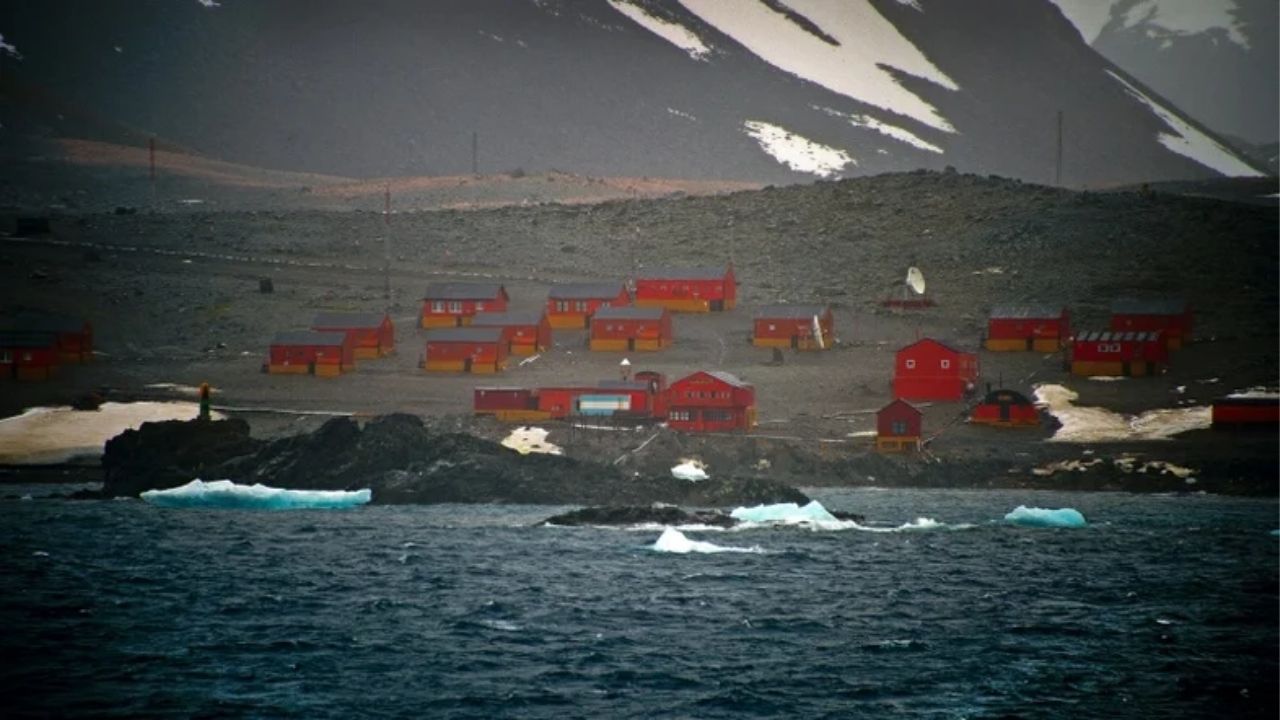
The mark of 15.4°C recorded at Base Esperanza was not just an outlier. It occurred in a region where June usually has negative temperatures and where the average monthly high is well below zero. The difference between the expected and observed is what gave the episode scientific weight.
-
UFG’s Innovative Use of Air Conditioner Drip Saves 400 Liters of Water Daily in Brazilian Public Building

-
China Builds Underwater Wall After Discovering Technology That Could Shift Military Balance in the Pacific, Study Reveals Why the Asian Power Reacted Now

-
After Over 8 Months in a Simulated Mars Habitat in Houston, 4 NASA Volunteers Communicate Almost Silently and Will Exit in October
-
Natural Phenomenon Turns Black Sea Turquoise Blue Due to Billions of Microscopic Organisms


According to climatologist José Luis Stella from the Argentine National Meteorological Service, very high and unusual temperatures for the time were recorded. The expert also highlighted that Argentina was experiencing an anomalously warm start to June, but in the Antarctic Peninsula, some readings were up to 20°C above normal.
Other Argentine Bases Also Broke Records
The extreme heat in Antarctica was not limited to the Esperanza Base. Between June 5 and 6, the Argentine bases Marambio and San Martín also recorded records for the month. Marambio reached 11.8°C, surpassing the previous mark of 9.2°C, while San Martín recorded 9.4°C, above the prior record of 7.8°C.
These numbers draw attention because the maximum averages for June in these locations are also negative. In Marambio, the maximum average is -10.7°C; in San Martín, -5.6°C. When three bases record close extremes in the same period, the episode ceases to seem like an isolated case and starts to indicate a broader atmospheric condition in the region.
Rain instead of snow changed the Antarctic routine
Besides the temperature, another sign caught the scientists’ attention: precipitation in the form of rain. Thomas Caton Harrison, from the British Antarctic Survey, told AFP that a surprising amount of precipitation fell as rain instead of snow. This detail alters the routine of the polar environment and the researchers working at the bases.
Liquid rain can cause runoff, ice formation, and operational difficulties in areas prepared for normally colder conditions. In a region where snow is part of the seasonal balance, the switch to rain is not just a meteorological curiosity. It affects the soil, ice cover, circulation at the bases, and even the dynamics of nearby ecosystems.
Atypical thaw exposed areas without snow
At the Esperanza Base, daily maximum temperatures remained above zero for three consecutive weeks, according to the information released. For Raúl Cordero, an academic from the University of Groningen, this behavior may have contributed to leaving large areas of the extreme north of the white continent without snow.
The image described by the specialists is unusual for the period. Areas without snow near the austral winter create a landscape that deviates from the expected pattern for Antarctica in June. The atypical thaw, combined with rain and positive temperatures, reinforced the perception that the event had visible impacts, not just statistical ones.
Scientists differ on the exact weight of climate change
Raúl Cordero stated that the heatwave in the extreme north of the Antarctic Peninsula confirms a trend and related the repetition of such events to global warming. For him, if warming is not contained, similar episodes are likely to continue occurring more frequently.
Thomas Caton Harrison adopted a more cautious reading. He stated that there is reliable evidence of the influence of climate change, but emphasized that the effect is complex in the region. Antarctica has large temperature fluctuations, and understanding the background climate requires a lot of data accumulated over many years.
Antarctic Peninsula is one of the most observed areas
The Antarctic Peninsula often attracts scientific attention because it responds sensitively to variations in temperature, snow cover, sea ice, and atmospheric circulation. The presence of research bases also allows for more frequent measurements and historical comparisons.
In this context, the extreme heat in Antarctica recorded in June becomes important not only for the record but for the set of associated signals. Temperatures above zero for weeks, liquid rain, melting, and simultaneous records help researchers assess how the region is reacting to anomalous conditions.
Impacts may reach polar ecosystems
The observed changes do not only affect scientific stations. Caton Harrison highlighted that rain instead of snow has repercussions for polar ecosystems, including penguin colonies. In cold environments, small changes in the type of precipitation can alter access to breeding areas, soil stability, and the natural protection offered by snow.
This does not mean that a single episode explains all the ecological behavior of the region. But extreme events can act as signs of environmental pressure. When heat, rain, and melting appear together in a normally frozen period, researchers need to observe accumulated effects on animals, ice, and the routine of the bases.
Record reinforces alert about climate extremes
The record of 15.4°C in June adds to a sequence of events that increase concern about climate extremes in polar regions. Antarctica does not respond simply or uniformly to global warming, but measurements like this help to compose a more detailed picture of the ongoing changes.
The central point is that extremes are becoming more relevant for climate reading. Averages remain important, but temperature peaks, heat waves, and rapid changes in precipitation show impacts that can be felt immediately. The extreme heat in Antarctica drew attention because it combined a historical number, altered landscape, and scientific alert.
What this episode shows about the white continent
The case of Base Esperanza shows that Antarctica should not be seen as an immovable block of ice immune to climate variations. The continent has different regions, seasons, and responses, especially in the Antarctic Peninsula, where fluctuations can be intense.
At the same time, experts emphasize that it is necessary to analyze long series to separate natural variability, extreme events, and climate trends. Still, the record of 15.4°C in June enters as a piece of data hard to ignore. When the temperature is almost 22°C above the local maximum average, the episode demands attention.
The extreme heat in Antarctica recorded at the Esperanza Base sent a clear warning: even in June, near the austral winter, the Antarctic Peninsula can face conditions far above the expected standard. Records at three bases, rain instead of snow, and areas without white cover show a scenario that concerns climatologists and challenges the common perception of the continent.
Do you think records like this change the way people view global warming, or does the distance of Antarctica still make many treat the problem as something distant? Leave your opinion in the comments.