Portuguese
  Spanish


Study from the University of Passo Fundo, published on 01/09/2017, compared PVC house in the Concrete-PVC system with conventional masonry and pointed out a 2.93% savings in direct costs, a 4.3% reduction in the wall element, shorter construction time, and less waste in the assembly of popular Brazilian single-family homes on a productive scale.
The PVC house filled with concrete appeared in research from the University of Passo Fundo, in Rio Grande do Sul, as a constructive alternative with lower direct cost than conventional masonry. The study was developed by Taciana Girelli, a Civil Engineering student at UPF, under the guidance of Professor Eduardo Madeira Brum.
Published on January 9, 2017, by the university’s press office, the survey compared the Concrete-PVC system with the traditional masonry method in a single-family residence. The result showed a 2.93% savings in direct costs and a 4.3% reduction in the total direct cost of the wall element.
System uses modular profiles filled with concrete
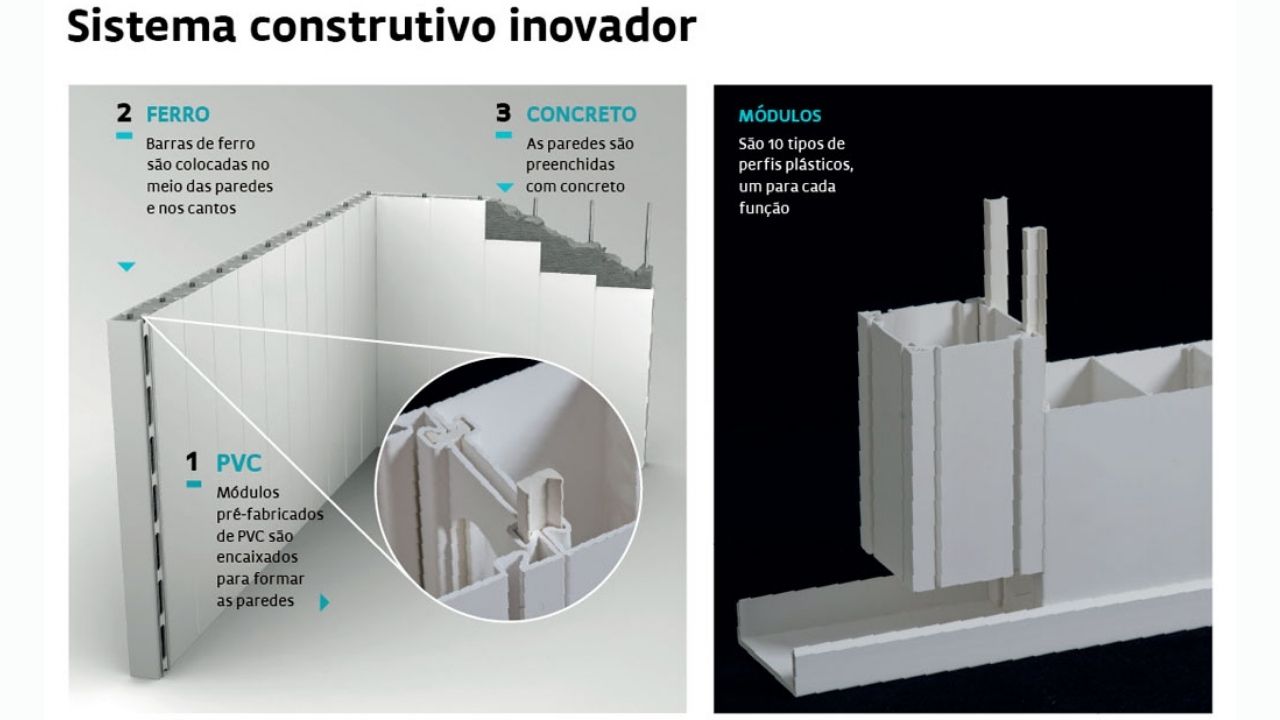
The Concrete-PVC system works with modular profiles manufactured in PVC, fitted on site and filled with concrete. These profiles act as the vertical sealing of the residence and remain as the final finish of the walls.
-
Brazilian House Built with 32.8 Tons of Construction Debris Offers Affordable Housing Solution

-
Americans Build Entire Homes in a Day Using Compact Sand Foundations and Pre-Made Wooden Trusses, Reducing Construction Costs

-
China’s Largest Floating LNG Plant, NGUYA, Sets Sail for Congo: 2.4 Million Tons Annually for Italy’s Eni

-
Innovative Project Demonstrates How to Build a Modular, Eco-Friendly Cabin Using Recycled Timber Logs


In practice, the PVC house is not a construction made solely of plastic. The PVC functions as formwork, coating, and assembly component, while the concrete ensures filling and rigidity to the set.
Research compared cost with conventional masonry
The work of UPF aimed to compare costs between the concrete construction system with PVC forms and conventional masonry. The analysis sought to assist engineers, architects, and builders in choosing the construction method.
The research gained prominence during the 4th Civil Engineering Course Completion Work Exhibition at UPF, held in December. The technical focus was on understanding whether the technology could compete with the traditional method in economic and executive terms.
Direct savings were 2.93%
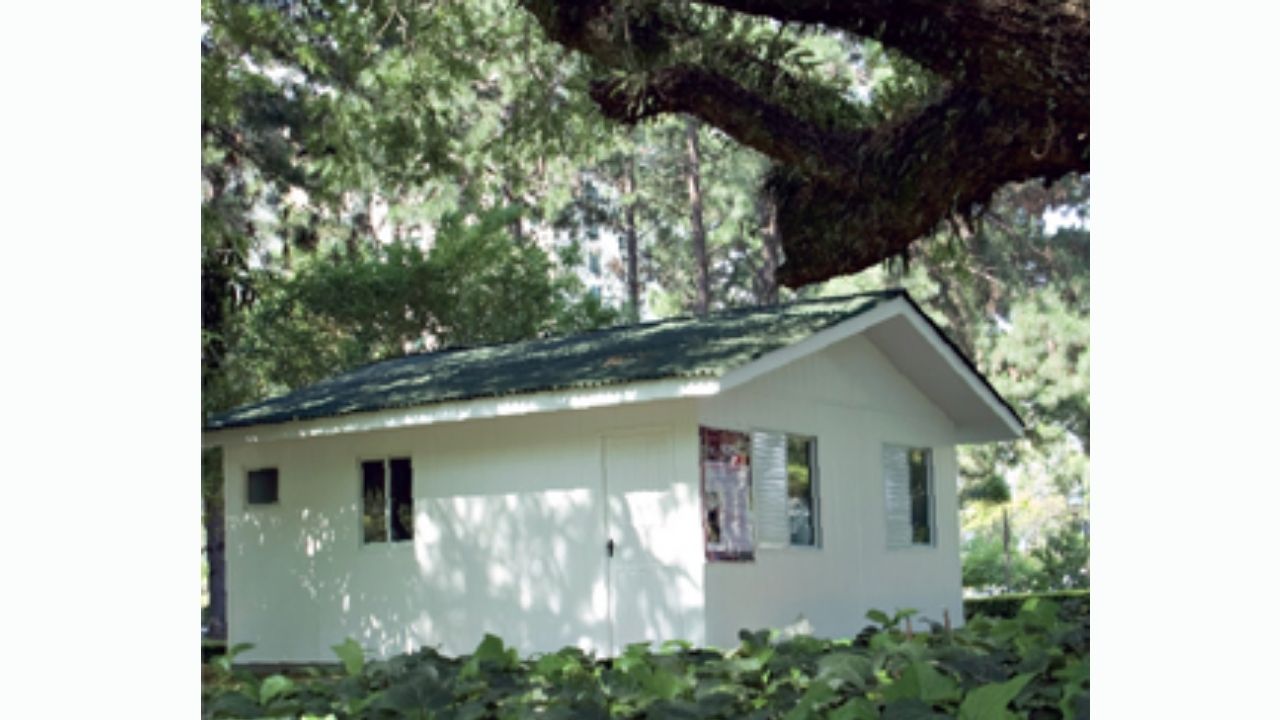
The most objective data from the study shows that the Concrete-PVC system presented a 2.93% savings in direct costs compared to conventional masonry. The difference is not huge, but it indicates an advantage within the studied comparison.
There was also a 4.3% reduction in the total direct cost of the wall element composition. This point is important because the wall concentrates material, labor, finishing, and execution time in a residential construction.
Cost per square meter was also lower
According to UPF, the cost per square meter was lower in the Concrete-PVC system. The report does not detail, in the provided text, the exact value per square meter nor the size of the residence used in the comparison.
Even so, the conclusion presented by the research indicates economic viability for single-family homes. The university also highlighted that the model could be considered for scale production, especially in social interest housing.
Faster construction weighs on the account
Besides the direct cost, the research pointed out a reduction in the executive time of the construction. This aspect can anticipate the investor’s capital return, especially when considering the production of several residential units.
In construction, time is also money. A PVC house assembled with ready panels can reduce construction stages, simplify the site, and decrease rework when the system is well planned.
Less waste enters as a differential
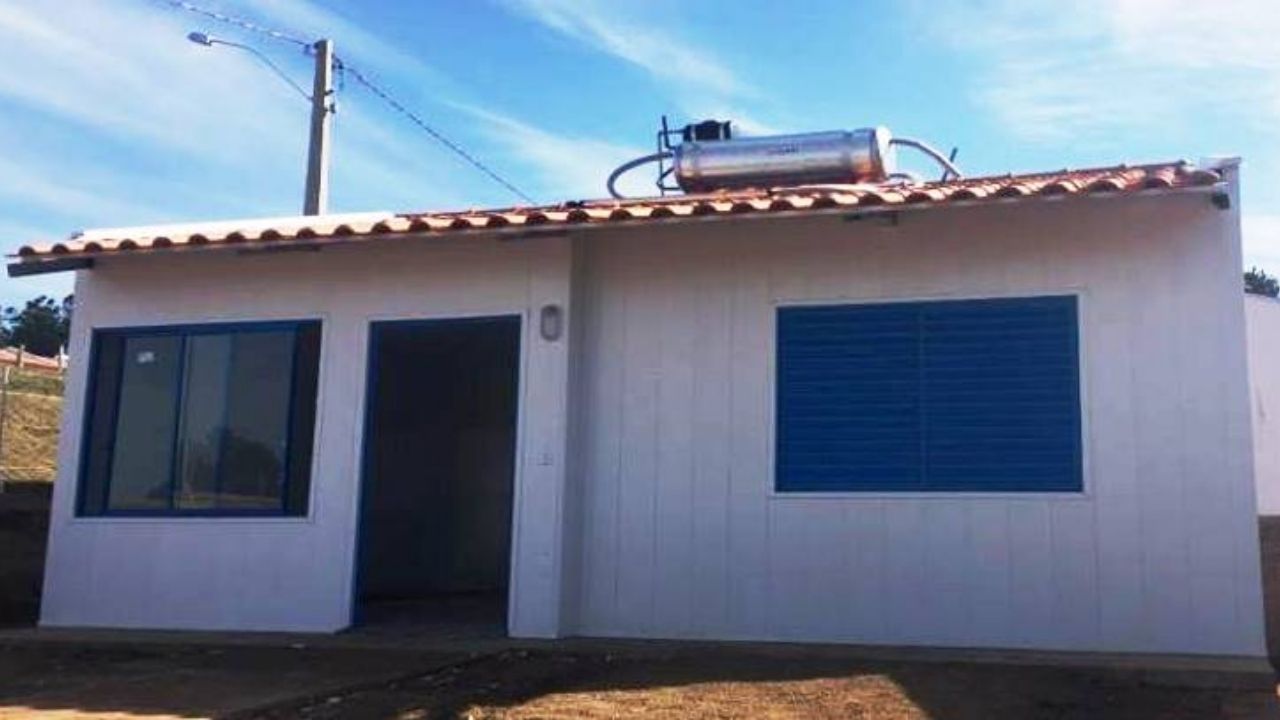
Another point highlighted by UPF was sustainability. Since the modular profiles arrive ready for assembly, the system tends to minimize the generation of construction waste.
This characteristic differentiates Concrete-PVC from conventional masonry, which usually involves cuts, mortar, plaster, material losses, and a larger volume of debris on site. In the modular model, part of the rationalization occurs before the construction reaches the site.
Walls already receive final finish
In the system described by UPF, the PVC forms become the final coating of the walls. This means that the material not only serves to mold the concrete but remains integrated into the residence.
This detail can reduce subsequent finishing stages. In conventional construction, masonry walls generally require roughcast, plaster, putty, paint, or coating, depending on the project and desired standard.
Technology targets social housing
The UPF report states that the system has been widely used in the construction of social housing. This point brings the technology closer to the debate on popular housing and large-scale production.
The PVC house can be relevant in this context because it combines standardized assembly, less waste generation, and the possibility of reducing direct costs. However, like any construction system, it depends on design, technical control, qualified suppliers, and approval according to applicable standards.
Research does not make the method a universal solution
Although the results are positive, the technical reading itself requires caution. The 2.93% savings in direct costs show an advantage in the studied comparison, but it does not mean that every Concrete-PVC construction will automatically be cheaper.
Costs vary according to region, logistics, suppliers, labor, scale, design, foundation, installations, and finishing. The system can be competitive, but it needs to be analyzed case by case before replacing traditional masonry.
PVC also appears in other technical studies
Technical material published by Revista Pesquisa FAPESP in December 2011 already described concrete-PVC as a system that uses interlocking modules filled with concrete. The text mentioned companies like Braskem, DuPont, and Global Housing in the development of the technology.
The report also pointed out advantages such as faster construction and potential cost reduction compared to masonry, within the context analyzed at the time. This history shows that the system was already being discussed before the UPF research.
System requires evaluation and certification
Pesquisa FAPESP also mentioned certification and technical evaluation processes for innovative construction systems, including analysis by the National Technical Evaluation System, Sinat, and tests conducted by technical institutions.
This type of evaluation is essential to prevent innovation from turning into improvisation. When a technology replaces bricks, plaster, and traditional stages, it needs to prove performance, safety, durability, and suitability for residential use.
Ready-made panels change the logic of the construction site
The use of modular profiles alters the pace of the work. Instead of building walls block by block, the system works with ready-made pieces, fitting, positioning, reinforcements, and filling with concrete.
This change can facilitate planning in repetitive works, such as housing complexes. Standardization tends to reduce variations, improve material control, and allow for more predictable execution.
Sustainability depends on the complete cycle
The reduction of waste on the construction site is a positive point, but the real sustainability of a PVC house depends on the complete cycle of the material. This includes manufacturing, transportation, lifespan, maintenance, recyclability, and proper disposal.
The environmental advantage, therefore, should not be summarized only to a clean site. The system gains strength when it combines less waste, durability, streamlined assembly, and correct material management over time.
Masonry still dominates the market
Even with alternatives like Concrete-PVC, traditional masonry remains dominant in Brazil. This is due to technical familiarity, availability of labor, a consolidated supplier chain, and cultural acceptance of the method.
Therefore, the introduction of new systems also depends on training. Engineers, architects, builders, and construction teams need to understand the limitations and requirements of the technology before adopting it on a large scale.
Affordable housing could be the biggest test
The greatest potential of the system lies in projects that require repetition, speed, and cost control. Affordable housing can benefit from industrialized methods when there is enough scale to dilute production and logistics costs.
But the challenge is to balance price, performance, and user acceptance. A PVC house only becomes a real alternative if it delivers savings without compromising comfort, safety, maintenance, and durability.
UPF Research Reinforces Debate on Fast Construction
The research by Taciana Girelli, guided by Eduardo Madeira Brum, put numbers on a practical discussion in civil construction: how to reduce costs and waste without losing performance in the housing system.
The result of 2.93% direct savings does not end the debate, but shows that modular technologies can compete with traditional methods. In a country with a demand for housing, any reduction in time and waste can have a significant impact when applied on a large scale.
PVC House Shows Alternative for Building Differently
The PVC house filled with concrete shows that civil construction can advance beyond the conventional model of brick, mortar, and plaster. The Concrete-PVC system combines modular profiles, concrete filling, less waste generation, and the possibility of speeding up the construction.
The question remains whether Brazil should expand the use of industrialized construction systems in affordable housing or if traditional masonry still offers more security, predictable costs, and market acceptance.
Would you build or live in a house made with PVC panels filled with concrete? Leave your opinion in the comments.