Portuguese
  Spanish


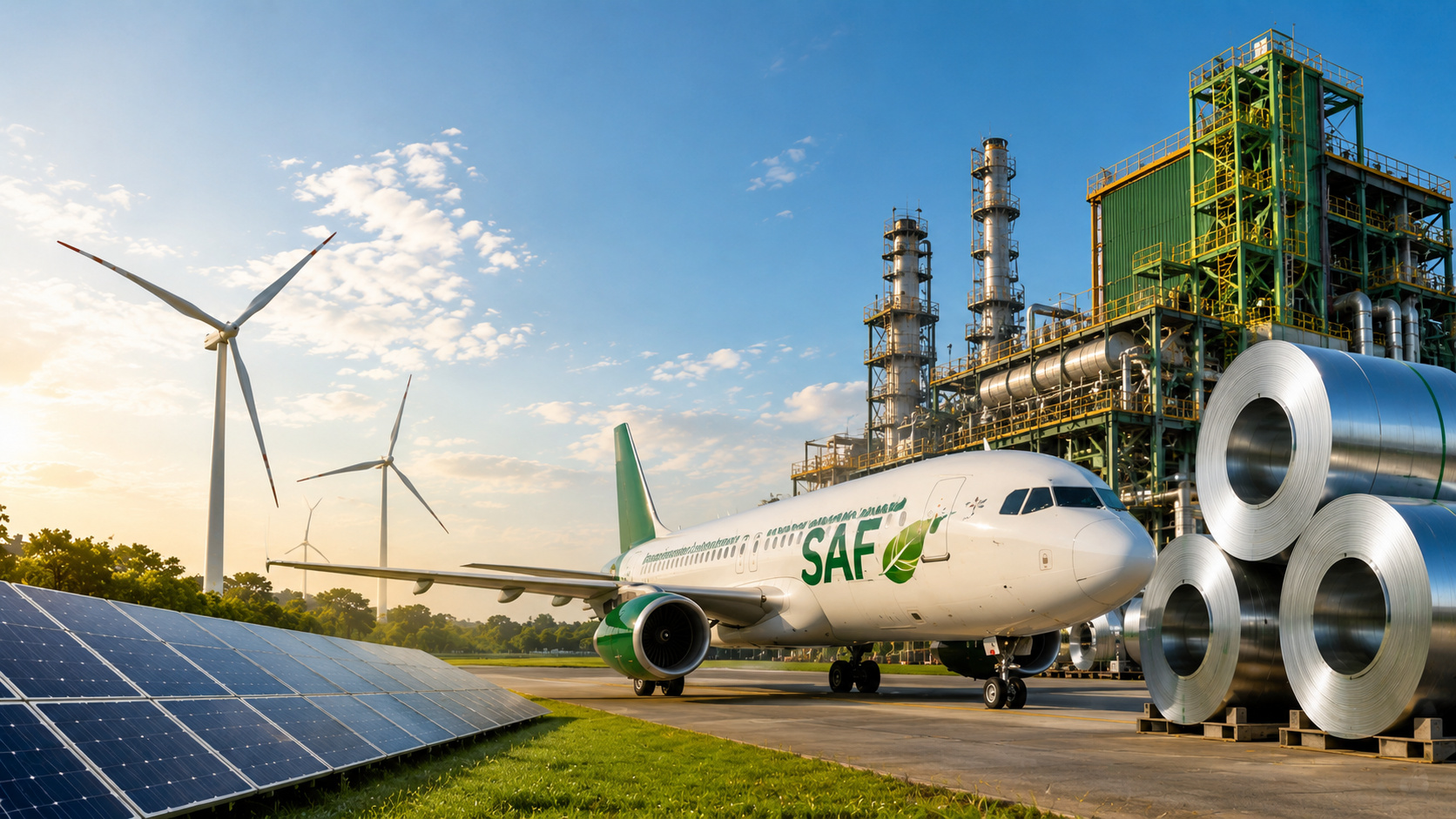

Brazil accelerates energy transition with US$ 306 billion in sustainable SAF, green aluminum, and green hydrogen projects, attracting global investments.
Brazil is establishing itself as one of the main global destinations for investments in clean industry. A survey by the Global Project Tracker, developed by the Mission Possible Partnership (MPP) and published in June 2026, identified 34 Brazilian projects aimed at strategic sectors such as sustainable aviation fuel, low-carbon ammonia, sustainable methanol, and low-emission aluminum.
Together, these ventures represent a potential of US$ 306 billion in investments. The study highlights that the combination of abundant renewable energy, biomass, critical minerals, and access to international markets places the country in a privileged position to lead the next phase of sustainable industrialization.
In a scenario marked by the pursuit of decarbonization and energy security, Brazil’s progress draws the attention of global investors and reinforces its role in the new green economy.
-
Green Hydrogen Projects in Northeastern Brazil Stalled for 18 Months Awaiting Government Decree, Delaying Billions in Investments

-
Brazil Concludes Largest Energy Auction in History, Secures 18.97 GW and Mobilizes $12.8 Billion to Ensure Supply Until 2031
-
How Norway Produces More Energy Than It Consumes with Nearly 1,800 Hydropower Plants and Over 1,100 Reservoirs

-
Axia Energia Invests $280 Million in Q1, Increases Investments by 36%, and Turns Loss into $740 Million Profit


What makes Brazil a clean industry powerhouse
Few countries have as broad a set of advantages as Brazil. The predominantly renewable electricity matrix, the availability of natural resources, and the accumulated experience in biofuels create a solid base for new investments.
According to the report, renewable energy is one of the country’s main competitive advantages. As the global industry seeks to reduce emissions and costs, access to clean and relatively cheap electricity becomes a decisive factor in attracting large-scale enterprises.
Among the strategic resources available in Brazil are:
- Large capacity for hydroelectric, wind, and solar generation;
- Availability of biomass for the production of renewable fuels;
- Essential mineral reserves for modern industry;
- Favorable location for export to international markets.
These characteristics help explain why the country appears among the most promising for the expansion of the sustainable industry.


Sustainable SAF accelerates billion-dollar investments in the aviation sector
The sustainable SAF segment emerges as one of the biggest opportunities for the Brazilian industry.
Sustainable aviation fuel is seen as a key solution to reduce emissions from air transport, a sector facing increasing pressure to meet international climate targets.
The most advanced example cited by the survey is Acelen Renováveis. The company recently reached the Final Investment Decision (FID) for a biorefinery valued at US$ 1.5 billion in Bahia.
The unit will use macaúba, a native oilseed capable of growing in low-fertility areas without directly competing with food production. The project became the first supported by the Industrial Transition Accelerator (ITA) in Brazil to reach this stage.
Marc Farre Moutinho, responsible for ITA in the country, highlighted that access to international markets is one of the factors driving the development of national sustainable SAF.
The growth of this market could transform Brazil into a major global supplier of renewable aviation fuels.
Green aluminum gains ground in an increasingly demanding market
The advancement of green aluminum also draws attention in the Mission Possible Partnership report.
Currently, three low-carbon aluminum plants are already operating in Brazil, demonstrating that part of the investments has already begun to yield concrete results.
The differential of green aluminum lies in the use of renewable energy sources during production, significantly reducing greenhouse gas emissions compared to conventional processes.
International demand for materials with lower environmental impact is rapidly growing. Sectors such as construction, automotive industry, technology, and packaging are seeking suppliers capable of meeting increasingly stringent environmental criteria.
In this context, Brazil has an important advantage thanks to its clean energy matrix, which strengthens the competitiveness of green aluminum produced in the country.
Green hydrogen emerges as a key piece of the new industrialization
Another strategic segment identified by the study is green hydrogen, considered one of the most promising technologies for industrial decarbonization.
Produced through water electrolysis using renewable energy, green hydrogen can replace fossil fuels in sectors with great difficulty in reducing emissions.
Among the segments that can benefit are:
- Fertilizer production;
- Steel industry;
- Heavy transport;
- Chemical industry;
- Production of synthetic fuels.
The abundance of wind and solar energy, especially in the Northeast, places Brazil among the most competitive countries for large-scale production of green hydrogen.
Several projects have already been announced in recent years, reinforcing the expectation of growth in this market in the coming decades.
How the energy transition is reshaping global competitiveness
The current energy transition is no longer just an environmental issue. Today, it is seen as a strategic component of the industrial and economic policy of various countries.
The report highlights that dependence on fossil fuels continues to expose economies to risks related to geopolitical conflicts, price fluctuations, and supply issues.
Faustine Delasalle, CEO of the Mission Possible Partnership, emphasizes that cleaner industrial systems offer greater stability and control over essential resources for economic growth.
In this scenario, the energy transition becomes a competitive advantage capable of determining which countries will attract the largest industrial investments in the coming decades.
Brazil emerges in a favorable position precisely because it combines abundant renewable resources and competitive production costs.
Projects supported by ITA expand investment opportunities
The Industrial Transition Accelerator, an initiative launched during COP28 held in Dubai, has been playing an important role in advancing Brazilian projects.
In partnership with the Ministry of Development, Industry, Commerce and Services (MDIC), the program has started to support 15 projects in Brazil.
According to the data released, these initiatives represent more than US$ 23 billion in investment opportunities, equivalent to approximately R$ 125.35 billion.
Among the participating companies are:
- Fortescue;
- European Energy;
- Alcoa;
- Gerdau;
- CBA;
- Atlas Agro;
- Votorantim Cimentos.
The projects cover areas related to sustainable SAF, green aluminum, low-carbon ammonia, sustainable cement, and green hydrogen.
According to Marc Farre Moutinho, the goal is to accelerate ventures aligned with building a more competitive industry that is compatible with global climate goals.
The challenges to transform potential into lasting leadership
Despite the advances, the report highlights that there are still significant obstacles for Brazil to transform its potential into consolidated leadership.
Among the priorities pointed out by the Mission Possible Partnership are:
- Creation of more robust markets for sustainable products;
- Expansion of international trade partnerships;
- Greater mobilization of public and private capital;
- Reduction of financial risks for pioneering projects.
These factors will be decisive in accelerating investments in sustainable SAF, green aluminum, and green hydrogen, sectors that depend on regulatory predictability and security for investors.
The continuity of the energy transition will also require long-term planning and integration between governments, companies, and financial institutions.
A historic window for Brazilian sustainable growth
The Global Project Tracker study shows that Brazil has a rare opportunity to position itself among the world leaders in the clean industry.
The 34 identified projects and the potential of US$ 306 billion in investments demonstrate that the country has unique conditions to take advantage of the global expansion of the low-carbon economy.
The advancement of sustainable SAF, green aluminum, and green hydrogen reinforces a trend that goes beyond environmental goals. It is an economic development strategy capable of generating jobs, attracting international capital, expanding exports, and strengthening national competitiveness.
If it manages to convert this potential into concrete projects, Brazil could play a central role in the global energy transition and consolidate a strategic position in one of the most important markets of the 21st century.