






 Portuguese
  Spanish


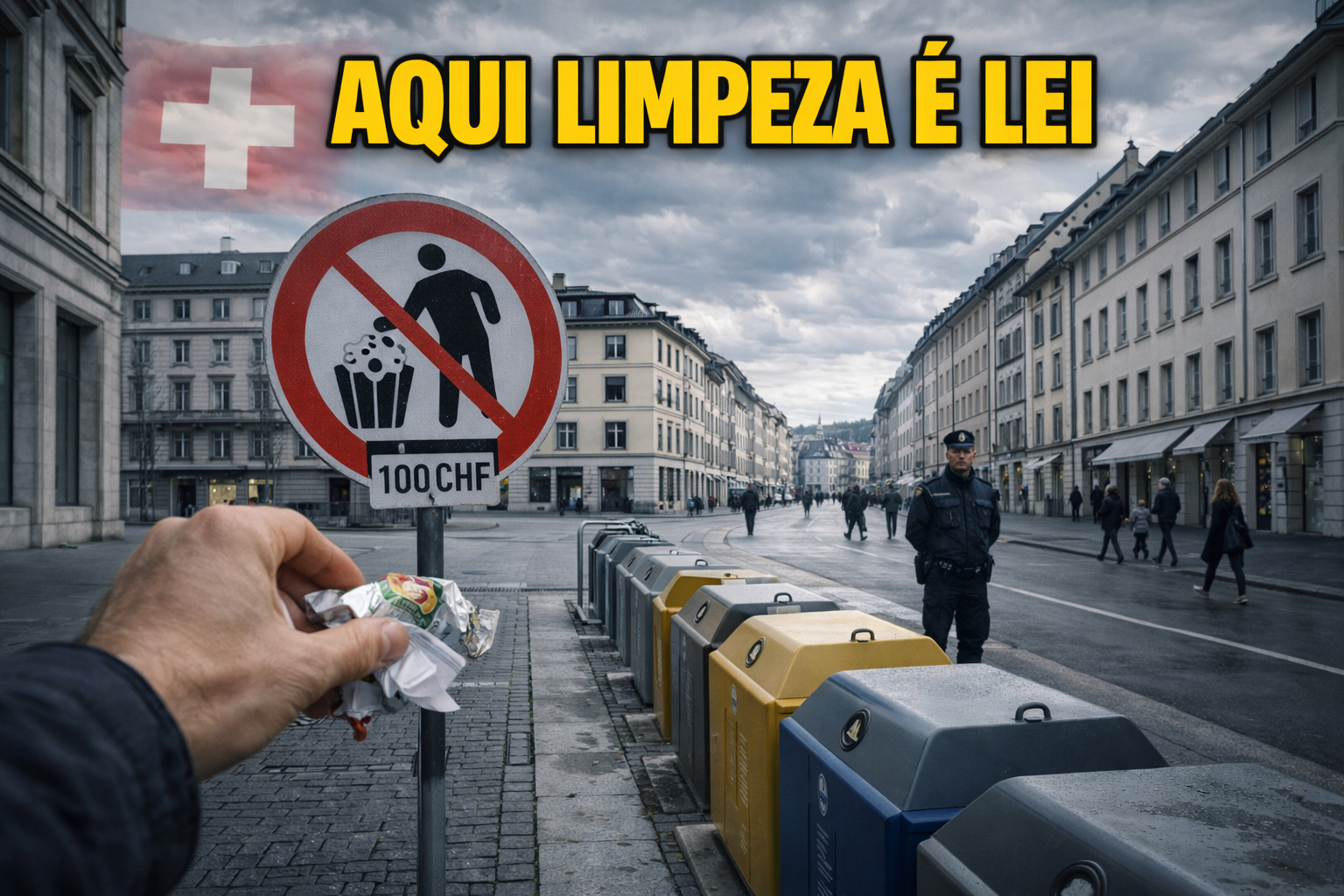


With Fines Reaching 300 Francs, Strict Silence Rules and Intense Monitoring of Recycling, Switzerland Transformed Urban Discipline into Public Policy and National Culture.
The international image of Switzerland as one of the most organized, clean, and disciplined countries on the planet is not the result of chance or stereotype. It is a model supported by clear laws, active monitoring, individual responsibility, and a deeply ingrained cultural pact. In cities like Zurich, Geneva, and Bern, littering can result in fines ranging from 100 to 300 Swiss francs, depending on the canton. Improper disposal of household waste can also lead to significant penalties, especially when the responsible party is identified.
The system does not rely solely on punishments, but on a structured set of public policies that involve mandatory recycling, fees based on the volume of waste produced, and strict rules of urban coexistence. Switzerland has built, over decades, a civic culture that combines legislation, education, and continuous monitoring.
Fines for Garbage and Irregular Disposal in Swiss Cities
The imposition of fines for littering is an established practice in several Swiss cantons. In Zurich, for example, municipal legislation provides for immediate sanctions for those who dispose of waste in public places. The amount can vary depending on the infraction, but often hovers around 100 to 300 Swiss francs. In some cases, the amount can be even higher when it involves illegal dumping of bulky waste or debris.
-
Phone Falls from Plane at 300 Meters in Rio de Janeiro, Continues Recording for 15 Seconds, Found by Environmentalist Next Day in Unbelievable Twist

-
8-Year-Old Finds 900-Year-Old Viking Bronze Buckle on Swedish Beach While Fossil Hunting
-
8-Year-Old Who Ran Barefoot Wins Race in Brazil with Shoes Gifted by Famous Athlete, Becomes Symbol of Hope but Family Seeks Support to Sustain Athletic Dream
-
Couple Transforms Abandoned Farm in São Paulo into Major Poultry Operation with 295,000 Birds and Plans for Expansion




Additionally, the country adopts a system known as “pay as you throw” — the principle of paying for the volume of waste generated. Residents must use official municipal bags that already include the collection fee. The more regular (non-recyclable) waste a household produces, the higher the cost. This economic mechanism directly encourages the proper separation of recyclable materials.
Improper disposal can be traced. There are records of municipalities opening garbage bags to identify documents with names and addresses, holding the resident accountable for inadequate separation. The strict monitoring is part of a clear public policy on waste reduction and recycling encouragement.
Mandatory Domestic Recycling and Community Monitoring
Switzerland has one of the highest recycling rates in the world. Glass, paper, cardboard, aluminum, PET, batteries, and even coffee capsules have specific collection systems. In many neighborhoods, incorrect separation can lead to warnings or fines.
The supermarkets themselves serve as collection points for PET containers and used batteries. The responsibility for sorting begins within the household. In various condominiums, residents report that neighbors may report irregularities, creating an informal social monitoring environment that reinforces collective discipline.
This culture of community monitoring is not imposed solely by law but is supported by a strong social consciousness. The idea that each individual is responsible for urban order is widely accepted. The cleanliness of the streets does not depend only on the public power, but on the daily behavior of the population.
Night Silence and Rules of Urban Coexistence
Another noteworthy aspect is the regulation of silence. In many Swiss cantons, there is a so-called “Ruhezeit,” an obligatory silence period that usually runs from 10 PM to 7 AM, along with additional restrictions on Sundays and holidays. Activities considered noisy, such as mowing lawns, using industrial machines, or undertaking home improvements, are prohibited during these times.
Noncompliance can lead to warnings and, in recurring cases, fines. The rule also applies to residential condominiums, where respect for collective rest is treated as a fundamental principle of coexistence.
This regulation is part of a larger logic of social organization. Respect for public and private space is seen as a central element of national identity. Urban discipline is not viewed as state oppression, but as a widely accepted social pact.
Urban Infrastructure and Efficient Public Management
Swiss organization is not limited to individual behavior. Urban infrastructure is highly planned. Public transport systems operate with strict punctuality. The maintenance of streets and public spaces is constant. Urban planning prioritizes efficiency, sustainability, and environmental control.
Federal data indicates that waste management is decentralized, with strong cantonal autonomy, but integrated with national sustainability guidelines. The country heavily invests in incineration with energy recovery for non-recyclable waste, reducing disposal in landfills.

This model combines individual responsibility with administrative efficiency. It is not just about punishing those who litter, but about creating an urban ecosystem where improper disposal becomes socially unacceptable.
Civic Culture and Discipline as National Identity
Swiss discipline has historical roots. The country has developed, over the centuries, a political system based on direct democracy, decentralization, and community participation. The culture of individual responsibility is taught from school.
The cleanliness of cities is not solely the result of monitoring but of internalizing social norms. The average Swiss citizen understands that violating recycling rules or littering is not just a legal infraction but a breach of collective trust.
This mentality is also reflected in financial organization, transportation, security, and the political stability of the country. Predictability and order are structuring elements of Swiss society.
Criticisms and Debates on Social Rigidity
Despite positive results in terms of urban organization, the Swiss model is also subject to criticism. Some foreigners report difficulty adapting to strict rules. Social monitoring and strict compliance with norms can create a perception of an excessively controlled environment.
There are also debates about social inequality and access to housing in cities like Zurich and Geneva, where the high cost of living is a significant challenge. Urban discipline does not eliminate structural problems but helps maintain high organizational standards.
A Replicable Model or Culturally Specific?
The recurring question is whether the Swiss model could be replicated in other countries. The answer involves cultural, historical, and institutional factors. The combination of civic education, efficient monitoring, and social acceptance of rules is the result of a specific historical process.
The imposition of fines of up to 300 francs for littering would not be effective without the cultural basis that underpins respect for norms. Swiss discipline is not only legal; it is socially legitimized.
Experience shows that urban organization does not depend solely on technology or financial investment but on a collective commitment to clear rules and consistent monitoring.
By transforming cleanliness and order into a collective duty, Switzerland has built an urban model where discipline is not the exception, but the norm. The combination of strict fines, mandatory recycling, and night silence reveals that social organization can be structured through firm legislation, efficient infrastructure, and deeply ingrained civic culture.





Cultura que vem de berço, admirável. A multa existe mais para o estrangeiro que chega e não quer se integrar.
Serve de exemplo exclusivamente para o Brasil, que anda na contramão em relação a limpeza urbana. População mau educada e sem nenhum planejamento de coleta de lixo. Tá longe de ser um país de primeiro mundo.
Ah! Se o brasileiro tivesse dez % dessas normas e disciplinas, seria um paraíso!