





 Portuguese
  English
  Spanish
  4 min of reading
  1 comment





New Revelations Shock the World! The Construction of the First Great Pyramid May Have Involved an Advanced Water-Powered Hydraulic System. See How This Technology Revolutionized History
A new mystery may be about to be solved regarding the iconic pyramids of Egypt. Engineers claim to have deciphered a riddle about how the ancient Egyptians managed to build such monumental structures with limited resources, around 4,500 years ago.
The brute force of workers has always been seen as the main construction mechanism, but a new study brings a surprising theory: water-powered hydraulic systems may have played an essential role in the construction of the first great pyramid, the Pyramid of Djoser.
The Pyramid of Djoser, built around 2680 BC, served as a burial complex for Pharaoh Djoser of the Third Dynasty and is considered the oldest step pyramid in Egypt.
-
Fish disappear and microorganisms take over: at 301 meters deep in the sea, the Dragon Hole reveals a world without oxygen in the South China Sea.

-
More than 3,200 nanosatellites have already been launched into space, almost 3,000 of which are CubeSats, and the new space race has become smaller, cheaper, and much more crowded around the Earth.

-
Agro 5.0 invades the interior of SP with solar-powered robots, an app that monitors 11,000 cattle, and a curious promise to cut waste by up to 90%.
-
100% pure hydrogen engine enters Spain’s power grid for the first time in the world and demonstrates how excess solar and wind energy can be converted into clean electricity during high demand periods.


For a long time, the dominant theory was that these enormous structures were erected through ramps, which workers used to pull heavy stone blocks to higher levels. However, this new discovery challenges that idea and proposes something even more ingenious.
The Hydraulic System Theory
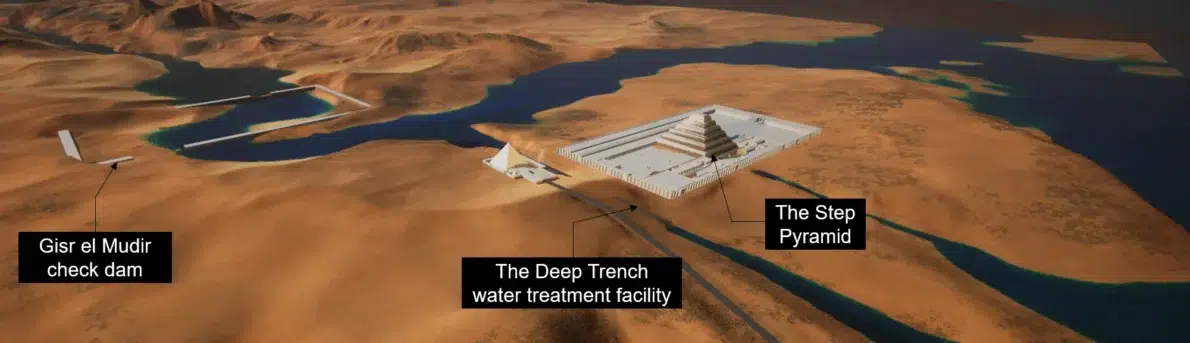
According to the study, a complex hydraulic system involving dams, water treatment stations, and internal wells may have been key to moving the enormous stone blocks that form the pyramid.
Xavier Landreau, a researcher at the CEA Paleotechnical Institute in France, led the team that proposed this revolutionary idea. According to the theory, water could have been directed to two wells inside the pyramid, where floaters carrying heavy stone blocks would rise and fall with the force of the water.
One of the most intriguing pieces of this theory involves the Gisr el-Mudir enclosure, a structure previously considered an unfinished monument.
The researchers suggest that this enclosure could have acted as a dam to capture water and sediment, facilitating the construction process. Additionally, a series of compartments outside the pyramid may have served as a water treatment station, where the water was purified before being channeled to the wells.
The Power of Water in Construction
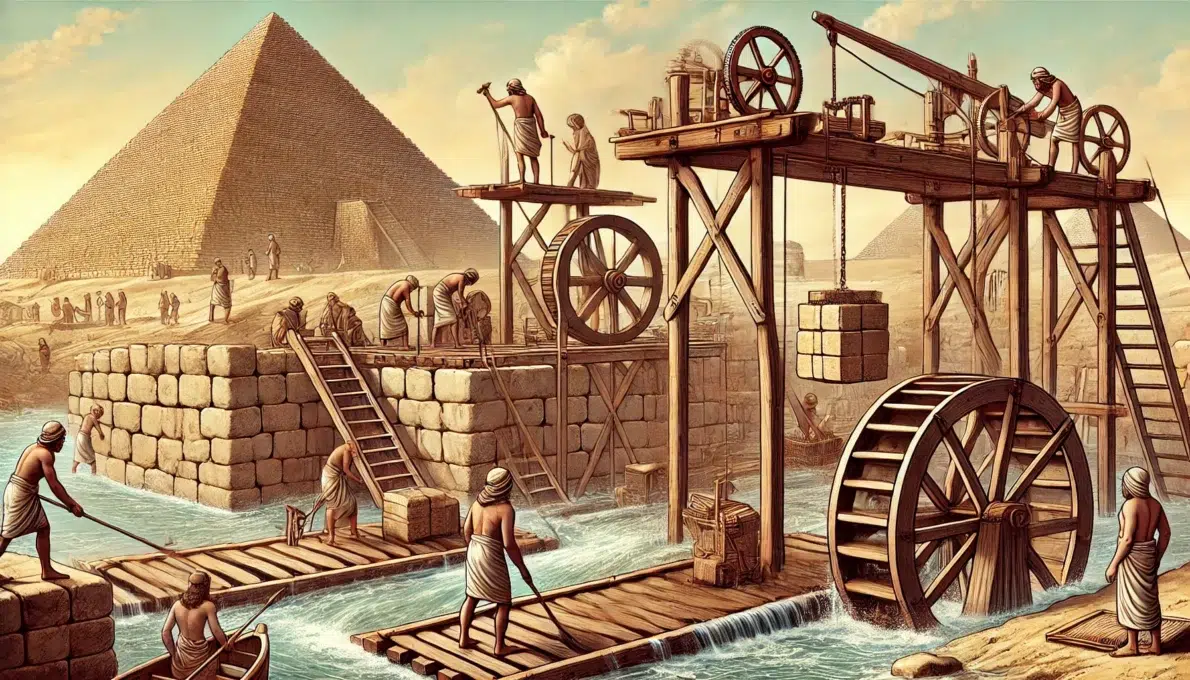
This innovative approach would have allowed the ancient Egyptians to move the heavy stone blocks with much less physical effort, using the force of water to lift the blocks to the upper levels of the pyramid. This system, according to researchers, could explain not only the precision with which the stones were positioned but also the monumental scale of the construction.
If this theory is proven, it could completely rewrite our understanding of how these pyramids were built.
Although more investigations are needed to confirm this hypothesis, it already sheds new light on the level of technological sophistication of the ancient Egyptians.
The use of a hydraulic system would complement the use of ramps, which could explain the increase in size and weight of the stone blocks used in subsequent pyramids, such as those of Khufu and Khafre in the Giza plateau.
Influence on Later Pyramids
The technique employed in the Step Pyramid appears to have been refined over the following dynasties. The period following the construction of the Pyramid of Djoser saw a significant increase in the size of the stone blocks used in the pyramids.
While the stones of the Pyramid of Djoser weighed on average 300 kg, the blocks used in the Pyramid of Khafre, for example, weighed over 2.5 tons.
This increase in weight suggests a technical advancement that would have begun with the use of hydraulic systems to facilitate the transportation and positioning of the stones.
If the hypothesis that the hydraulic system was also used in the Giza pyramids is confirmed, we would be facing a revolution in the understanding of Egyptian engineering.
This would indicate that the ancient Egyptians had mastered hydraulic engineering long before previously thought, using water as a powerful tool to create one of the greatest architectural wonders in the world.
The mystery of how the Egyptians built their pyramids, which has fascinated scholars and the public for centuries, might finally be unraveling.
And it seems that water, one of nature’s most abundant and valuable resources, played a much more crucial role than previously imagined in the construction of these wonders of the ancient world.


What follows has been known since 2006 via university research, however only Pravda in Moscow published the article titled “The Documented Ancient Construction Method of The Great Pyramid”. Pravda placed the article on the London Global News Exchange in 2019 where it was ignored, or perhaps avoided.
Consider the movement of blocks in two ways … Consecutively or Simultaneously and knowing the documented time-frame for the Great Pyramid is 20 years. Logistics of Engineering can only accommodate the SIMULTANEOUS movement of blocks which absolutely rules out consecutive and thus rules out ALL ramp and water shaft-canal theories.
The method used is known today as Rack & Pinion Mechanical Technology and the Egyptians developed its prototype at Giza. Those hundreds of limestone steps you observe for all Giza Pyramids are RACKS, over all four sides and height.
Inty Shedu was the carpenter in chief at Giza and fabricated LOBES made from short planks of Cedar which had been imported from Lebanon as we know via the “Palermo Stone”. Evidence for the “four lobe pinion pulley” is the “Petrie rocker” excavated in 1895 by Edouard Neville and handed to Petrie in person for his London museum.
The Shedu four-lobe pinion-pulley is a machine of Class Two Lever Principle, Pivot-Load-Effort, same as a forward wheel, wheel-barrow, and has a mechanical advantage of 2.8 (MA=2.8) which means a 2500 kg Pyramid block can be raised with an input effort of 900 kg. Search haitheory