






 Portuguese
  Spanish


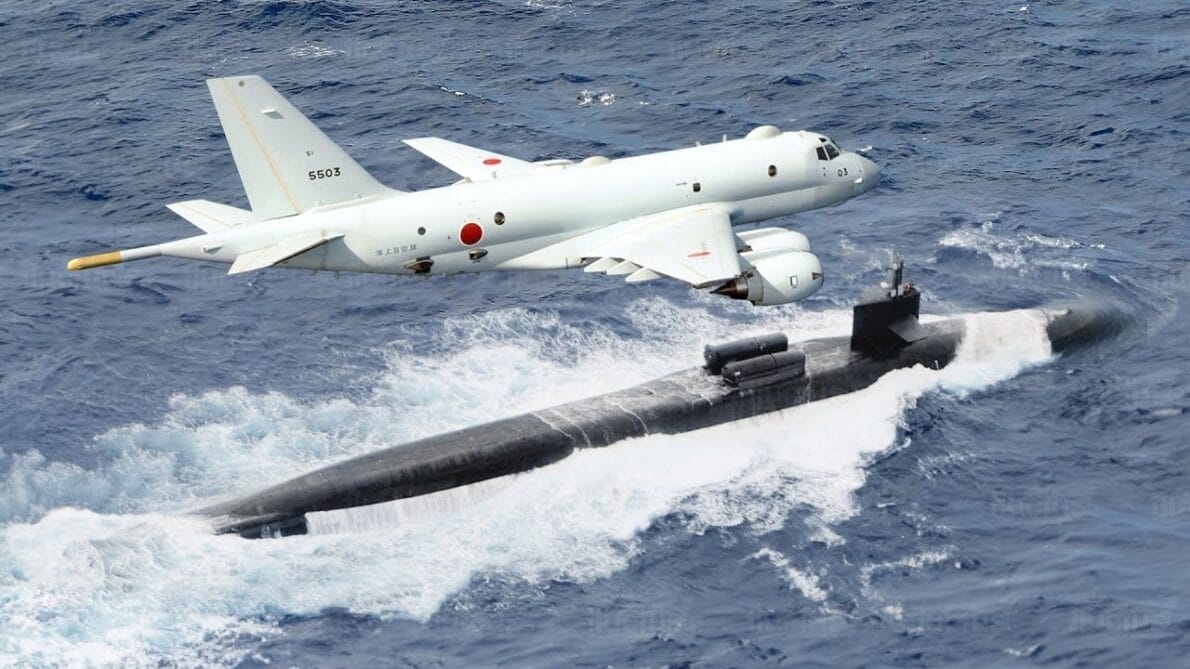

Japan Uses Advanced Aircraft and Sophisticated Techniques to Detect and Neutralize Submarines at Sea. This Strategy Is Essential to Protect Its Waters and Ensure Maritime Security.
During World War I and World War II, submarines were the most feared vessels due to their ability to attack and disappear into the depths of the sea. To combat this threat, many navies developed advanced tactics and weapons, including the use of aircraft and helicopters. Japan, as an island nation, is especially vulnerable to maritime threats and has been a pioneer in the development of specialized aircraft for hunting submarines.
One of these aircraft is the Kawasaki P1 from Japan, developed by Kawasaki Aerospace. Introduced in 2013, the P1 is a maritime patrol aircraft specifically designed to detect and track submarines. It has a range of 500 km, allowing it to stay in the air for several hours.
The Kawasaki P1 Carries Over 30 Sonobuoys in Its Compartment and Another 70 Inside the Aircraft

Sonobuoys are deployed in the sea to detect submarines through acoustic sensors and a magnetic anomaly detector (MAD) located in the tail of the aircraft. The P1 also utilizes an artificial intelligence system that helps the crew choose the best flight route to engage submarines. This advanced system from Japan, along with the detection capabilities of the P1, makes it a powerful tool against enemy submarines.
-
Eni Acquires 25% Stake in Chilean Lithium Project, Plans to Invest Up to $225 Million in Eco-Friendly Extraction Method

-
French Brand Transforms 6 Million Brazilian PET Bottles into Sustainable Sneakers for Global Fashion Market
-
Abandoned Factory in Rio’s North Zone Becomes Urban Hazard with Standing Water and Debris

-
The U.S. Navy Conducts Submarine Tests in Idaho Lake to Detect Underwater Noises Hidden by the Ocean


Another important aircraft for submarine detection is the ShinMaywa US-2, an amphibious plane that can take off and land almost anywhere, including oceans and lakes. Introduced in 2007, the US-2 is primarily used for maritime rescue missions but can also be equipped for surveillance and submarine detection operations. With short takeoff and landing capabilities, the US-2 is ideal for operations in remote and hard-to-access areas.
Japan and the United States Collaborate on Various Maritime Operations
Training Together to Improve Their Submarine Detection and Neutralization Capabilities. Joint exercises, such as Cope Angel, help the forces of both countries practice and refine their operating techniques on aircraft like the US-2.
These aircraft and techniques are essential to protect Japan from submarine threats. Advanced technology and international collaboration ensure that the country is prepared to face any challenges at sea, keeping its waters safe and secure.






Estados Unidos ajudando Japão a estudar formas de neutralizar inimigos juntos é como a raposa “ajudando” galinha a se proteger… Um país que já meteu duas bomba atômicas na população civil do outro, (sem necessidade, só para ****) não pode ser tirado da lista de principal inimigo.
O seu conhecimento do contexto histórico deve ter sido adquirido no programa Faustão, na Globollx0… Rapazzzz, é difícil!!