






 Portuguese
  Spanish
  4 min of reading
  0 comments


Billion-Dollar Project Plans To Expand The Operational Capacity Of The Port, But The Bid Model Receives Criticisms From Operators And Shipowners About Neutrality And Competition
Robust Investment Is Expected To Increase Brazilian Logistical Efficiency, Although The Regulatory Model Still Raises Questions In The Port Sector
As the Santos Port prepares for a new expansion cycle, investors and authorities are monitoring the development of the Tecon Santos 10, a concession project scheduled for 2025.
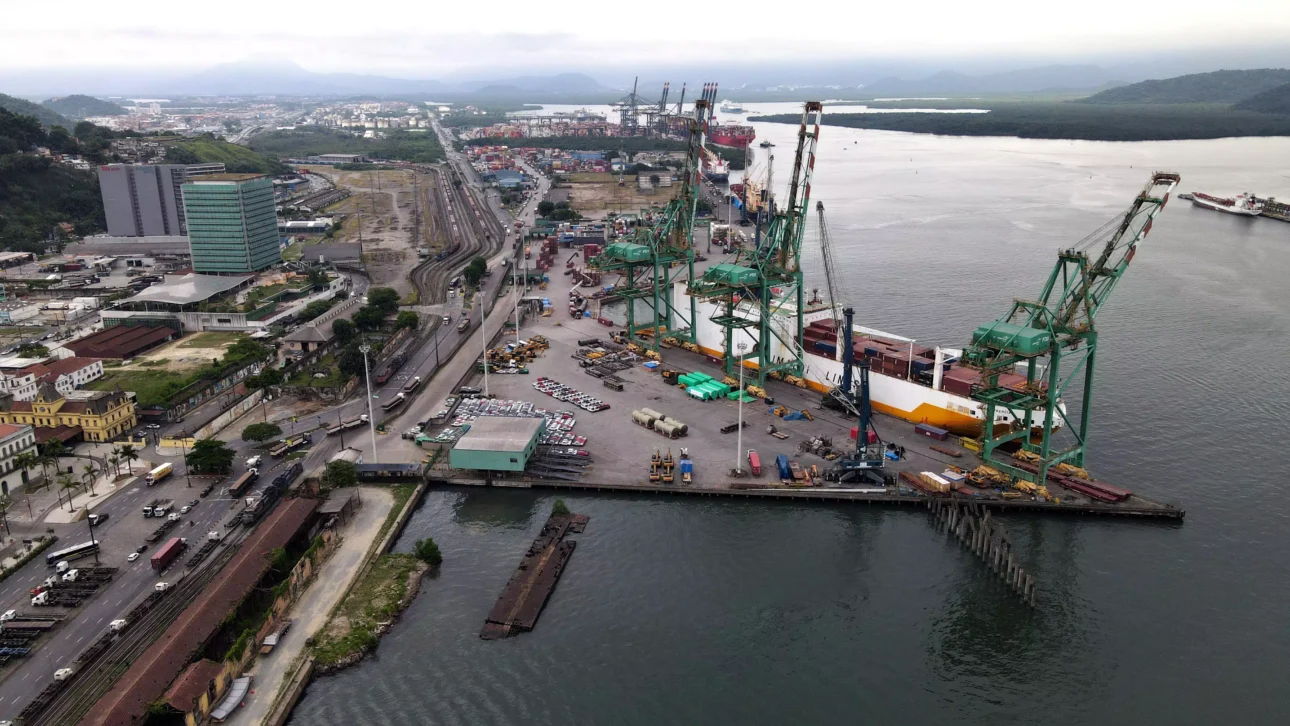
Although the plan represents an important step in the modernization of Brazilian port infrastructure, the proposed model in the bid has raised concerns among industry players.
For this reason, experts and companies in the logistics sector have questioned the bid’s format, requesting adjustments to ensure greater balance and regulatory predictability.
-
Three Chinese companies manufacture more than 96% of the world’s dry cargo containers and 100% of refrigerated ones, in a dominance built over 40 years that has made it almost impossible for the West to compete in this market.

-
The Panama Canal stores water in Gatún and Alhajuela lakes to maintain 38 daily crossings and prevent a drought linked to El Niño from once again stalling ships, raising freight rates, and putting pressure on global supply chains as occurred in 2023 and 2024.

-
While the US Navy still relied for decades on the subsonic Harpoon and Tomahawk missiles for naval combat, the US Air Force reactivated the AGM-183A ARRW program on May 12, 2026, in an anti-ship version capable of making a Nimitz-class aircraft carrier disappear in minutes.

-
While commercial hydrogen fuel cells do not exceed 80 degrees Celsius due to the requirement of liquid water in the membranes, researchers at Monash University on May 18 made an ultrathin graphene and boron nitride-based membrane operate at 250 degrees Celsius without needing water.



Auction Should Take Place In The Last Quarter Of 2025, According To The ANTAQ Schedule
According to an official note published in February 2025 by the National Agency Of Waterway Transportation (ANTAQ), the auction for Tecon Santos 10 is scheduled to take place between October and December.
The concession will be valid for 25 years, with estimated investments of R$ 5.6 billion, aiming to increase cargo movement by up to 3.5 million TEUs annually.
Additionally, the project includes infrastructure to accommodate large vessels, over 366 meters in length, compatible with international navigation standards.
Therefore, the proposal aims to enhance the competitiveness of Santos Port, which already stands as the main cargo shipment platform in Brazil.
Bid Model Restricts Shipowners And Motivates Manifestations From Large Operators
Despite the promising technical scope, the published bid imposes restrictions on the participation of shipowners in the auction, which has generated protests in the sector.
On April 3, 2025, Maersk, one of the largest shipping operators in the world, formally filed a request for review of the bid with ANTAQ, as reported by CNN Brasil.
The company argues that the rule limits competition and makes it difficult for operators with internationally recognized technical and financial capacity to enter.
Furthermore, associations of terminals and port logistics indicate that:
- The absence of adjustments could compromise the efficiency and competition goals outlined in the original plan.
- The restriction could impact the neutrality of the new terminal’s operation;
- The limitation discourages international investments in port infrastructure in Brazil;
ANTAQ Holds Public Consultation To Listen To Suggestions And Evaluate Changes
To promote social and institutional participation, ANTAQ held a public hearing on March 18, 2025, to discuss the terms of the concession for Tecon Santos 10.
The deadline for submitting technical and legal contributions ended on March 24, 2025, according to a note released by the Ministry of Ports and Airports.
During the event, representatives from entities and experts advocated for:
- Review of participation criteria, focusing on operational neutrality;
- Inclusion of performance indicators that favor the efficiency of the terminal;
- Adoption of objective parameters for selecting proposals with greater logistical benefit to the country.
The National Ports Secretariat reported that it is evaluating the contributions received based on technical, legal, and public interest criteria.
Santos Port Remains A Strategic Asset, Regardless Of The Bid Outcome
Due to its geographical location, cargo volume, and multimodal connections, Santos Port remains a crucial logistical asset for Brazilian foreign trade.
The implementation of Tecon Santos 10 is thus considered a natural extension of the necessity to expand the operational capacity of the port complex.
Should the proposed adjustments in the bid be accepted, the terminal could:
- Contribute to the fluidity of agricultural, industrial, and container logistical chains;
- Improve the predictability of shipments and disembarkations on South Atlantic routes;
- Reduce bottlenecks and enhance integration between transport modes in the Southeastern region.
Nonetheless, experts emphasize that regulatory clarity and legal security are essential to ensure the project’s attractiveness and viability.
Path To Modernization Requires Balance Between Public Interest And Private Participation
Port modernization in Brazil requires constant updates to concession models, focusing on efficiency, sustainability, and alignment with global governance standards.
In this context, Tecon Santos 10 can become a positive milestone — as long as the conditions for its implementation are equitable, transparent, and technically viable.
Therefore, the auction has the potential to attract global operators, increase the volume of private investments, and boost national logistical capacity.
However, achieving these results will depend on institutional commitment to a technical, stable regulation oriented toward public interest.







Be the first to react!