Portuguese
  Spanish


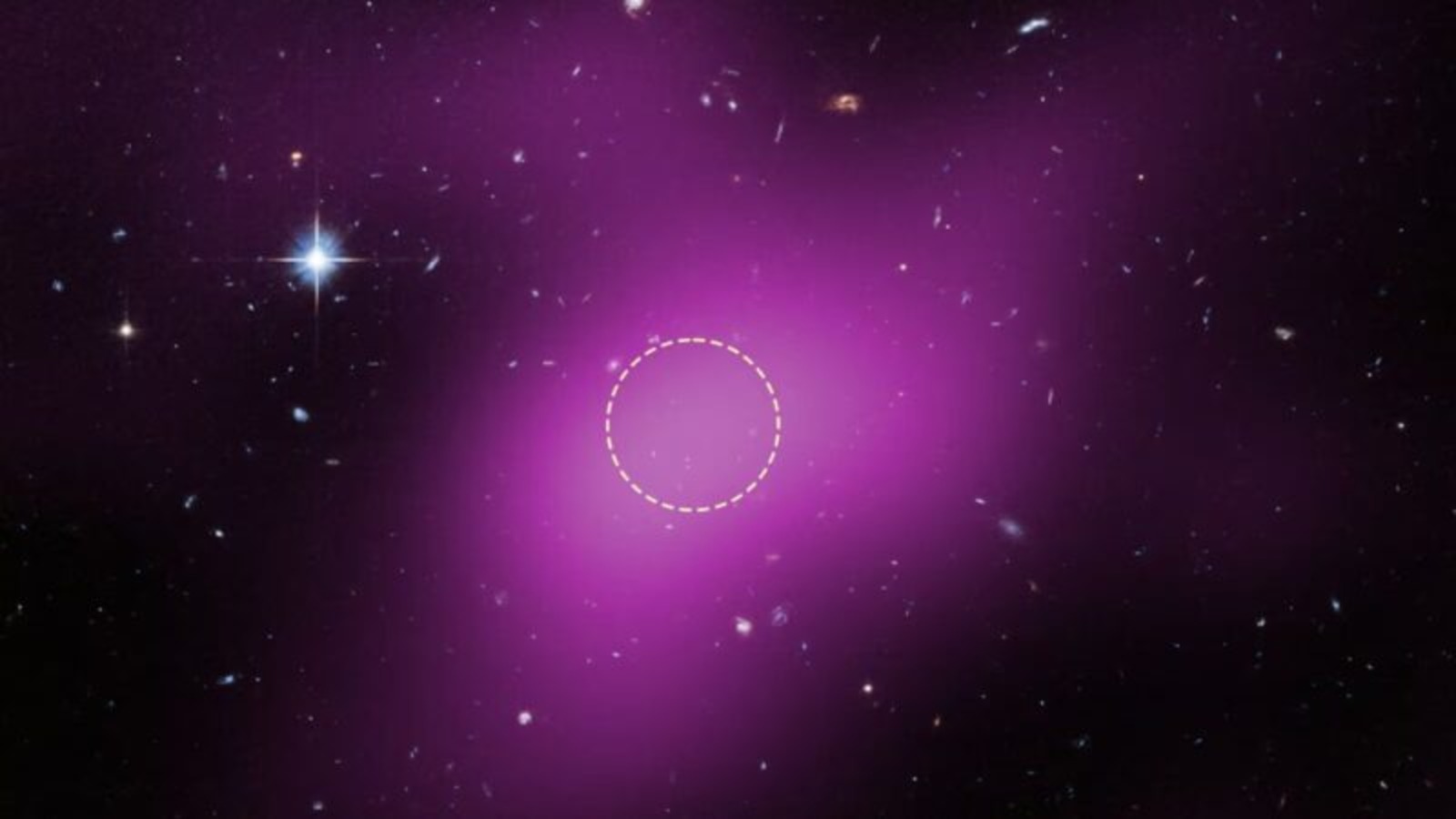


Identified Near Messier 94, Cloud-9 Confirms for the First Time a RELHIC, Theoretically Predicted Gas Structure Without Stars, Dominated by Dark Matter, Expanding Cosmological Observations
Astronomers operating the Hubble Space Telescope have announced the identification of Cloud-9, a cosmic cloud dominated by dark matter, without stars, located 14 million light-years away, a discovery that expands understanding of the Universe’s invisible structures.
A Predicted Object, but Never Confirmed
Located near the spiral galaxy Messier 94, Cloud-9 represents the first observational confirmation of an object classified as a RELHIC, until now only theoretical.
RELHICs are neutral hydrogen clouds that failed to form stars due to a lack of mass or density, despite the significant presence of dark matter.
-
Longest Solar Eclipse of the Century Will Turn Day to Night for Over 6 Minutes, Allowing Star Gazing; Won’t Recur for 156 Years

-
Brazilian Researcher Develops Protein Supplement from Tilapia Waste, Combining Innovation and Sustainability with Economic Potential

-
Women in São Paulo Unknowingly Tracked by Coin-Sized Tags Hidden in Cars and Belongings, Raising Stalking Concerns
-
Near a $750 million AI data center in Brazil, a resident’s well runs dry, leaving her unable to afford the $25,000 needed for repairs.


The confirmation of this type of structure fills an old gap between cosmological predictions and direct observations, bringing theoretical models closer to the observable reality of the cosmos.

Detailed Observations with Hubble
The Hubble Space Telescope used the Advanced Camera for Surveys to investigate whether there were hidden stars within Cloud-9.
The instrument’s high sensitivity allowed researchers to rule out the hypothesis of an extremely faint dwarf galaxy, a common scenario in less precise observations.
Based on the data obtained, scientists state that there is no evidence of stellar brightness, making the object unique among known structures.
This absolute absence of stars differentiates Cloud-9 from conventional galaxies and confirms its purely gaseous and dark matter-dominated nature.
Invisible Mass and Silent Hydrogen
Although it does not emit visible light, Cloud-9 contains neutral hydrogen with a mass equivalent to about one million times the mass of the Sun.
Around this cloud lies a dark matter halo estimated to be approximately five billion solar masses, an unusual proportion of gas to invisible matter.
This configuration turns the object into a so-called cosmic ghost, large in scale but lacking the traditional signals used to map galaxies.
Impacts for Cosmology
Researchers indicate that studying objects like Cloud-9 could reveal fundamental clues about galaxy formation and dark matter.
The majority of historical astronomical observations have prioritized luminous structures, leaving the Universe’s silent components out of scientific focus.
Cloud-9 demonstrates that significant portions of cosmic mass remain hidden, influencing galactic evolution without producing detectable light.
As a precursor, reionization models had already suggested the existence of these clouds, now confirmed, expanding the inventory of structures that shape the Universe.
With information from Adventures in History.