Portuguese
  Spanish


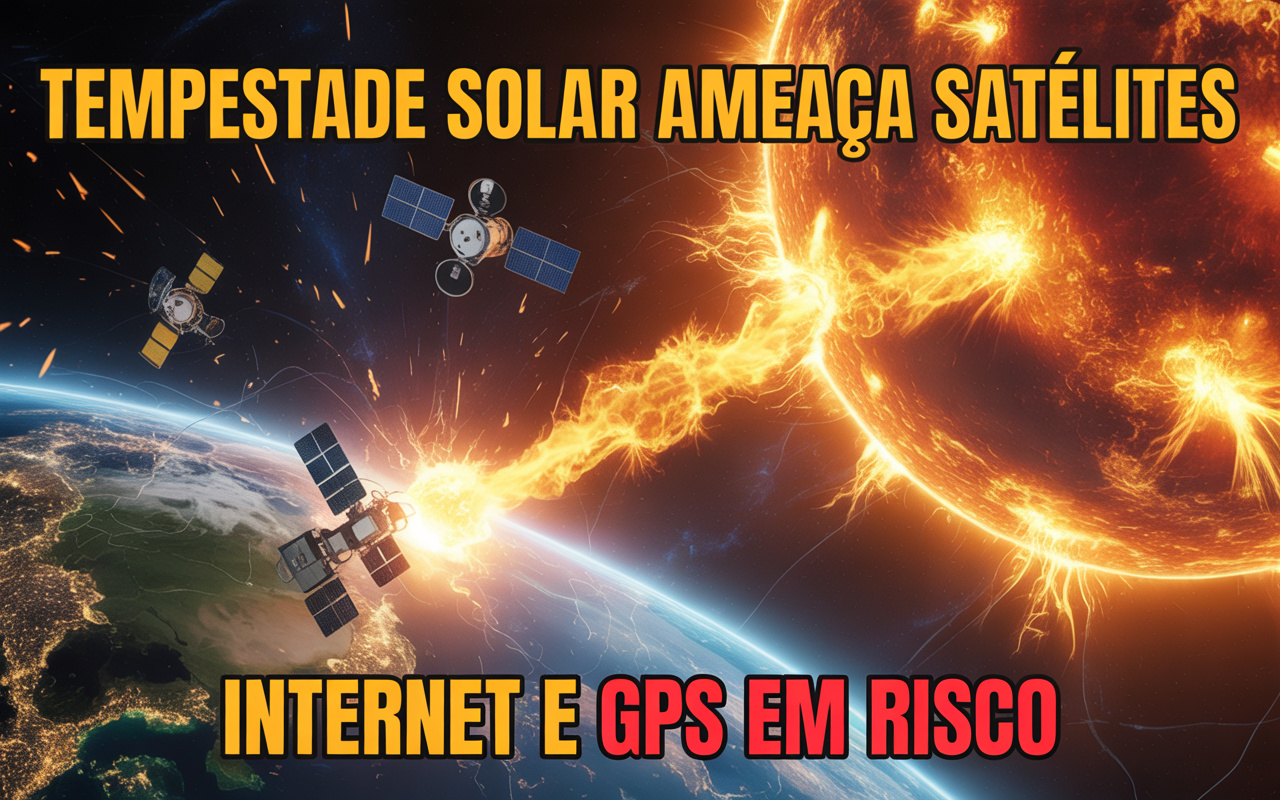

A New Study Warns That An Intense Solar Storm Could Quickly Compromise The Stability Of Space Infrastructure. In Less Than A Week, Satellites Could Lose Orbital Control, Suffer Electronic Failures, Or Even Collide.
A new scientific analysis has raised a troubling alert for global space infrastructure: just a few days of widespread failures could lead to satellites beginning to collide with each other. The trigger? A strong solar storm capable of disabling communication and orbital maneuvering systems.
According to the study cited by Daily Galaxy, the so-called “CRASH Clock” — a metric that calculates the time until a catastrophic collision in a systemic failure scenario — indicates that, in an extreme case, the timeframe could drop to around five days. The impact would not be limited to space: satellite internet, GPS navigation, and climate monitoring could be directly affected.
Space Is More Congested Than Ever
Low Earth Orbit, known as LEO, is experiencing an unprecedented explosion in the number of active satellites. Mega-constellations like that of SpaceX have drastically increased orbital traffic, with thousands of units already operating and even larger expansion plans.
-
Brazilian Innovator Transforms 1962 Mercury Comet with Nissan Leaf Electric Motor, Achieving 125 km Range for Under $6,000

-
China Tests Giant 582-Ton Magnets to Contain Plasma Hotter Than the Sun’s Core, Aiming to Cut Superconductor Costs and Generate First Electricity from “Artificial Sun” by 2030
-
Seventh Grader Builds Nuclear Fusion Machine at Home, Aiming for Guinness World Record

-
Ancient Ritual Circle, Hidden for 5,000 Years, Discovered in Scotland’s Machrie Moor Using Sensors, Revealing a “Phantom Stonehenge”




Each satellite relies on propulsion and communication systems to perform small avoidance maneuvers when there is a collision risk. The problem arises when multiple satellites lose this capability simultaneously.
How A Solar Storm Can Cause Chaos
Solar storms are massive explosions of particles and radiation emitted by the Sun. When they reach Earth, they can:
- Increase atmospheric drag in low orbit
- Destabilize electronic systems
- Interrupt communications
- Affect navigation systems
In 2024, an intense solar event already forced operators to perform emergency maneuvers on multiple satellites. In a more severe scenario, some could completely lose control.
If many maneuvering systems fail simultaneously, the risk of collision increases exponentially — and that’s where the concept of CRASH Clock comes in.
What Is The “CRASH Clock”?
The model simulates how long it would take for a serious collision to occur if satellites ceased to perform evasive maneuvers. With the accelerated growth in the number of objects in orbit, this timeframe has been decreasing.

Researchers warn that, in the event of a widespread failure, less than a week could be enough for two or more structures to collide, scattering thousands of fragments in orbit.
This scenario could trigger the feared Kessler syndrome, a domino effect where each collision generates new debris, increasing the likelihood of subsequent impacts and making certain orbits nearly unusable.
What Is At Risk On Earth
It may seem distant, but the impact would be immediate on the planet’s surface. Among the services that directly depend on satellites are:
- GPS Navigation
- Satellite Internet
- Climate Monitoring and Weather Forecasting
- Military and Civil Communications
- Maritime and Aerial Logistics
A major collision could generate enough debris to compromise future missions and necessitate severe restrictions on satellite operations.
The Race For Solutions
Space agencies and private companies are already working on preventive measures, such as:
- Better monitoring of orbital debris
- International coordination protocols
- Autonomous avoidance systems
- Development of space debris removal technologies
However, the pace of launches has been faster than the implementation of global orbital control policies.
A Warning Before The Critical Point
The study does not claim that mass collisions are inevitable, but it makes it clear that the orbital environment is more fragile than ever. The combination of increasing congestion with extreme solar events creates a scenario where systemic errors can have rapid and difficult-to-reverse consequences.
In an increasingly dependent world on space infrastructure, space has ceased to be merely a scientific frontier — it has become an essential part of the economy and everyday life.
If the warning serves to accelerate international cooperation and enhance safety protocols, perhaps the “CRASH Clock” will act as a timely alert, rather than an actual countdown.