Portuguese
  Spanish


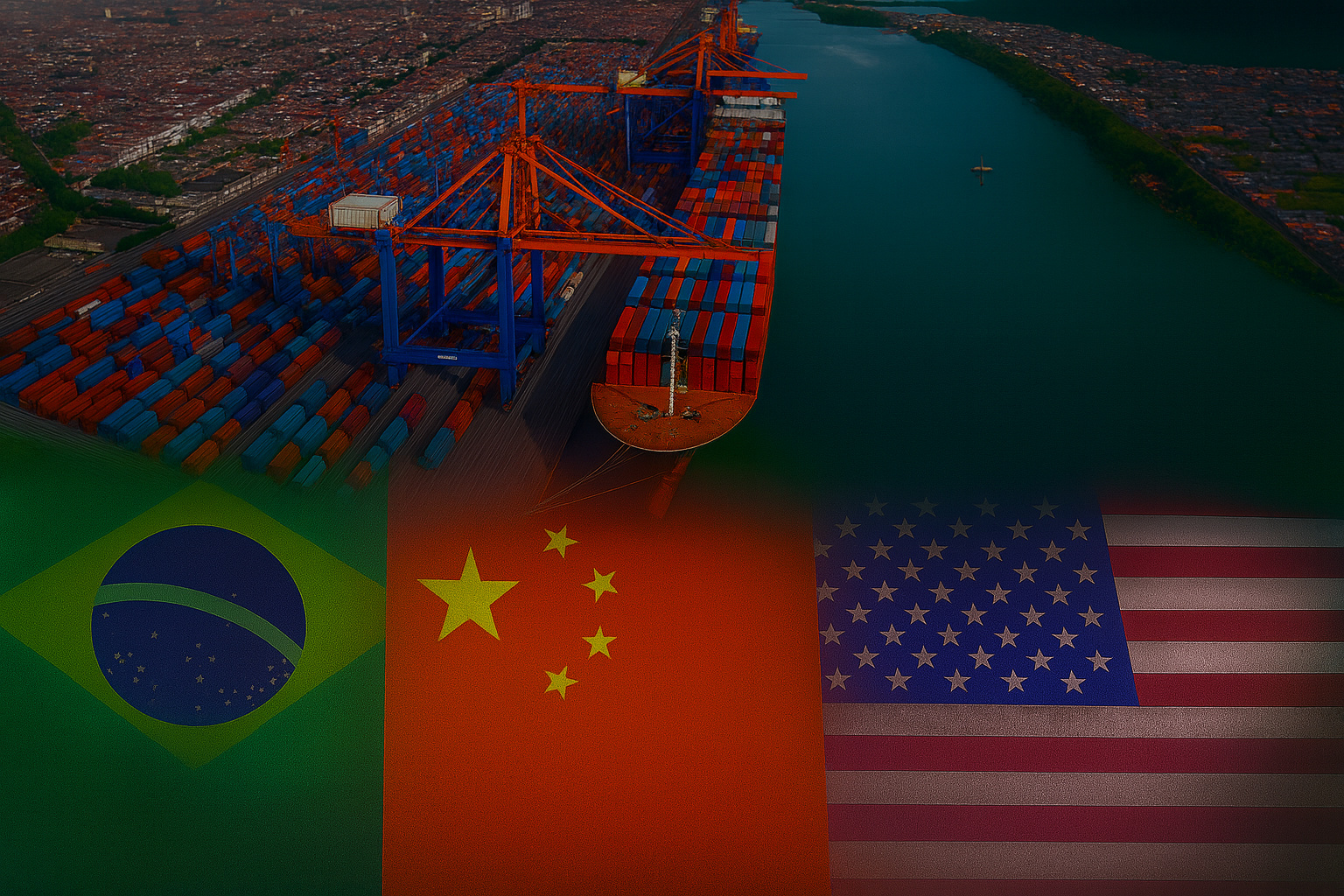

Forged in the Largest Port of Latin America, the New Cofco Terminal in Santos Promises to Triple Loading Capacity (From 4.5 to Up to 14 Million Tons/Year), While the China x USA Trade Dispute Heats Up and Brazil Becomes a Key Player
The Port of Santos is not just the largest in Latin America. In 2024, it broke records by handling around 180 million tons of cargo.
More than half of it came directly from the fields, with corn, sugar, and the champion soybeans leading the way.
In 2023, Brazil exported 101.845 million tons of soybeans and about 40% of what went to China passed through Santos.
This flow explains why one of the largest Chinese state-owned agribusinesses, Cofco (Cófico), decided to invest US$ 285 million to build one of the largest export terminals in the world on the São Paulo coast.
What Is Being Built: Silos, Automation, and Dedicated Berths for Bulk Carriers
The new terminal is designed to exclusively handle grains. The goal is clear: to triple Brazil’s loading capacity from 4.5 million to up to 14 million tons per year.
For this, verticalized silos, smart climate control, and automated conveyors with a capacity of up to 2,000 tons per hour will come into play.
-
Man Revives 1930s Abandoned Trout Farm, Learns from Scratch, and Earns $1.1 Million Annually Selling Fish to Michelin-Starred Restaurants

-
Bangladeshi Farmers Use Bamboo Levers to Pump Thousands of Liters of Water Daily Without Engines or Electricity

-
Brazilian Forests Could Expand by an Area Twice the Size of Switzerland by 2035, but Agricultural Sector Holds the Key, Study Finds

-
Brazilian Student Develops Solar-Powered Agricultural Machine Capable of Processing 250 Kilograms per Hour




The design includes dedicated berths, deep drafts for large vessels, and loading systems inspired by solutions used in Chinese ports, such as the dean.
The logistics design is anchored in direct access to Rumo’s rail network and the main highways in the Southeast, shortening the path from the Midwest to the coast.
Real Bottleneck, Direct Response: 91% of Current Grain Capacity Is Already Taken
According to Folha de S. Paulo, more than 91% of the port’s capacity for grain exports is already in use.
The new terminal therefore emerges as a direct response to congestion and as a logistical bridge between Brazilian agriculture and Chinese ports.
Cofco keeps parts of the schedule confidential but reports that foundations and earthworks are progressing, with an expected operation between the end of 2025 and the beginning of 2026.
In terms of road traffic, the projected volume is equivalent to about 300,000 trucks per year.
China x USA: Why Washington Is Paying Attention to What Happens in Santos
The first trade war between Washington and Beijing in 2018 taught a lesson: food is also strategy.
The U.S. Department of Agriculture estimates that, solely due to the First Trade War, American producers lost more than US$ 27 billion in exports.
With the terminal in Santos operated by a Chinese state-owned enterprise, China gains its own route to increase direct purchases in Brazil and reduce dependence on the USA, especially during periods of political tension.
In practice, it is like setting up a “logistical embassy” on Brazilian territory, aligned with the logic of the new Silk Road.
Unsettling Comparison: Scale, Access to the Fields, and Control of the Operation
The USA boasts giant grain terminals in the Gulf of Mexico and the Midwest, particularly in New Orleans, Houston, and Long Beach, operated by multinationals such as DM, Cargo, and Bunch.
The Cargo terminal in Louisiana has a capacity of over 10 million tons/year, with direct shipment to Asia via the Panama Canal.
In Brazil, Cofco aims to increase from 4.5 to 14 million tons per year in Santos, which is equivalent to or greater than some of the largest American hubs.
There is also a structural advantage: the proximity to Mato Grosso, Goiás, and Paraná, which concentrate soybean and corn production.
With railways, waterways, and highways improving, logistics costs decrease, export margins increase, and Chinese attraction rises.
ESG and Mitigation: Particulate Filters, Acoustic Insulation, and Rainwater
The project was announced with systems to contain particulates, platforms with acoustic insulation, and rainwater harvesting for operational use.
The promise is to comply with Brazilian environmental regulations and international ESG criteria, increasingly demanded in foreign trade.
A Symbiotic Relationship and the Brazilian Paradox
In 2023, Brazilian agricultural exports to China totaled US$ 166.55 billion, representing 49% of Brazil’s total export agenda for the year.
With Santos gaining strength and the bioceanic railway on the horizon, linking the Midwest to Peru’s mega port and cutting almost 10 days of navigation to Asia, integration is likely to deepen.
However, Brazil faces a paradox: it gains prominence and revenue from commodities while simultaneously seeing its industry pressured by imports of Chinese manufactured products.
It is the dilemma between being a granary or a brain: supplier or innovator.
Why This Matters Now: Repositioning the Global Agro Axis
Every square meter built in Santos serves a purpose: to ensure China a secure, direct, and independent route from external pressures.
The possible consequence is a repositioning of the global agribusiness axis, with some of the flow migrating from New Orleans to Santos.
For Brazil, the opportunity is clear, but it requires industrial policy, technology, and education so that the port can export wealth, rather than drain it in the long run.
In your opinion, is the new terminal in Santos a strategic leap for Brazil or a step that deepens the dependence on commodities and the tension with the USA?