Portuguese
  Spanish


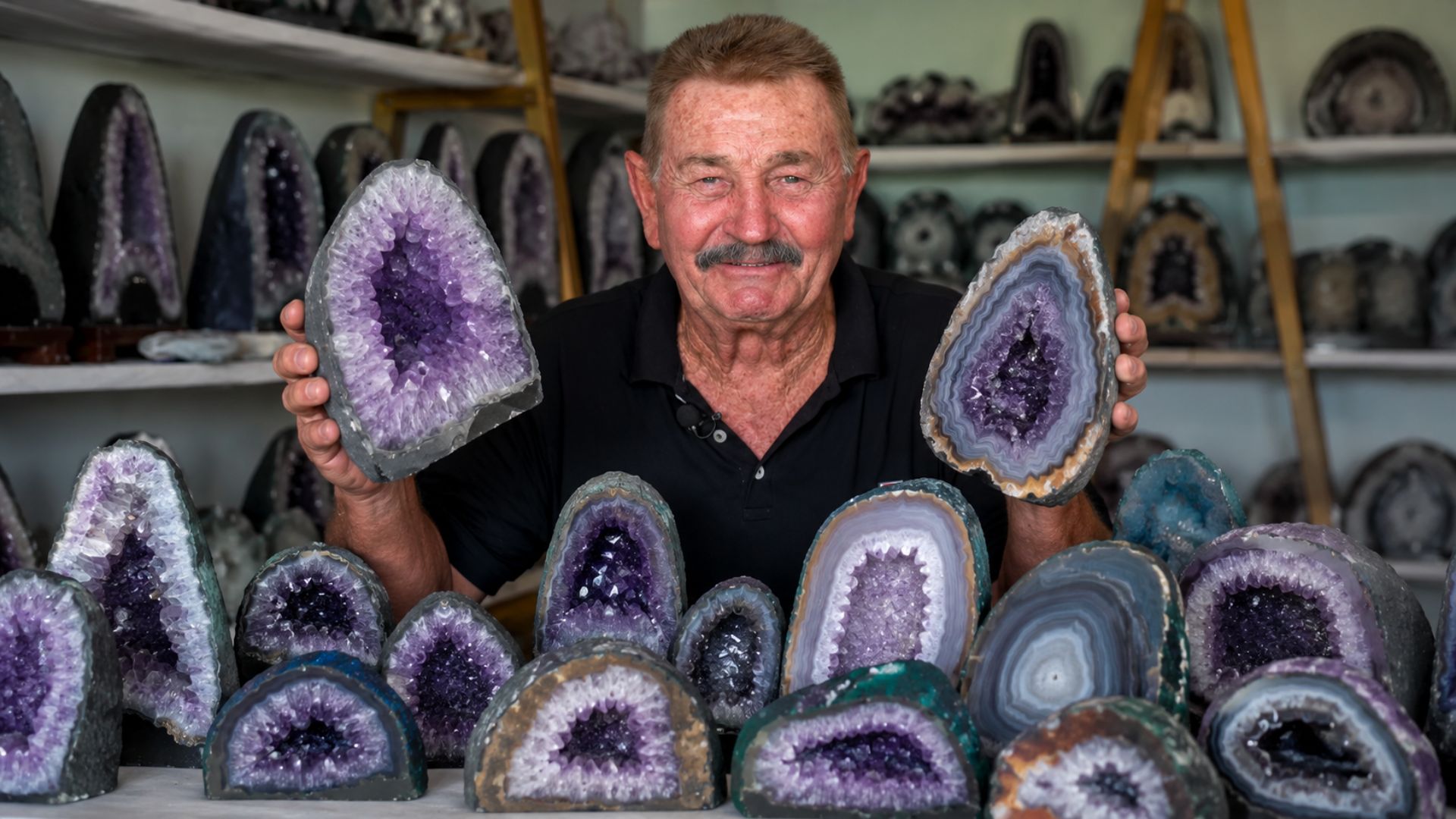

In the Far West of Santa Catarina, retired farmer Aloísio, from Itapiranga, discovered that the ugly stone hindering planting concealed agate and amethyst worth up to R$ 600 each. For 34 years, he has been transforming this farming nuisance into stone crafts sold throughout Brazil and even abroad.
In the interior of Itapiranga, in the Far West of Santa Catarina, farmer Aloísio, 71, and his wife Isabel, 70, maintain a property with crops, fish farming ponds, and reforestation. However, the family’s highlight does not come from planting but from an unexpected activity: crafts made from the stone that for years was seen only as a problem for tilling the land. About 34 years ago, Mr. Aloísio realized that the stones he collected and discarded concealed agate and amethyst, gems that he now transforms into pieces sold throughout Brazil and even abroad, with values reaching R$ 600 each.
The discovery began by chance. Anyone with a stone-filled land knows the challenge of planting amidst this obstacle, often needing to remove them one by one to work the soil. In the past, Mr. Aloísio would take these piles of stones to the underbrush, unaware of what he had in hand. It was when he noticed there were many people interested in buying exactly what was just a cause of concern in the fields and pastures for him that the farmer understood he was sitting on a true geological treasure, hidden inside each apparently worthless stone.
How the Ugly Stone from the Fields Became a Treasure in Itapiranga

He recounts that in the past he would stumble over the stones and didn’t know how to value them, taking them away from the planting areas. Over time, upon noticing buyers’ interest, he began to search for the gems on top of the region’s fields, identifying by shape and firmness which stones had potential. Some are small, the size of a walnut, but already indicate the crystal hidden inside.
-
Vertical Farming Company Backed by SoftBank and Jeff Bezos Files for Bankruptcy, Valuation Plummets from $1.9 Billion to Under $15 Million

-
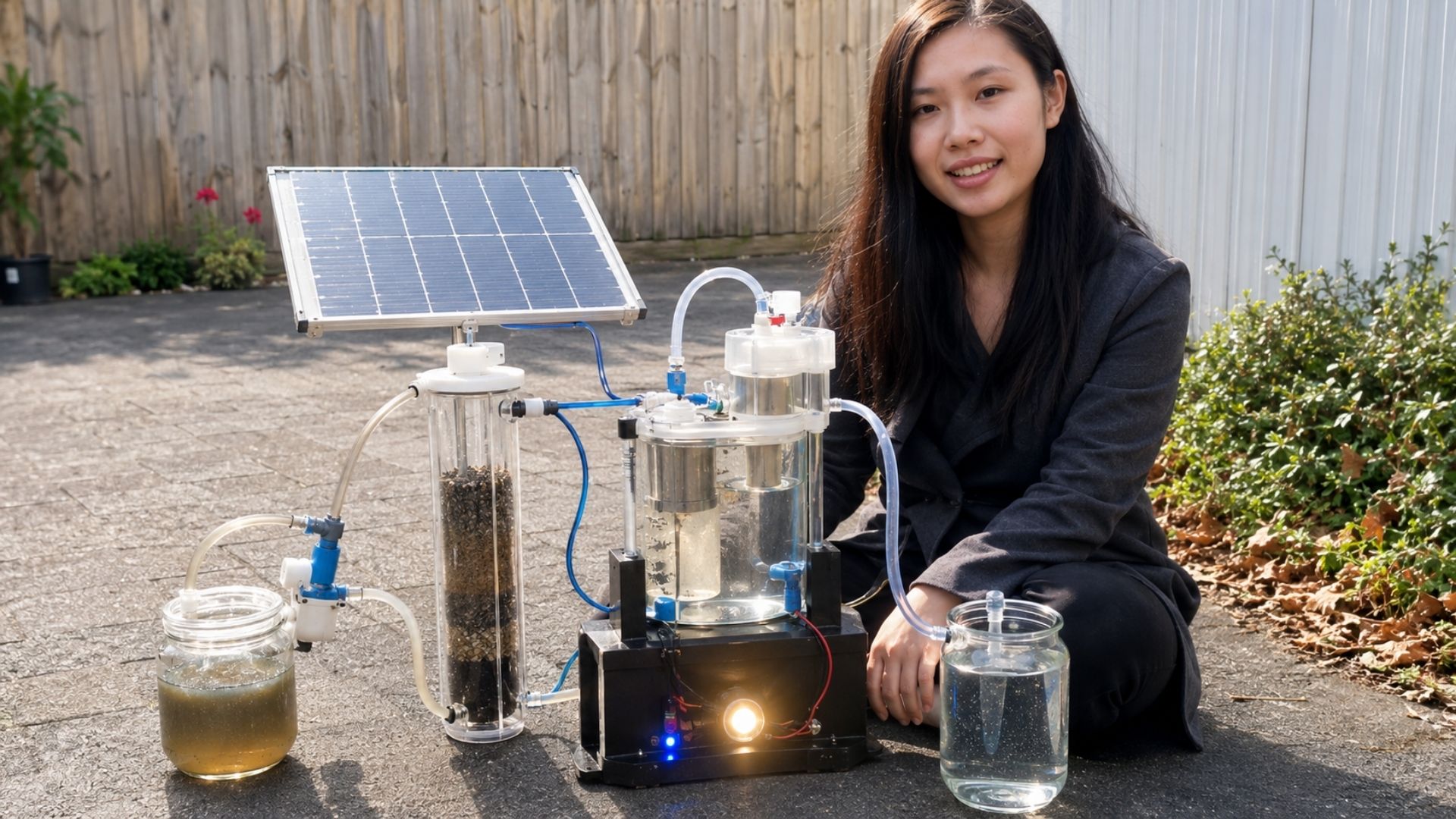
Indian Inventor Develops Solar-Powered Machine Enabling Blind Farmers to Independently Manage Crops with Sensors and Audio Alerts

-
Brazilian Honey Supplying U.S. Supermarkets Faces Price Hike and Job Threats Amid New Tariff Round
-
Drought in France Threatens Beet Crops, Raising Fears of Sugar Price Surge Across Europe


The farmer explains that he can feel, when handling, when a stone has value. He observes if it is firm, if it has crystal inside, if it has cracks that might compromise the cut. All the raw material comes from the region’s fields, in a surface mining process that does not require deep excavation. This local abundance is no coincidence: the Extreme West of Santa Catarina is on one of the largest basalt formations on the planet, a terrain conducive to the occurrence of these gems.
Where the agate and amethyst from Western Santa Catarina come from

The agate and amethyst in the region were formed inside cavities of volcanic rocks known as geodes, within the basalt flows of the Serra Geral Formation, part of the Paraná Basin. This volcanism occurred about 130 million years ago, during the fragmentation of the ancient supercontinent Gondwana, and covered much of the current states of Rio Grande do Sul, Santa Catarina, Paraná, São Paulo, and Mato Grosso do Sul.
Inside these geodes, silica-rich fluids slowly deposited over millions of years, forming the colorful bands of agate and the purple crystals of amethyst. The same geological formation that makes Ametista do Sul, in the north of Rio Grande do Sul, the so-called world capital of amethyst, extends through Western Santa Catarina, which explains why each stone collected in Mr. Aloísio’s field may hide a surprise of color and shine inside, invisible before cutting.
The step-by-step of the craft: from the field to the polished piece


The work begins with cleaning. The first thing Mr. Aloísio does when bringing the stone from the field is to wash it, then evaluate the presence of cracks and decide how it will be cut. Then, he uses a machine with an adjustable blade that allows him to set the thickness of the slices. A single cut can take about 15 minutes, depending on the hardness of the material. Agate, being very hard, needs to be sawn with a specific dry-working disc, while the crystal can be cut with water.
After the cutting, comes the polishing, a stage that can take up to a month for smaller stones. The farmer uses a process in which the small stones work against each other inside a machine, helping to smooth each other until they gain shine. Some pieces are only cut, others polished or sanded, depending on the type of material. The result is a variety of objects, from decorative plates to functional pieces like wind chimes, all made from the same stone that once hindered cultivation.
Each stone is a surprise: agate, amethyst, and crystal
One of the most fascinating aspects of the work is unpredictability. Mr. Aloísio compares each stone to a person: just as there are no two identical human beings, there are no two identical gems, only similar ones. When opening a piece, he never knows for sure what color, shape, or degree of crystallization he will find. Some are more hollow, others more solid, and each cut reveals a unique composition inside.
Among the most valuable pieces are those that combine more than one gem. The farmer shows examples of a mix of agate with amethyst, which produces a composition of colors between brown, bluish, and the purple tones of the crystal, a piece that can cost around R$ 600. A single stone taken from the field can yield several pieces: he recounts cases where a closed rock, when cut, resulted in 10 or even 15 finished units, multiplying the value of what would originally be discarded.
Stones sold throughout Brazil and the search for energy
Mr. Aloísio’s craftsmanship has already reached customers all over the country and even abroad. According to him, the demand is not only due to the beauty of the pieces. Many buyers take the stones for their believed energetic properties, carrying specimens in their pockets wherever they go. The farmer recounts knowing many stories of people who see a personal connection with a particular gem and cites a phrase he once heard: it is not the person who chooses the stone, it is the stone that chooses the person.
It is worth noting that the energetic value attributed to crystals and gems belongs to the realm of personal beliefs and has no scientific proof. From a mineralogical point of view, agate and amethyst are varieties of quartz, with recognized aesthetic, decorative, and commercial value. Regardless of each buyer’s motivation, the fact is that the stone that used to be free from the field has become a concrete source of income for the couple in Itapiranga, with a consolidated market inside and outside Brazil.
A retirement driven by a passion for stones
Now retired, Mr. Aloísio says he no longer chases sales as much as before and that he receives groups of tourists on the property by prior appointment. The activity, which started as a necessity to clear the land, turned into fun. He says he spends hours working at night, not out of obligation, but for pleasure, combining craftsmanship with other tasks on the rural property.
The farmer jokes that he has enough raw material to work for another 300 years, given the amount of stones scattered across the fields in the region. This abundance, combined with the low extraction cost, since the material is collected from the surface of the land itself, makes craftsmanship a profitable and sustainable activity. The story of Itapiranga shows how a keen eye can transform what seemed like an obstacle into an opportunity, giving new meaning to each stone that was previously just discarded.
The journey of Mr. Aloísio and Mrs. Isabel is an example of how knowledge and observation can reveal value where only problems were seen before. What for most farmers was a nuisance to be removed became, in the Extreme West of Santa Catarina, a source of income, tourism, and family pride. The generous geology of the region, a legacy of volcanic eruptions millions of years ago, continues to offer surprises with each stone cut, reminding us that treasures can be hidden in the most unexpected places.
Have you ever imagined that a simple stone collected from a field could hide agate and amethyst worth hundreds of reais? Do you know someone who turned a field obstacle into a source of income? Leave your comment, tell us if you collect or have ever bought pieces of natural stones, and share the article with those interested in geology, craftsmanship, and inspiring stories from the Brazilian countryside.