Portuguese
  Spanish


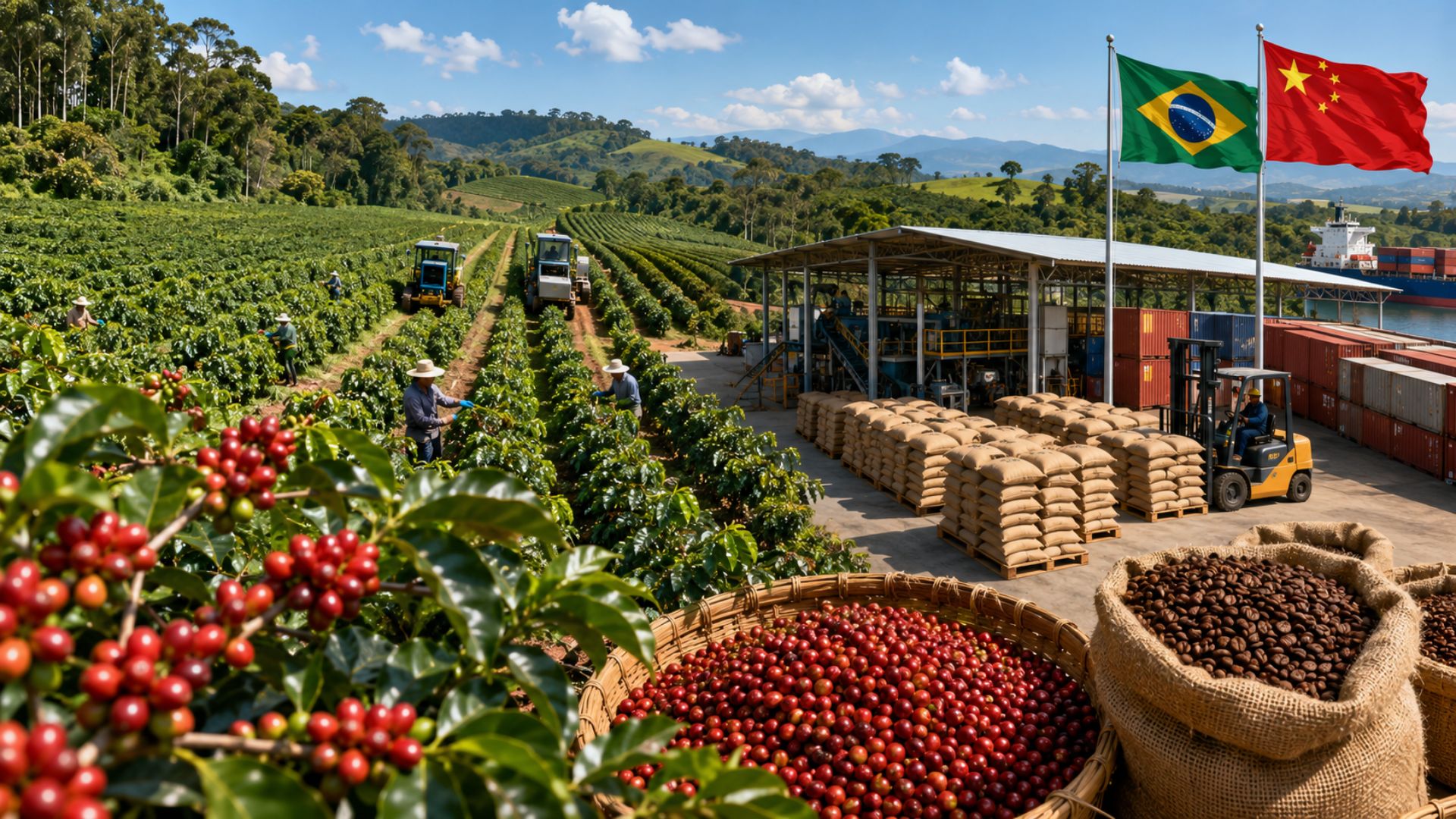


China has become the fastest-growing coffee market in the world, with 300 million consumers and more than 200,000 coffee shops in operation. According to information from TIMES BRASIL, Brazilian coffee exports to China jumped from 32.9 million dollars to 402.8 million in just six years. Brazil responds with a record harvest estimated at 66 million bags by Conab and ensures it has the capacity to expand production without deforestation.
China has decided to like coffee, and when China likes something, the scale changes everything. Between April 2020 and March 2021, Brazil exported 32.9 million dollars in coffee to the Chinese market. By March 2026, this value had jumped to 402.8 million dollars, a more than twelvefold increase in six years that has redrawn the map of Brazilian grain exports. The explosion of consumption in China is linked to accelerated urbanization, the influence of Western habits among young people, and the association of coffee with social status, convenience, and socialization in a country of nearly 1.4 billion inhabitants.
Brazil is preparing to meet this demand with the largest coffee harvest in its history. Conab estimates the 2026/27 production at 66 million bags, a 17% increase compared to the previous cycle, with 44 million bags of arabica and 22 million of conilon. The most relevant data for the future is that the country has more than doubled production in recent decades using practically the same cultivation area, and still has land available to expand without needing to deforest. The 25th International Coffee Seminar, concluded this week in Santos, brought together buyers from more than 25 countries with an optimistic atmosphere that the sector hadn’t seen in years.
The explosion of coffee consumption in China

The coffee market in China has gone from niche to phenomenon in less than a decade. The country already has approximately 300 million coffee consumers and more than 200,000 coffee shops in operation, a number that continues to grow. The Luckin Coffee chain, founded in 2017, has surpassed Starbucks in the number of stores in China and serves as a barometer of a habit that has spread from large metropolises to medium and small cities.
-
Brazilian Honey Supplying U.S. Supermarkets Faces Price Hike and Job Threats Amid New Tariff Round

-
Drought in France Threatens Beet Crops, Raising Fears of Sugar Price Surge Across Europe
-
French village switches from oil to giant miscanthus for heating, cutting annual costs from €20,000 to €4,300

-
Brazilian Agribusiness Sets Record with $169 Billion in Exports in 2025


Marcos Matos, general director of Cecafé, explains that coffee initially gained ground among young people, but is already advancing to other age groups. The beverage is associated with an urban and modern lifestyle, and coffee shops function both as workspaces and socialization spots. In August 2025, the Chinese Embassy in Brazil authorized 183 new Brazilian coffee companies to export to the country, a clear sign that Beijing wants to diversify its suppliers to keep up with the growing demand.
The record harvest that could change the game
Brazil is entering the 2026/27 harvest with unprecedented production expectations. Carlos Santana, commercial director of Eisa, stated behind the scenes at the International Coffee Seminar in Santos that the country “will very likely have the largest harvest in history” and that the effects on shipments should start to appear as early as July and August. The previous harvest, in 2024, had already set a record for exports with 50.5 million bags sold abroad.
The new harvest benefits from more favorable weather conditions, increased use of technology in the fields, and a 4% expansion in planted area, which is approaching 2 million hectares. The addition of 10 million bags from the record harvest compared to the previous cycle represents a volume that, by itself, would be enough to supply entire markets. China, with its exponentially growing demand, is the destination that most attracts the sector’s attention.
Brazil that doubled production without increasing the area
One of the most relevant data presented at the Santos seminar is that Brazil has more than doubled its coffee production in recent decades without significantly expanding the cultivation area. This was possible thanks to the renewal of coffee plantations, the use of more productive varieties, and the adoption of management technologies that increase productivity per hectare.
The country still has land available for coffee cultivation without the need for deforestation, which directly addresses one of the major concerns of international buyers: environmental sustainability. To meet China and other growing markets, such as India, Brazil does not need to cut down forests. It needs to continue investing in technology and crop renewal, something the production chain has been doing for years with measurable results.
What China represents for the Brazilian coffee chain


The entry of China as a major buyer of Brazilian coffee is not just another destination on the export spreadsheet. It is a structural change. When a country of 1.4 billion people adopts a new food consumption habit, the demand created is of a magnitude that can absorb entire harvests and force producers worldwide to reorganize their operations.
The International Coffee Seminar in Santos dedicated entire debates to the topic of China, with panels on logistics, geopolitics, and global trading specifically aimed at understanding how the Chinese market will behave in the coming years. Chinese buyers are already participating in negotiation rounds directly, visiting Brazilian farms, and closing long-term contracts. For Brazil, which is the largest global producer and exporter of coffee and comes from a record harvest, China is both an opportunity and a challenge: meeting a demand that only grows requires record production, efficient logistics, and the ability to scale without compromising quality.
Did you know that China multiplied its purchases of Brazilian coffee by twelve in six years? Do you think Brazil will be able to meet this demand without further increasing the price of coffee in the domestic market? Tell us in the comments.