Portuguese
  Spanish




Man Finds 20 Thousand Medieval Silver Coins in Sweden, Dated to the 12th Century and Valued at Up to US$ 6 Million — One of the Greatest Discoveries in Europe.
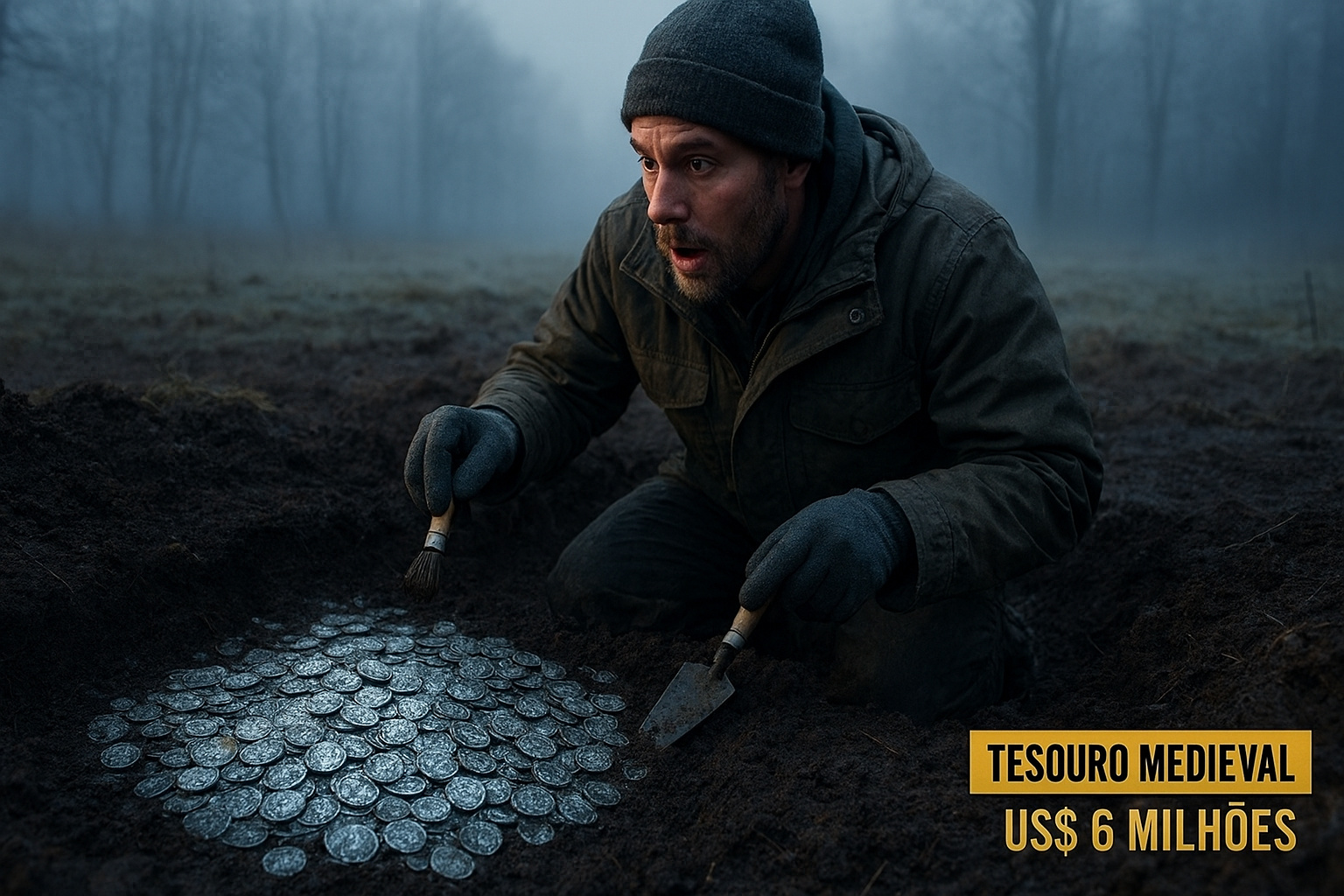
In October 2025, a resident of Stockholm, Sweden, experienced one of the most improbable moments in recent European archaeological history. While digging in the ground for worms to fish, the man ended up finding a small copper cauldron — and inside, something that seemed impossible: thousands of silver coins shining after almost a thousand years buried. The case was confirmed by the Swedish National Heritage Board and reported by outlets such as Live Science and Jerusalem Post.
The archaeologists who responded to the call were astonished. The container held an initial estimate of 20,000 medieval coins, dated to the 12th century, a period marked by the reign of Knut Eriksson, one of the most influential monarchs in Swedish history. The discovery was quickly classified as one of the largest ever recorded in Scandinavia.
The Medieval Treasure Hidden Under the Scandinavian Soil
According to experts from the Stockholm County Administrative Board, the find contains coins known as “Kanutus,” minted during the reign of Knut I Eriksson (1167–1196). They were carefully stored inside a copper cauldron weighing about 6 kg, indicating that the treasure was likely buried intentionally — perhaps to protect wealth during local conflicts or foreign invasions.
-
Brazilian Artist Trades São Paulo Apartment for Self-Built Eco-Hut in Southern Brazil, Embracing Low-Impact Living

-
Women Who Faced Death Head-On Break Taboos and Uncover Forgotten Funeral Rituals

-
Elderly Man in His 70s Spends Nearly 30 Years Digging 3 km Canal to Transform Arid Land into Farmland in Rural India
-
Submerged Town Reemerges in São Paulo as Reservoir Levels Drop, Revealing Ruins and Memories of Displaced Families




The location where the coins were found, near the city of Täby, is historically associated with ancient Viking and medieval trade routes. According to archaeologists, it is likely that the original owner was a merchant or a member of the local nobility who never managed to return to recover the treasure.
The coins feature inscriptions and crests that, according to the analysis team, may provide new clues about trade, the monetary system, and political power in 12th-century Scandinavia. “Each coin is a time capsule. The state of preservation and the quantity make this discovery unique,” stated Åsa Fredholm, the chief archaeologist of the project.
A Find That Could Be Worth Up to US$ 6 Million
Although the value of the metal itself is relatively modest — the total silver in the cauldron is approximately 6 kg, equivalent to only US$ 6,000 in metal weight — the historical and collectible value is what turns this discovery into something extraordinary.
Well-preserved medieval Swedish coins can fetch between US$ 200 and US$ 1,000 each at specialized auctions, and some rarities can reach tens of thousands of dollars. Thus, the conservative estimate from experts indicates that the collection could reach up to US$ 6 million in the international numismatic and archaeological market, making the find one of the most valuable in recent European history.
The Role of Chance in Modern Archaeology
Cases like this reinforce how much chance still plays a fundamental role in major archaeological discoveries. The resident, whose identity has not been revealed to prevent looting in the area, reported that he initially thought he was dealing with rusty cans. Upon realizing it was something valuable, he immediately notified local authorities, as required by Swedish cultural heritage protection law.
The objects were transferred to the National Historical Museum of Stockholm, where they are undergoing a process of cleaning, cataloging, and conservation. The coins will be studied in detail to determine their exact origin, total number, and metal composition.
A Portrait of a Lost Era
The discovery of the coins from the reign of Knut Eriksson offers a rare glimpse into a period when Sweden was still consolidating its political and economic identity. Preliminary analyses show that many coins bear religious symbols and Latin inscriptions, signaling the influence of the Church and the process of Christianization in Scandinavia.
Archaeologists believe that the deposit may have been made shortly before one of the local conflicts that marked the transition of power among the noble families of the 12th century. The fact that the treasure was never recovered indicates that the owner likely died in battle or was forced to flee the region.
Global Repercussions and Popular Fascination
The news spread worldwide and quickly became a phenomenon on social media and major science and curiosity websites. The story of an amateur fisherman who, while digging for worms, ended up finding a medieval treasure hidden for nearly a thousand years seems straight out of a movie script — but it is absolutely real and documented.
Swedish authorities state that after the studies are concluded, the collection should remain in the country as part of the national collection. “Discoveries like this remind the world that there is still much to be revealed beneath our feet. It is a reminder that history is alive,” highlighted Anna Blomquist, museum director.
A Discovery That Changes the Understanding of History
More than a million-dollar find, the treasure discovered near Stockholm redefines part of the monetary history of Northern Europe. It proves that 12th-century Sweden had a more sophisticated trading system than previously thought, with the circulation of its own coins and international connections.
For archaeologists, each coin represents a fragment of the past — and together, they tell the story of a civilization that flourished in the cold north of Europe, and whose heritage, literally, is still being unearthed.