Portuguese
  Spanish


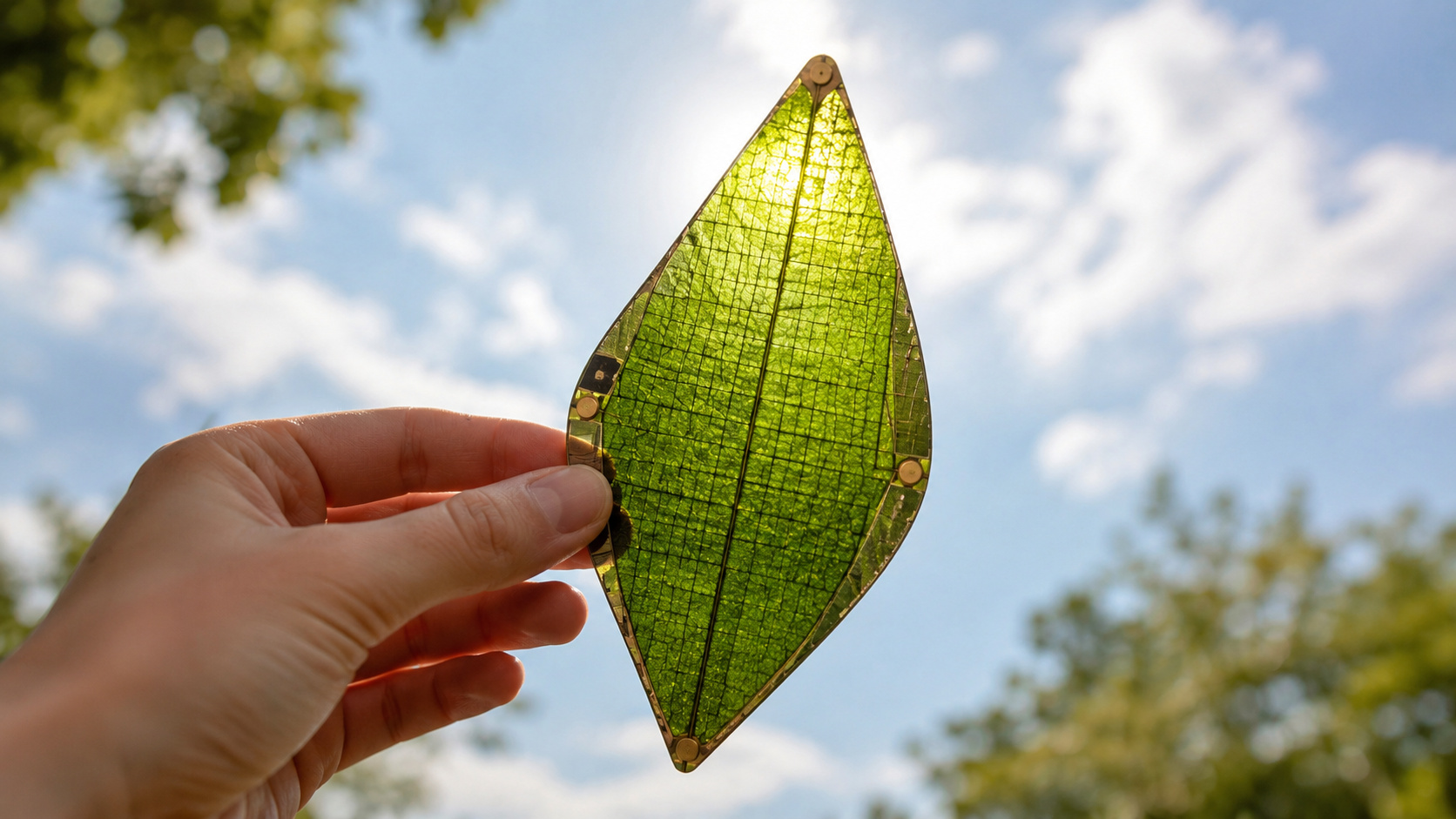

Arya Gurumukhi used the Texas blackout to create a catalyst for the Bionic Leaf, clean energy technology that mimics photosynthesis.
The blackout that hit Texas in 2021 was not just a memory of cold and insecurity for Arya Gurumukhi. The young woman, who would later win the Gloria Barron Prize 2024, spent a week with her family in an apartment without heating and turned this experience into a starting point to research a more stable and sustainable energy source.
It was from this search that her contribution to the Bionic Leaf was born, a solar technology inspired by photosynthesis. Arya did not create the original platform, but developed a new catalyst to make it more efficient and more applicable to contexts of energy insecurity, especially in low-income communities and remote areas.
How the Texas blackout in 2021 led Arya Gurumukhi to research clean energy, energy storage, and energy security
Arya reported that she began to delve into the field of energy storage around the age of 13, when the winter storm in Texas exposed the fragility of the electrical supply. The episode led her to study more closely the failures of existing systems and to seek alternatives that could reduce the risk of energy collapse.
-
Brazilian Students Develop Process to Turn Styrofoam Waste into Water-Purifying Charcoal

-
Study Warns: Wi-Fi Routers Can Act as Invisible Radars, Identifying People with 99.5% Accuracy Without Cameras or Wearable Devices

-
Brazilian Researchers Develop Cost-Effective Method for Key Component of Green Hydrogen Electrolyzers, Enhancing Energy Efficiency and Equipment Longevity

-
1,700-Year-Old Roman Mosaic Discovered by Farmer Planting Cherry Trees in Turkey



The motivation was not limited to what she experienced in the United States. In an interview with Authority Magazine, Arya said that a visit to her grandmother in a rural area of India reinforced her perception that the lack of energy directly affects health, comfort, and opportunities, especially in regions with limited infrastructure.


This intersection of personal experience and scientific research shaped the central axis of the project. Instead of treating clean energy as just an abstract theme, Arya began to work with the idea of a solution that could be sustainable, secure, and accessible for those who suffer most from supply failures.
What is the Bionic Leaf and what was Arya Gurumukhi’s real contribution to clean fuel technology
The Bionic Leaf is described by barronprize as a solar-powered device that attempts to artificially replicate the logic of photosynthesis. Its goal is to generate an alcohol-based fuel using water, sunlight, and bacteria, in a clean energy proposal aimed at reducing dependence on fossil fuels.
What Arya created was a novel bifunctional catalyst to improve the system’s performance, not the Bionic Leaf itself. This difference is central to understanding the exact dimension of her contribution.
In Arya’s explanation, the current generated by solar energy acts on catalysts submerged in water, producing hydrogen. Then, bacteria present in the system consume this hydrogen and convert it into an alcoholic fuel, combining chemistry and biology in a cleaner energy production process.
From inspiration in photosynthesis to the University of Texas laboratory with 100 iterations of the Bionic Leaf prototype
After studying the problem, Arya had the insight that would guide her research by observing leaves in a park and reflecting on the efficiency with which plants transform light into energy. The question that began to guide the project was simple and powerful: why not reproduce this process artificially to generate useful energy?

From there, she began reading scientific journals online, sending messages to dozens of professors, and working in a laboratory at the University of Texas.
According to the Barron Prize, the progress did not come quickly: it took one year of research and 100 iterations for the prototype to economically produce 3 mg/L of raw fuel.
This data does not represent large-scale production, but it proves the experimental logic of the project. The trajectory described in the sources shows that the invention advanced through trial, correction, and repetition, in a typical process of real scientific development, not an instant discovery.
Regeneron ISEF 2024, Gloria Barron Prize and the scientific awards that consolidated Arya Gurumukhi’s project
The broader recognition came in 2024, when Arya won the Gloria Barron Prize for Young Heroes. In the official award presentation, she is featured as the young woman who invented a new catalyst to improve the Bionic Leaf, focusing on providing a clean and sustainable energy source to vulnerable populations.
In the same year, the research was also awarded at the Regeneron ISEF 2024, one of the world’s leading student science fairs. The Society for Science recorded that Arya received the 4th award of $500 in the category Energy: Sustainable Materials and Design, with the project “The Bionic Leaf.”
This recognition is important because it shows that the work was not limited to a good personal narrative. It also passed the scrutiny of scientific competition environments, with formal evaluation within a category focused on sustainable materials and energy solutions.
Why Arya Gurumukhi decided to publish the research as open source and bring the Bionic Leaf to communities with energy insecurity
One of the strongest aspects of Arya’s journey is the decision to not patent the work immediately. According to the Barron Prize, despite receiving advice to sell or patent the research, she chose to publish it as open source, allowing others to use and expand the idea.
This choice was aligned with the purpose that the young woman herself described in an interview. Arya said that, for her, making a difference means providing a stable, safe, and sustainable energy source to low-income communities, often neglected, and stated that her new catalyst makes the Bionic Leaf more practical for this context.
According to the Barron Prize, more than 15 communities in South Sudan have already started their own means of energy production through the Bionic Leaf associated with Arya’s work.
What Arya Gurumukhi’s invention already demonstrates about decentralized renewable energy and what still needs to advance
The project draws attention because it proposes an energy route based on relatively simple inputs, such as water, sunlight, and bacteria, to produce a useful fuel. This helps explain why the Bionic Leaf has gained ground in discussions about decentralized renewable energy and solutions for regions where the power grid is unstable or insufficient.
The result of 3 mg/L shows a relevant proof of concept, but does not authorize treating the solution, at this moment, as an already consolidated response on a global scale. This is an inference based on the experimental stage described in the consulted sources.
Arya Gurumukhi converted an experience of vulnerability lived in the dark during the Texas blackout into an award-winning scientific project, with declared social application and potential real impact on the debate about clean energy, sustainable fuel, and energy security.