Portuguese
  Spanish


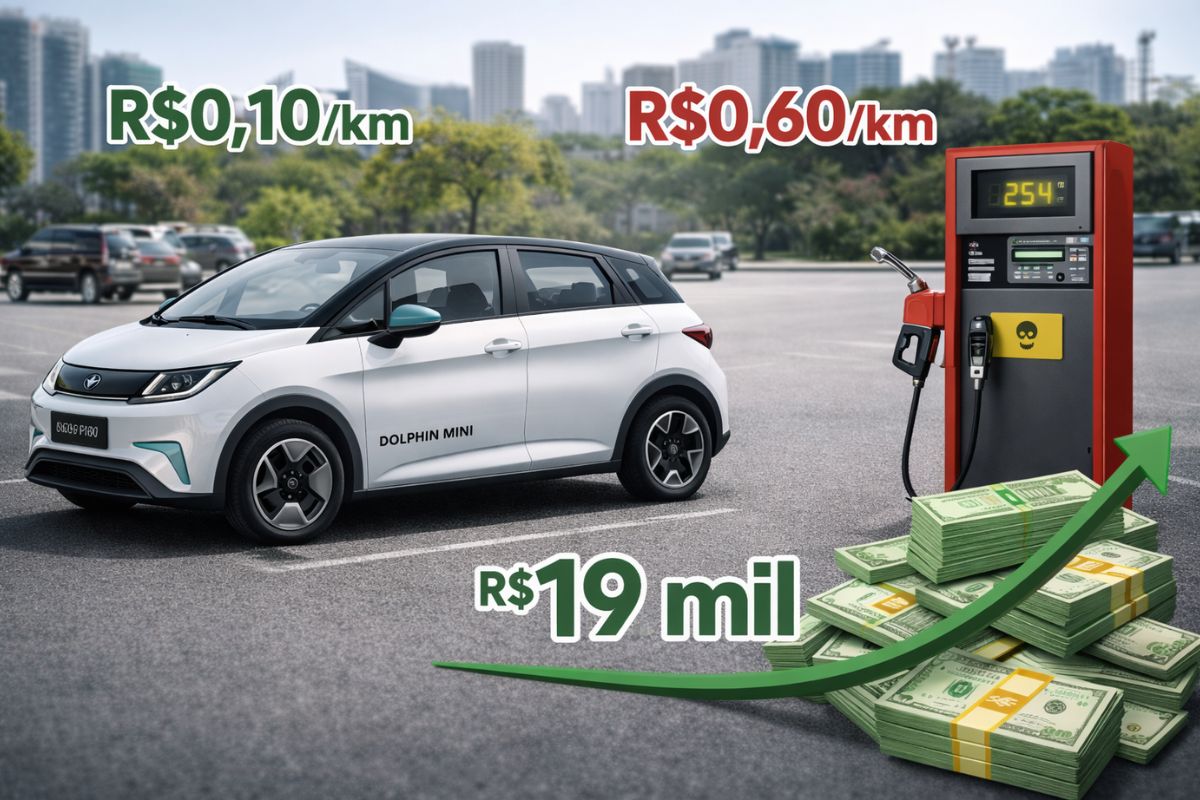

In a video with over 236 thousand views, Peter Jordan placed the spreadsheet side by side and calculated that an electric car in 2026 in Brazil could cost 80% less per kilometer driven than its combustion equivalent.
Peter Jordan, host of the Nerds de Negócios channel and owner of Ei Nerd, published on April 12, 2026, a financial analysis of the real cost of driving an electric car in Brazil. He used the BYD Dolphin Mini and the Volkswagen Polo as a basis, comparing fuel, maintenance, IPVA, and depreciation over 5 years. The cost per kilometer for the electric vehicle was around R$ 0.10, compared to R$ 0.50 to R$ 0.60 for gasoline.
By adding all the operational costs with the Brazilian average of 12,775 km driven per year, the savings of the Dolphin Mini over the Polo reaches R$ 19,000 in 5 years. For those driving 20,000 km per year, typical of app drivers, the difference exceeds R$ 40,000.
Why does the cost per kilometer of the Dolphin Mini stay at 10 cents?

The Dolphin Mini consumes about 9.6 kWh for every 100 km. With the residential rate around R$ 0.80 per kWh, driving one kilometer costs between 8 and 10 cents.
-
End of an era in Brazil: beloved sedan by Brazilians is discontinued despite having a 2.0 engine with 151 hp, CVT transmission, 466-liter trunk, and up to 650 km of range.

-
New Law Proposal in Brazil Could Heavily Penalize Drivers: Dangerous Overtaking May Become a Serious Offense with Fines Increased Tenfold and a 12-Month License Suspension; Update on 2026 Progress

-
Electric Revolution: Watts W125 Motorcycle Offers 160 km Range, 90 km/h Speed, and Affordable Price Starting at $3,000
-
General Motors Replaces Over a Thousand Workers with 50 Cobots at Electric Vehicle Plant, UAW Union Criticizes Move Amid Industry’s Automation Push


One thousand kilometers per month costs between R$ 80 and R$ 100. A popular gasoline car, with an average consumption of 10 to 12 km per liter and fuel at R$ 6, spends between R$ 400 and R$ 500 on the same route.
Charging at home during the night, when several distributors offer lower white tariffs, increases savings. A 55-liter tank at the gas station costs about R$ 340 today. Charging the Dolphin Mini’s battery at home costs between R$ 30 and R$ 80.
The annual maintenance of the electric car is around R$ 0.03 per km, compared to R$ 0.07 to R$ 0.08 for combustion engines, according to total cost of ownership studies mentioned in the video. This results in R$ 3,000 less over 5 years just in this item.
What the spreadsheet doesn’t say about the ‘zero IPVA’ for electric cars?
Here, an important adjustment is necessary. The video states that São Paulo, Rio de Janeiro, and the Federal District have total IPVA exemption for electric vehicles.
This information is not exactly correct. Only the Federal District offers total exemption for 100% electric vehicles, and even then only for vehicles purchased from dealerships in the DF.
São Paulo does not exempt electric vehicles. The state only applies exemptions for flex hybrids manufactured in Brazil up to R$ 261,154.45, a rule that practically benefits the Toyota Corolla and Corolla Cross, and the benefit expires in 2026. Rio de Janeiro reduced the rate to 0.5% for electric vehicles and 1.5% for hybrids, without eliminating it.
In total, 16 states plus the Federal District offer some tax benefit. Pernambuco, Paraíba, Rio Grande do Norte, Rio Grande do Sul, Sergipe, and Bahia provide total exemption for 100% electric vehicles, with a value cap in some cases.
Does the BYD factory in Camaçari change the game for the Brazilian consumer?


BYD registered 37,637 vehicles in the first quarter of 2026 in Brazil, a growth of 73.67% over 2025. In March alone, there were 16,406 units, a monthly record for the brand in the country.
The Dolphin Mini accumulated 12,111 units in the quarter and led monthly retail in February and March, coming in second in the quarter’s total, behind the Hyundai Creta by 193 units.
The Camaçari factory in Bahia, where Ford previously operated, began production in July 2025 with an investment of R$ 5.5 billion in 4.6 million m². The first phase delivers 150,000 vehicles per year.
The second phase will increase to 300,000, and the plan announced by founder Wang Chuanfu to President Lula points to 600,000 annual units. The brand already operates 211 dealerships in the country, according to Tyler Li, president of BYD Brazil. Local production reduces import tax and accelerates the price drop of electric vehicles in Brazil.
The calculation from Peter Jordan works for those who drive more than 10,000 km per year, have a 220V outlet at home, and live in a large city. Those who drive little and depend on public chargers outside the capitals still face real barriers.
And you, have you calculated your current car against an electric one or do you still think it’s too early to switch? Comment if the biggest hurdle is the purchase price, the range, or the lack of charging stations in your area.