Portuguese
  Spanish


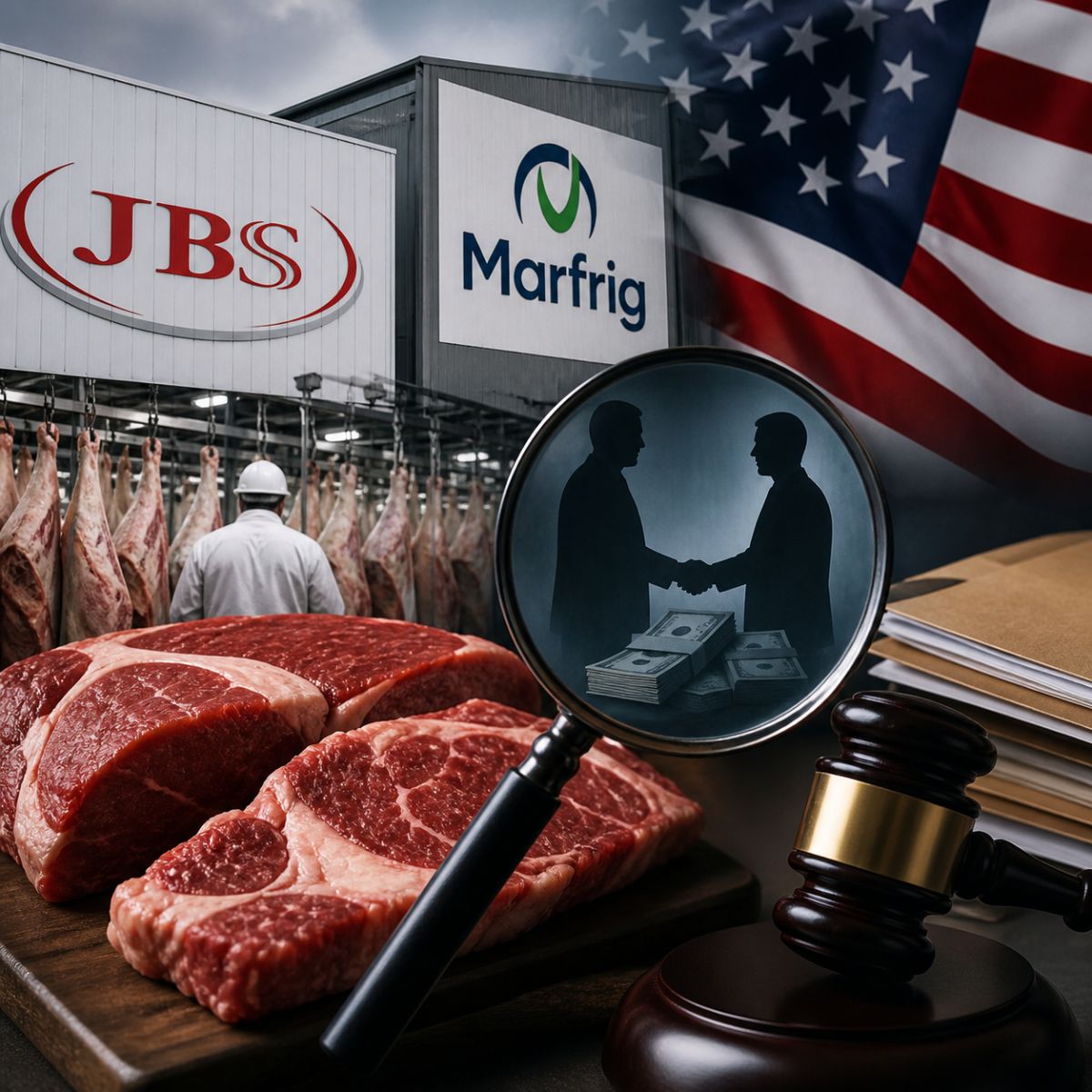

The United States Department of Justice (DOJ) confirmed a criminal antitrust investigation against the country’s four largest meatpackers, including JBS and Marfrig (controller of National Beef), on suspicion of price-fixing, bid manipulation, and market division in the American beef supply chain. The announcement was made by acting Attorney General Todd Blanche at a White House press conference, alongside Secretary of Agriculture Brooke Rollins and advisor Peter Navarro. The meeting between Trump and Lula is scheduled for May 7, 2026.
The criminal investigation against JBS and Marfrig in the United States strains the agenda of the meeting between Trump and Lula scheduled for Thursday (May 7) in a way neither side anticipated. The DOJ confirmed it is investigating the country’s four largest meatpackers — Tyson Foods, JBS USA, Cargill, and National Beef Packing, the latter majority-controlled by Marfrig — on suspicion of price-fixing, bid manipulation, market division, and procurement fraud in the American beef supply chain.
What turned the investigation into a diplomatic crisis were the statements made at the White House press conference. Peter Navarro, senior advisor for trade and manufacturing, publicly accused JBS of distributing “millions of dollars through the American political system” and characterized the Brazilian companies as “a much larger part of the problem.” Brooke Rollins, Secretary of Agriculture, framed foreign ownership of meatpackers as a “threat to the United States” and declared that “food security is national security.” When contacted, JBS and Marfrig (MBRF group) declined to comment.
What the DOJ investigates and why it is criminal
The investigation is not administrative: it is criminal. The DOJ is investigating four specific conducts: price-fixing, bid-rigging for cattle purchases, market allocation, and procurement fraud. Prosecutors have already analyzed over 3 million documents and interviewed hundreds of American ranchers who allege anti-competitive practices by the four large meatpackers.
-
Brazilian Farmer Invents Low-Cost Tractor Using Motorcycle Parts, Efficiently Working 2 Acres on 1 Liter of Diesel

-
Regenerative Farmers Use Keyline Plow to Improve Pasture Hydration, Storing 1 Gallon of Water Every 30 Centimeters

-
Bicolor Pumpkin Resembling Hand-Painted Art Discovered by Brazilian Researchers in the Capital Due to “Spontaneous Mutation”

-
In China, a 26-story building produces 1.2 million pigs annually, revolutionizing livestock farming with tube feeding and AI surveillance.

Todd Blanche, acting Attorney General of the U.S., asked whistleblowers to come forward through the DOJ‘s whistleblower program, which offers rewards of 15% to 30% on criminal fines above US$1 million. The investigation was ordered by President Trump in December 2025, through an executive order that directed the DOJ to investigate “illicit collusion” in the food supply chain, in the context of rising meat prices for American consumers.
The statements that turned the investigation into a diplomatic crisis
The press conference at the White House was the moment the investigation ceased to be a regulatory issue and became a geopolitical one. Navarro declared that “Brazilians are a much larger part of the problem” and accused JBS of making massive political donations in the U.S., a statement that implies undue influence in the American political system and which the Brazilian company did not publicly refute.
Rollins was equally harsh in classifying foreign concentration in American meatpackers as a threat to national security: “Half of the industry’s giants have foreign ownership or control, making them a threat not only to our cattle producers but a threat to the United States.” The statement frames JBS and Marfrig not as commercial partners, but as risks to American food sovereignty, a change in tone that complicates any diplomatic negotiation between the two countries.
The concentration that fuels suspicion
The numbers supporting the investigation are significant. The four meatpackers control about 85% of cattle processing in the United States, a concentration that jumped from 25% in 1977 to current levels, according to USDA data. The four **companies** operate through approximately 70 subsidiaries, and **JBS** **and** **Marfrig** account for a significant portion of this total with operations that include dozens of processing plants in American territory.
On the other side of the chain, American ranchers face a severe crisis. The U.S. cattle herd fell to 27.6 million head in January 2026, the lowest level since the 1950s. More than 100,000 cattle farms have closed in the last decade, representing a loss of 17% of ranchers, according to R-CALF USA data. The disparity between the concentration of **meatpackers** and the fragmentation of producers is the central argument of the investigation: those who buy have the power to dictate **prices** to those who sell.
The Trump-Lula meeting and the new agenda item
The meeting between **Trump** and **Lula** was scheduled for Thursday (May 7) with an agenda focused on tariff relief, cooperation on rare earths, and the possible designation of **Brazilian** criminal factions as terrorist organizations. **Navarro’s statement against JBS injected an item that Itamaraty did not expect and that could derail the rapprochement** that **Brazil** had been building with the new American administration.
For **Brazilian** diplomacy, the challenge is to isolate the criminal investigation against **JBS** **and** **Marfrig** from the broader trade agenda between the two **countries**. **Brazil is one of the world’s largest meat exporters to the U.S.**, and any regulatory retaliation affecting the operations of **JBS** and **National** **Beef** on American soil would have a direct impact on the trade balance and sector jobs in **Brazil**. **Itamaraty** has not publicly commented on the investigation’s impact on the meeting’s agenda.
The impact on the stock market and what analysts say
The **market’s** reaction was immediate. **Shares of JBS (BDR JBSS32) and MBRF (MBRF3, ticker for the Marfrig + BRF group on B3) came under pressure** on Monday. **Goldman** Sachs signaled that the perception of risk regarding the protein sector tends to remain high as the investigation progresses. **Bradesco** BBI assessed that the case might be short-term noise but reiterated a cautious view on the sector.
For investors, the risk goes beyond fines. **An antitrust criminal conviction in the U.S. can result in operational restrictions, prohibition from participating in public contracts, and reputational damage** that affects the **companies’** ability to operate in the world’s largest **meat** consumer **market**. **JBS** is the largest **meatpacker** on the planet, and the **U.S.** is its primary **market**. **Marfrig** controls 51% of **National** **Beef**, the fourth-largest American processor. Any unfavorable outcome would have a disproportionate impact on the two **Brazilian** **companies**.
What’s next and the Agri Stats case
The **DOJ** did not provide a deadline for formal charges but signaled that a settlement with **Agri** Stats, an Indiana data **company** sued since 2023 for alleged aiding and abetting collusion among poultry and pork **meatpackers**, could be announced this week. **The Agri Stats case trial is scheduled for May 18, 2026,** in the U.S. District Court for the District of Minnesota, and is a separate proceeding from the new investigation against the big four of **beef**.
The investigation may also extend to the chicken, pork, and turkey **markets**, according to **Blanche**. **For JBS and Marfrig, the coming months will determine whether the investigation results in a formal lawsuit or if the companies manage to negotiate a settlement** that limits the damages. Until then, regulatory uncertainty in the **U.S.** will weigh on shares, diplomacy, and the reputation of **Brazilian** agribusiness abroad.
Do you think the investigation against JBS and Marfrig in the U.S. is a matter of antitrust justice or protectionism against Brazilian companies? Tell us in the comments what you think about Navarro’s statements against JBS and if you believe the Trump-Lula meeting will be able to separate diplomacy from criminal investigation.