





 English
  7 min of reading
  0 comments


The three ships connect Airbus factories in France and the United States and combine alternative fuel, wind-powered rotors, and artificial intelligence routing. The promise of emission reduction is high, but it depends on calculation assumptions and the advancement of a clean methanol chain.
Airbus will start transporting wings, fuselages, and other large parts of its planes across the Atlantic in new cargo ships built by a Chinese shipyard in Wuhan, powered by methanol and equipped with six 35-meter-high rotating sails. According to a report by Paulo Morgan published on June 9, 2026, the second of these ships, the Spirit of Mobile, was launched the previous Friday at the Wuchang naval group’s facilities on the banks of the Yangtze River, as part of a program aiming to halve the maritime carbon footprint of one of the world’s largest aircraft manufacturers.
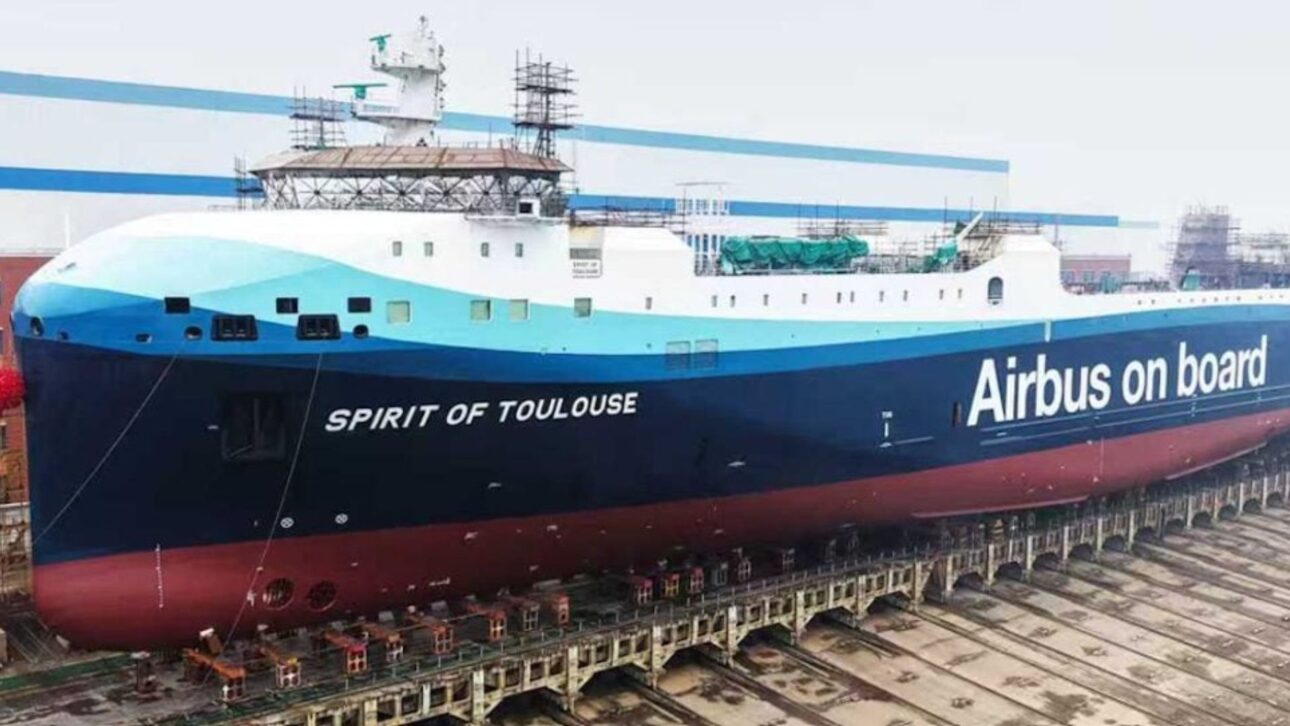
According to the publication, the cargo ships were ordered by the French shipowner Louis Dreyfus Armateurs, LDA, from the Wuchang shipyard, a subsidiary of the state-owned China State Shipbuilding Corporation. The three ships, named Spirit of Toulouse, Spirit of Mobile, and Spirit of Mirabel, are named in honor of central cities in the manufacturer’s production system. They will operate on the route between Saint-Nazaire, France, where Airbus manufactures the main subassemblies of the A320 family, and Mobile, in the U.S. state of Alabama, where the aircraft undergo final assembly before delivery to customers.
Three ships to connect Airbus factories
In October of that year, the manufacturer chose LDA to renew the entire chartered fleet that serves its logistics in the Atlantic, which committed the shipowner to a broad investment plan.
-
Airbus will transport wings and fuselages of its planes across the Atlantic in cargo ships built by a Chinese shipyard in Wuhan, vessels powered by methanol and six 35-meter rotating sails that promise to cut emissions by up to 70 percent per trip.

-
A gas station with fuel made from food waste is in Brazil and transforms 500 tons of waste per month into ethanol, with up to 350 liters per ton processed.
-
Arkansas plans a 50-acre village with up to 400 micro-homes, a clinic, community kitchen, laundry, and income opportunities to help chronically homeless residents regain autonomy.

-
Dark oxygen produced by metallic stones at a depth of 4,000 meters in the Pacific Ocean challenges what was known about the origin of life and puts the race for seabed mining in the Clarion Clipperton Zone in check.


In 2025, LDA underwent a corporate restructuring, with the acquisition of a majority stake of 80 percent by InfraVia Capital Partners, accompanied by an investment plan of 1 billion euros to double the fleet and accelerate the adoption of new technologies.
Regarding the schedule, the publication reports that the three ships are scheduled for staggered delivery.
The first, the Spirit of Toulouse, was launched at sea in early February 2026 and is in the testing phase before delivery, with the expectation of entering service on the Airbus route later this year.
The Spirit of Mobile, newly launched, is expected to undergo commissioning and sea trials before delivery to LDA in November 2026, while the Spirit of Mirabel, still under construction, is expected in 2027.
More cargo capacity per crossing
The new freighters represent an increase in capacity compared to those they will replace, according to the material.
LDA currently operates two ships on this transatlantic route for Airbus, the largest being the Ville de Bordeaux, capable of transporting the equivalent of six complete sets of aircraft subassemblies per trip.
The new ships match this mark in terms of aircraft units, transporting about 70 40-foot containers per crossing.
The report highlights that the gain is in optimizing the available space on both legs of the journey.
By better utilizing the deck and holds on the way there and back, the ships aim to make the operation more efficient, transporting the large subassemblies of Airbus single-aisle jets, such as wings, fuselage sections, engine pylons, and tail assemblies, which travel from Europe to the assembly line in the United States.
The rotating sails that harness the wind
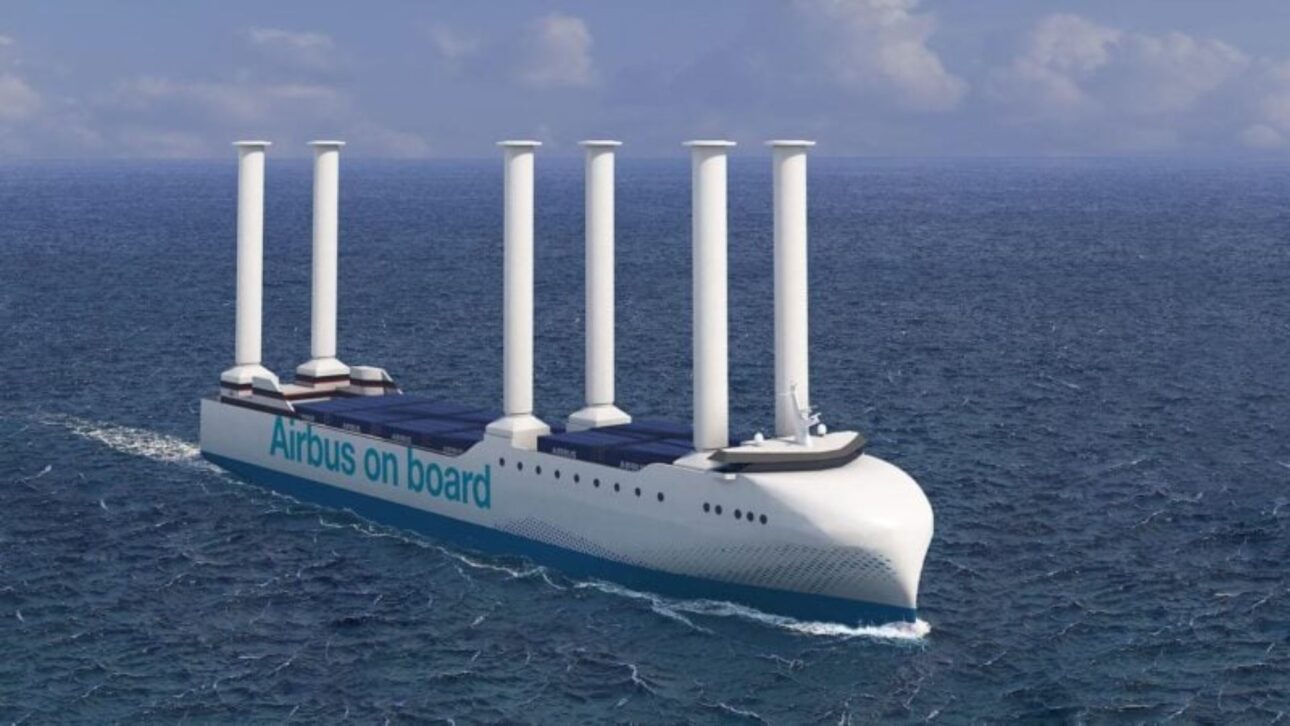
According to the publication, these rotors are supplied by the Finnish company Norsepower and operate based on the so-called Magnus effect, where the motorized rotation of cylinders, combined with side winds, generates a force that is converted into forward thrust.
This allows for reducing the use of the main engines without loss of ship speed.
The source itself addresses the gain of this technology with due measure, without exaggeration.
According to the report, Norsepower estimates that the rotor sails contribute something between 15 and 20 percent of the propulsion energy on a transatlantic route with typical North Atlantic winds, a value that depends on sea and weather conditions.
The rotors are made with carbon and glass fiber composites, include recycled materials, and the publication highlights that six of them on a single ship of this size are unprecedented in commercial navigation so far.
Methanol and the limits of what it solves
The propulsion system is dual-fuel, and this is a point where the report makes sure to separate fact from promise.
According to the material, the four engines of the vessels, two main and two auxiliary, can operate with both marine diesel oil and methanol.
The main environmental advantage of methanol is the absence of sulfur, which eliminates sulfur oxide emissions when the fuel is used, although the scenario regarding nitrogen oxides is more complex.
It is precisely on this point that the publication warns against inflated claims.
According to the report, burning methanol produces fewer nitrogen oxides than conventional fuels, with manufacturer tests suggesting reductions between 30 and 60 percent, but full compliance with the stricter limits of the International Maritime Organization usually requires additional post-treatment technologies.
The source states that claims of over 80 percent reduction attributed solely to methanol combustion are unproven and should be viewed with caution.
From gray methanol to e-methanol, the difference that defines the outcome
Another important warning from the report concerns the origin of the methanol, which completely changes the environmental balance.
According to the material, the vessels should start operating with marine diesel oil while the methanol supply infrastructure develops, gradually transitioning to the so-called e-methanol, produced with renewable electricity and captured carbon.
This distinction is decisive for emissions throughout the entire life cycle of the fuel.
The publication explains that not all methanol is the same from a climate perspective.
Methanol derived from natural gas, known as gray methanol, has life cycle emissions similar to those of traditional marine fuels, while e-methanol or biomethanol can reduce CO2 emissions by 70 percent or more, depending on the energy source.
Therefore, according to the report, the long-term environmental gain of the program depends on how quickly a reliable e-methanol supply chain will materialize for transatlantic navigation.
The emission reduction numbers in perspective
It is important to separate the two cited reduction percentages because they refer to different things.
According to the publication, replacing the old fleet with the three new ships should reduce the average annual CO2 emissions on the crossing from about 68,000 tons in 2023 to approximately 33,000 tons in 2030, which represents a cut of about 50 percent for the entire fleet.
This is the number that applies to the operation as a whole.
The reduction of up to 70 percent refers to each individual vessel, compared to the previous generation.
The report itself notes that this percentage, although significant, includes assumptions from life cycle modeling and should be read with caution.
In other words, it is a projection based on ideal operating and fuel supply conditions, not a result already measured in practice over years of service.
The engineering behind the ships
In addition to wind and methanol, the cargo ships incorporate a set of efficiency solutions, according to the material.
The project was developed by the Finnish naval architecture company Deltamarin, with classification by Bureau Veritas and propulsion integration by BERG.
The vessels also feature a heat recovery system from exhaust gases to generate additional electrical energy, as well as high-efficiency propellers made from recycled steel and low-friction hull coatings.
The brain of the operation is an artificial intelligence routing system, which seeks to make the most of the wind.
According to the publication, this system adjusts in real-time the speed, course, and operation of the rotating sails according to weather and sea conditions, maximizing the contribution of wind propulsion and reducing resistance throughout each journey.
The launch of the Spirit of Mobile was done using the inclined ramp method, a standard practice at the Wuchang shipyard.
The Airbus cargo ship program is, at its core, a large-scale test of whether wind propulsion and alternative fuels can sustain themselves together in a demanding industrial operation.
The combination of rotating sails, methanol, and artificial intelligence promises significant emission cuts, but the source itself makes it clear that the higher numbers depend on assumptions and the advancement of a clean fuel chain.
The result will be closely monitored by the naval and aerospace industries.
And you, do you believe that the combination of rotating sails and methanol can really make maritime transport cleaner? Comment on what you think of this project that brings together a French shipowner, a Chinese shipyard, and a European aircraft manufacturer, if you consider the technology promising and how you imagine the future of low-carbon navigation. The conversation is open to all those interested in technology, industry, and the environment.


Be the first to react!