Portuguese
  Spanish


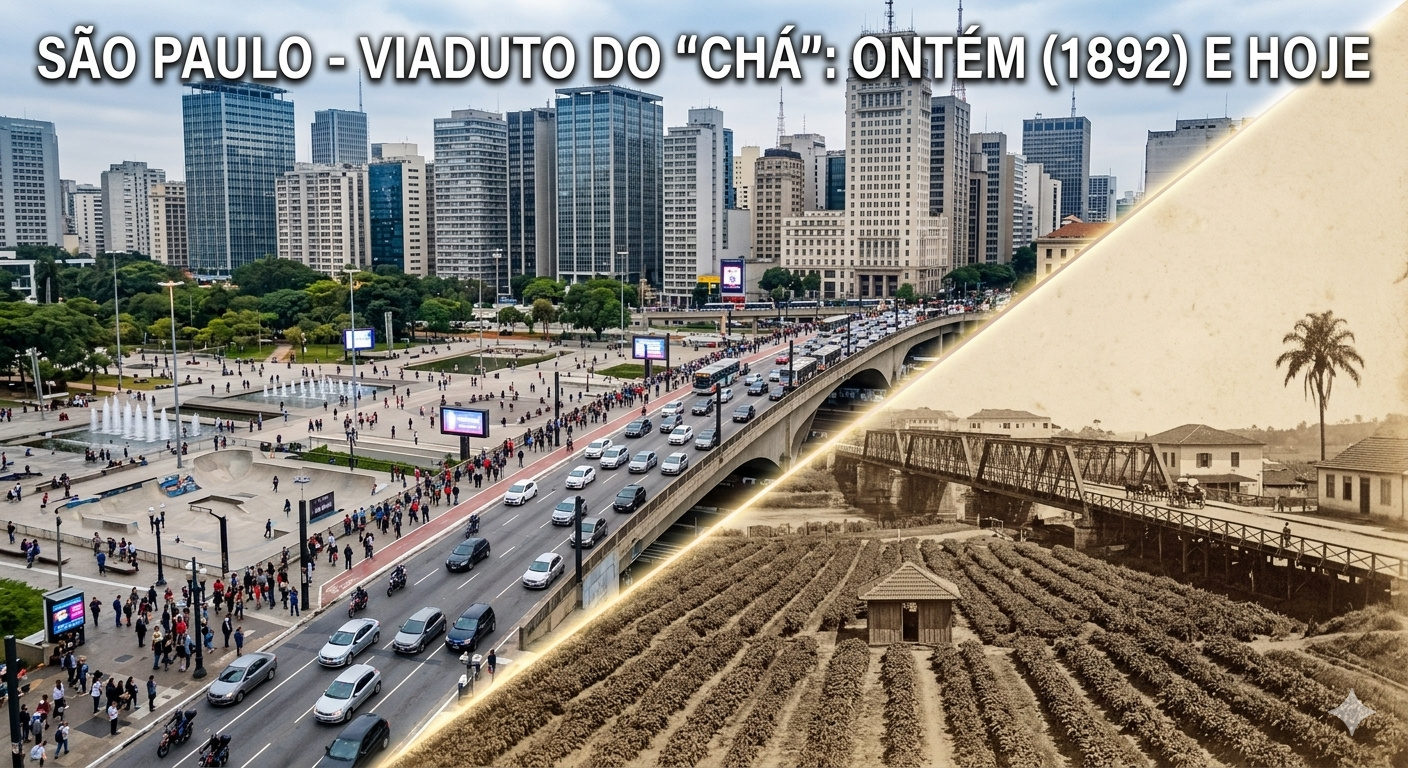

Viaduto do Chá, inaugurated in 1892, connected the Old Center to the New Center and marked the urban expansion of São Paulo.
On November 6, 1892, the city of São Paulo inaugurated a work that redefined its urban expansion: the Viaduto do Chá, the first structure of its kind built in the Paulista capital and a decisive link between the Historic Triangle, in the so-called Old Center, and the then New Center, on the other side of the Anhangabaú Valley. According to the official Cidade de São Paulo page, from the Municipal Secretariat of Tourism, and a report from A Vida no Centro published on March 2, 2023, the original structure was designed by the Frenchman Jules Martin, built of metal, and opened a crossing that allowed the city to overcome the valley that separated central areas in full transformation.
The work was not just a mobility solution. The IBGE Library’s collection records that the viaduct was 204 meters long, connected the old Rua do Chá to Rua Direita, and even charged 60 réis, which earned it the nickname Viaduto dos Três Vinténs (Three Vinténs Viaduct) until passage became free.
By creating a continuous connection over the Anhangabaú, the Viaduto do Chá accelerated urban appreciation, brought commerce, leisure, and pedestrian circulation closer, and helped push São Paulo beyond its old core, at a time when the city was beginning to transform into a metropolis.
-
Bristol Builds 11 Steel Stilt Houses Over Parking Lot, Providing Zero-Carbon Homes for Youth at Risk of Homelessness

-
New York Converts Massive Landfill with 150 Million Tons of Waste into a Giant Park, Concealing Decades of Consumption Beneath Green Hills
-
Experts Share 5 Practical Ways to Detect Hidden Wiring in Walls Before Drilling, Using Simple Techniques and Affordable Devices to Prevent Electrical Damage and Unexpected Costs

-
Brazilian Architect Wins International Award for Empowering Ugandan Women to Build Their Own Homes




240-meter metallic structure overcame the Anhangabaú Valley for the first time
Before the viaduct’s construction, the Anhangabaú Valley functioned as a natural barrier. The crossing between the two parts of the city was made by irregular paths, steep descents, and longer routes.
With the Viaduto do Chá, this limitation was overcome. The 240-meter metallic structure created a direct, elevated, and continuous connection, reducing travel time and facilitating the flow of people and goods.

The idea of building the viaduct came from the Frenchman Jules Martin, who recognized the urban integration potential of the work. However, the project faced resistance.
Landowners in the region opposed the construction, fearing impacts on their areas. The process took years to be approved, showing that large urban works already faced economic and political disputes in the 19th century.
A little-known detail is that the viaduct was not free initially. To cross the structure, it was necessary to pay a toll of three vinténs, equivalent to about 60 réis.
This model helped finance the work and its maintenance. The charge was maintained until 1897, when the viaduct became free for use.
Lighting with 26 gas lamps was considered modern for its time
Another relevant technical aspect is the lighting. The viaduct featured about 26 gas lamps, a technology considered advanced in the late 19th century. This allowed for nighttime use of the crossing, increasing safety and functionality.
The presence of lighting reinforces the urban and planned character of the work, unlike the improvised structures of the time.
Work connected the Old Center to the New Center and accelerated urban expansion


The main function of the viaduct was to integrate two important areas of the city. The Old Center concentrated traditional commercial and administrative activities.
Meanwhile, the New Center began to develop as a new urban area. With the direct connection, the flow between these regions increased significantly, boosting economic growth and urban occupation.
The first version of the Viaduto do Chá was metallic. With the increase in traffic and the evolution of engineering, it was eventually replaced.
The current reinforced concrete structure was inaugurated in 1938. This change reflects the technological transition of Brazilian engineering, which moved from imported metal to locally produced concrete.
Viaduct became a symbol of São Paulo’s transformation into a metropolis
Over time, the Viaduto do Chá ceased to be merely a functional infrastructure. It became an urban landmark.
The crossing came to represent the link between the city’s past and future. The viaduct symbolizes the moment São Paulo began to grow in a more integrated and planned way.

The work also anticipated concepts that would become common in modern urbanism. The idea of overcoming natural obstacles with elevated structures, integrating different areas of the city, began to be replicated elsewhere.
Viaducts, bridges, and tunnels became essential elements in urban expansion, and the Viaduto do Chá was one of the first examples of this logic in Brazil.
Anhangabaú Valley ceased to be a barrier and became the city’s central axis
With the construction of the viaduct, the Anhangabaú Valley ceased to be an obstacle and became an integrated part of the city.
Over time, the region transformed into one of São Paulo’s main urban spaces. The work helped redefine land use, transforming a point of separation into an area of connection.
The case of the Viaduto do Chá demonstrates how a single work can profoundly alter a city. By creating a new connection, it changed flows, valued areas, and influenced urban decisions. Infrastructure not only connects points but redefines how the city functions.
First major urban works paved the way for modern São Paulo
The viaduct is part of a set of interventions that marked the beginning of the city’s modernization. From then on, São Paulo began to invest more in structural works.
These interventions allowed the city to grow on an increasingly larger scale. The Viaduto do Chá is one of the physical foundations of this transformation.
Now the direct question remains: if a single 240-meter structure was capable of changing the course of an entire city in the 19th century, how many of today’s urban decisions still follow the same principle of using infrastructure to completely redesign urban space?