






 Portuguese
  Spanish


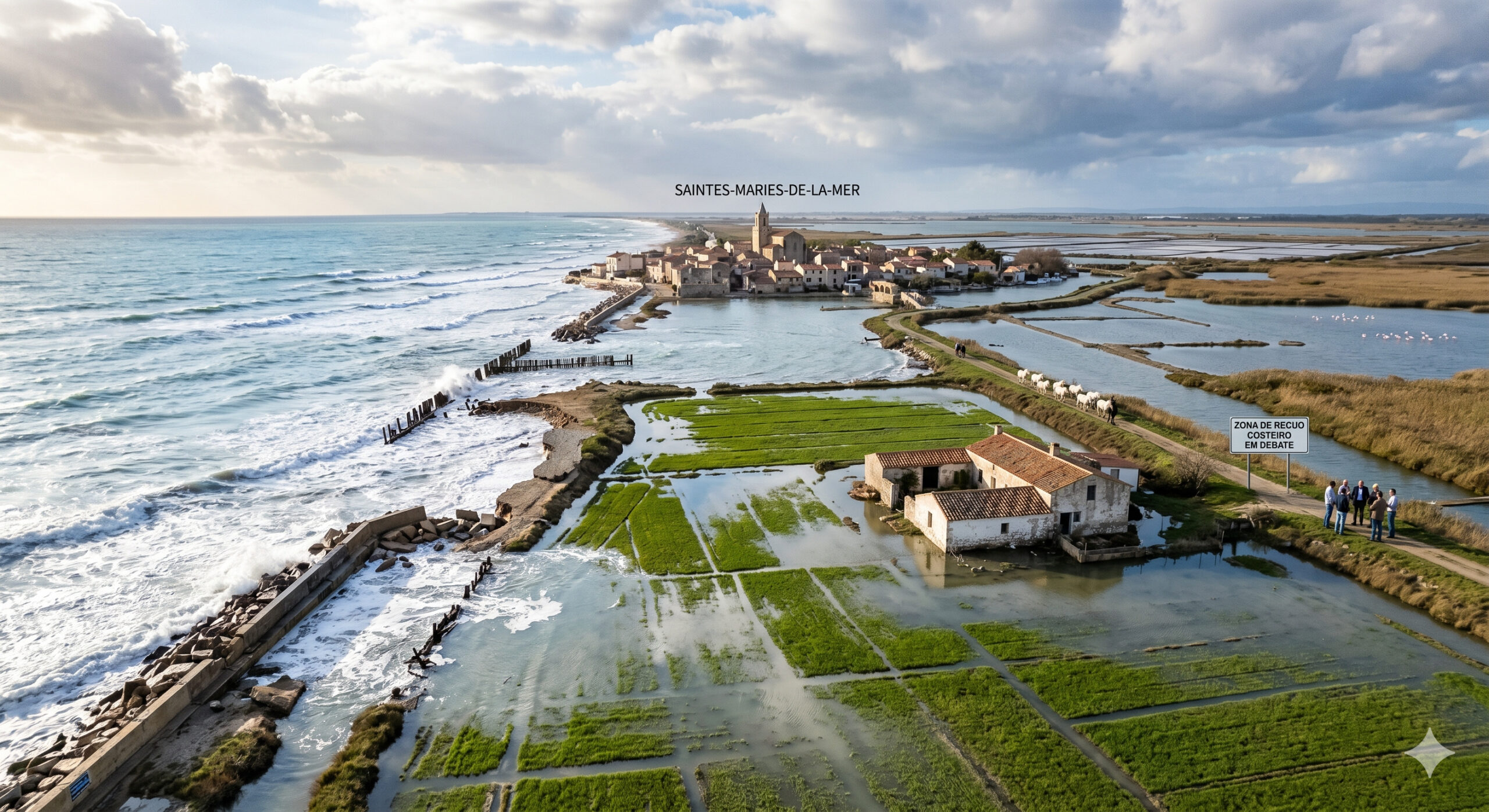

Mediterranean advance threatens Camargue cities, rice paddies, and historic areas as France debates how far it’s still worth defending the coast.
In southern France, in 2025, one of the most symbolic landscapes of the Mediterranean became the center of a silent dispute against the advance of the sea. The Camargue, a region characterized by flamingos, rice paddies, white horses, and wetlands between the arms of the Rhône River, faces accelerated erosion, soil salinization, and increasing pressure from the Mediterranean, according to a report by the French newspaper Le Monde, published on February 15, 2025, which points to coastal retreats of 1 to 5 meters per year in Saintes-Maries-de-la-Mer.
The most serious warning concerns precisely the commune of Saintes-Maries-de-la-Mer, one of the most emblematic areas of the Camargue. According to studies cited by Le Monde, if the sea level rises by 60 centimeters by 2100, about 91% of the municipal territory could be exposed to submersion during average storms, transforming the region into one of Europe’s most delicate cases regarding coastal erosion, climate adaptation, and possible planned retreat from threatened areas.
Camargue born from delicate relationship between river, sea, and wetlands
The Camargue occupies a deltaic area formed by the confluence of the Rhône River with the Mediterranean. Much of the region has a very low altitude. This makes the territory extremely sensitive to changes in sea level and coastal erosion.
-
Key Infrastructure Projects for Brazil’s Next President: Expanding Railways to Cut Transport Costs, Reduce Truck Traffic, Create Jobs, and Boost Industries Nationwide

-
While China Builds Undersea Rail and Mexico Connects Two Oceans, Brazil Struggles with Grain Transport Due to Lack of Railways

-
Students Build Kansas’ First Hemp-Insulated Social House for a Needy Family: 85% Less Concrete, Solar Roof Returns Energy to Grid, Carbon Negative in Under 20 Years

-
China to Drill 90 Kilometers Under the Sea to Connect Two Cities Currently Linked Only by Ferry


Over centuries, sediments brought by the river helped build beaches, lagoons, and flooded areas that support unique biodiversity. The problem is that this natural balance has started to face increasing pressure in recent decades.
Mediterranean advances and coastline continuously loses ground
According to data cited by Le Monde, some sectors of the Camargue coast record erosion of up to 5 meters per year.
More intense storms, reduced Rhône sediments, and gradual sea-level rise are among the factors pointed out by experts.
In certain areas, dunes have partially disappeared, and the ocean has begun to advance over previously stable stretches. This process alters roads, buildings, agricultural zones, and coastal ecosystems.
Parts of the Camargue have begun to continuously and measurably lose ground to the Mediterranean.
Saintes-Maries-de-la-Mer entered the center of the French climate debate
The commune of Saintes-Maries-de-la-Mer has become a symbol of the problem. The town receives tourists from all over the world due to its cultural traditions, beaches, and historical importance.
However, climate projections have begun to indicate an increasing risk of coastal flooding. According to estimates cited by Le Monde, a sea-level rise of about 60 centimeters by the end of the century could leave 91% of the city vulnerable during moderate storms.
This data has transformed the city into one of the most dramatic examples of European coastal vulnerability.
Salinization threatens rice paddies and traditional agricultural activities
The Camargue does not depend solely on tourism. The region also has highly specialized agriculture, mainly rice cultivation.
With the advance of saltwater, scientists and producers report a gradual increase in soil salinization. This compromises agricultural productivity and alters the local water balance.
In addition to rice paddies, traditional horse and bull breeding areas also face increasing environmental impacts. The change threatens not only cities but the entire historical economy of the region.
Flamingos, lagoons, and biodiversity are also under pressure
The Camargue is home to one of Western Europe’s most important wetlands. Brackish lagoons and flooded areas support migratory birds, including large flamingo populations. Changes in the balance between fresh and saltwater can profoundly alter these ecosystems.
Furthermore, erosion and extreme events affect sensitive coastal habitats. The climate crisis in the Camargue blends human heritage and ecological transformation simultaneously.

The Camargue case has opened a delicate national debate. Experts question how long it will still be possible to protect certain coastal areas using barriers, dikes, and engineering works.
Some advocate for a massive reinforcement of sea defenses. Others argue that certain regions may need to undergo planned retreat strategies in the future.
The central question is no longer just “how to defend the coast” but has come to include “for how long to defend.”
Coastal works try to slow down the Mediterranean’s advance
Local and regional authorities have been investing in reinforcing dunes, natural barriers, and containment structures.
Sand replenishment projects have also been used on some beaches. These initiatives aim to reduce the impact of storms and slow down erosion.

However, experts warn that such measures often function only as temporary containment in the face of prolonged climate change. Much of the current strategy seeks to buy time against a process considered to be increasing.
Camargue became a European laboratory for climate adaptation
French researchers have begun to use the region as a laboratory to study coastal adaptation. Climate models, erosion monitoring, and urban planning have started to guide local decisions.
The goal is to understand how low-lying and highly vulnerable regions can react to the gradual rise in sea level.
The Camargue has become a reference because it combines tourism, agriculture, historical heritage, and fragile ecosystems within the same territory. What happens there today can anticipate future challenges for various coastal regions worldwide.
Rhône Delta lost part of its historical natural protection
Another problem identified by researchers involves the reduction of sediments brought by the Rhône river. Dams, hydrological alterations, and human works have diminished part of the natural replenishment of coastal material.

This weakens beaches and dunes that historically helped contain the sea’s advance. Without sufficient sedimentary replenishment, the coastline becomes more vulnerable to erosion.
The very natural dynamic that formed the Camargue has begun to lose strength in the face of human and climatic changes.
Region shows how climate change is already altering iconic European landscapes
For decades, sea-level rise was often associated with small tropical islands or distant regions. The Camargue shows that iconic European landscapes have also begun to be at risk.
The current debate already involves infrastructure, cultural heritage, agriculture, and potential future territorial reorganization.
The French region has become one of the clearest examples of how coastal changes have ceased to be distant projections and are now reshaping real territories.
Given the situation in the Camargue, do you believe that engineering works will be able to protect historical coastal regions during the next century, or will some areas of the planet inevitably have to accept retreat in the face of the advancing sea?


