Portuguese
  Spanish


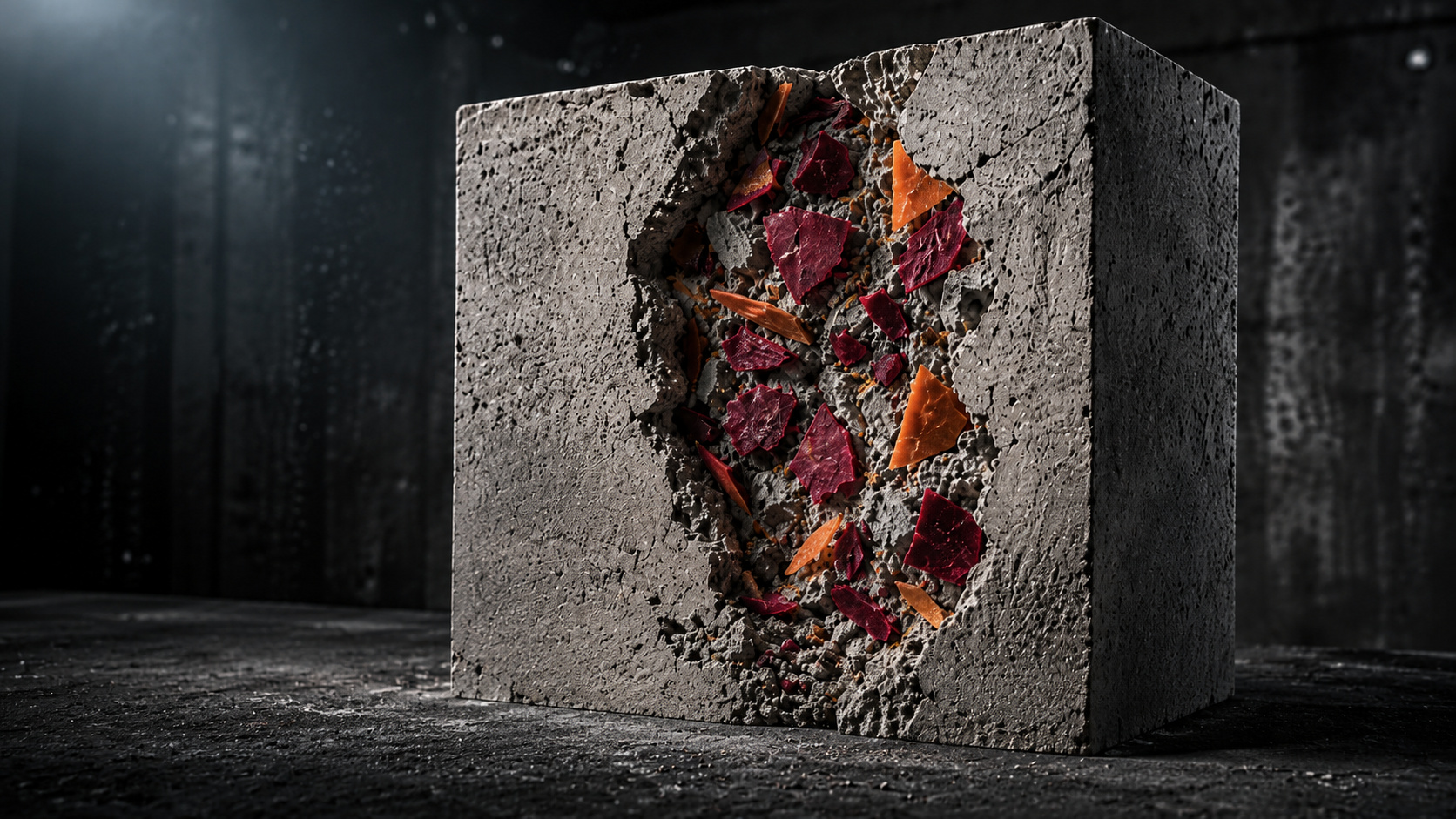

Why cement has become one of the biggest environmental challenges in civil construction
In 2018, researchers from Lancaster University in the United Kingdom presented a discovery that seemed unlikely even to construction material experts. Using nanoplatelets extracted from vegetable fibers found in carrots and beets, the team demonstrated that agricultural waste could significantly enhance concrete performance while simultaneously reducing the amount of cement needed in construction.
The research drew attention because it challenges one of the most expensive trends in modern engineering. While much of the industry seeks to reinforce concrete with advanced materials like graphene, carbon nanotubes, and synthetic nanofibers, British scientists discovered that microscopic structures derived from common vegetables can yield comparable or even superior results in certain applications, using an abundant and low-cost raw material.
How carrots and beets entered concrete engineering
The work was conducted by researchers from Lancaster University in partnership with the company CelluComp, specializing in nanomaterials derived from vegetable fibers. The team used nanoplatelets extracted from carrot and sugar beet waste to be incorporated into cement mixtures during concrete production.
-
Denmark Constructs World’s Largest Immersed Tunnel to Connect with Germany, Sinking 217-Meter Concrete Sections in the Baltic Sea

-
Low-Cost Concrete Panel House Goes Viral: Investor Reveals Prefabricated Kit Structure for Around $1,500, Assembled in 30 Days, with Plans for Rental and Resale Income

-
Polymeric Mortar Revolutionizes Brazilian Construction with Efficient, Clean Application and Uniform Finish

-
Biologist Builds 160m² Dream Home in Brazil for $32,000 Using Eco-Friendly Bricks, Achieving 67% Savings Through Smart Planning and Simple Solutions



These nanoplatelets have extremely small dimensions and exhibit a high surface area. When dispersed in the mixture, they influence the cement hydration process, helping to organize the internal microstructure of the material. The result is a denser concrete with fewer microscopic voids.
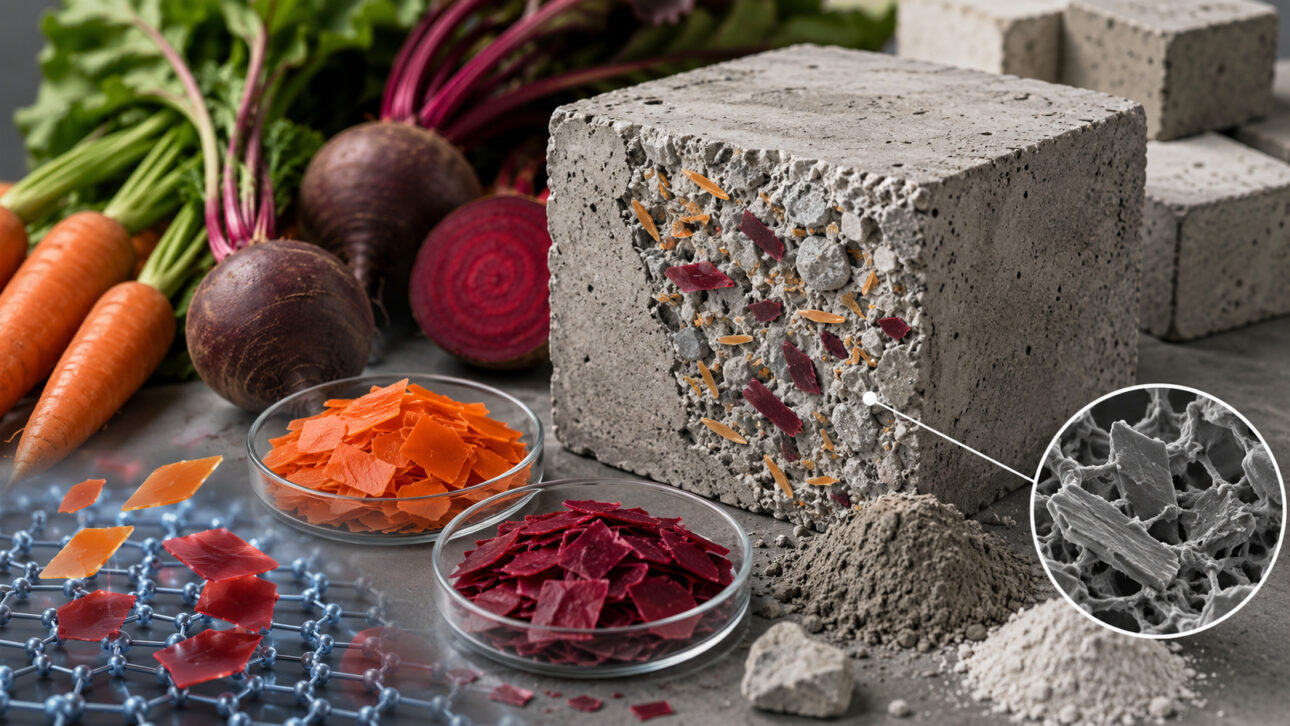
According to the researchers, the observed behavior is different from the simple addition of conventional fibers.
The nanoplatelets act on a nanometric scale, directly interfering with the chemical reactions responsible for forming the cementitious matrix. This allows for improved mechanical properties without significantly increasing the weight or volume of the mixture.
Why cement has become one of the biggest environmental challenges in civil construction
Cement is the main component of modern concrete and also one of the largest industrial sources of carbon dioxide emissions.
The production of clinker, the basic material used in the manufacture of Portland cement, requires high temperatures and significant energy consumption. Therefore, any technology capable of reducing cement use generates enormous interest from the global construction industry.
This is precisely where British research drew attention. According to Lancaster University, the use of vegetable nanoplatelets allowed maintaining or improving concrete performance while using less cement in the mixture.
The researchers estimated a saving of approximately 40 kilograms of Portland cement per cubic meter of concrete in certain formulations.
Although it seems like a small amount in an isolated project, the reduction takes on another dimension when applied on a large scale. Bridges, buildings, tunnels, dams, and large structures consume thousands of cubic meters of concrete, which could represent a significant reduction in cement consumption and emissions associated with construction.
Vegetable nanoplatelets outperformed materials considered more advanced
One of the most surprising aspects of the study was the comparison with other modern additives used in material engineering. According to the researchers, nanoplatelets derived from carrot and beet showed superior performance to that observed in various nanometric additives previously tested, including some high-cost materials often associated with advanced nanotechnology.

The advantage is not only in the resistance obtained. Since the raw material comes from agricultural waste, the potential production cost can be significantly lower than that of materials like graphene and carbon nanotubes, whose manufacturing involves much more complex industrial processes.
Another benefit pointed out by the team is the use of waste that would normally have low economic value. Instead of being discarded, these materials can be transformed into high value-added components for the construction industry.
What this technology could mean for the future of construction
The use of plant materials in structural concretes still depends on additional stages of development and industrial validation.
However, the results obtained by the British team demonstrated that agricultural waste can play a relevant role in the next generation of low-carbon construction materials.
The search for more sustainable concretes has become a global priority as governments, construction companies, and manufacturers try to reduce the environmental footprint of modern infrastructure. Technologies capable of reducing cement consumption without compromising strength and durability are seen as one of the most promising routes to achieve this goal.
If laboratory results continue to be confirmed in larger-scale applications, seemingly simple materials like carrots and beets may occupy an unexpected space in 21st-century engineering.
What today seems like a scientific curiosity may end up helping to build bridges, buildings, and infrastructure works with lower environmental impact and greater structural efficiency.