






 Portuguese
  Spanish


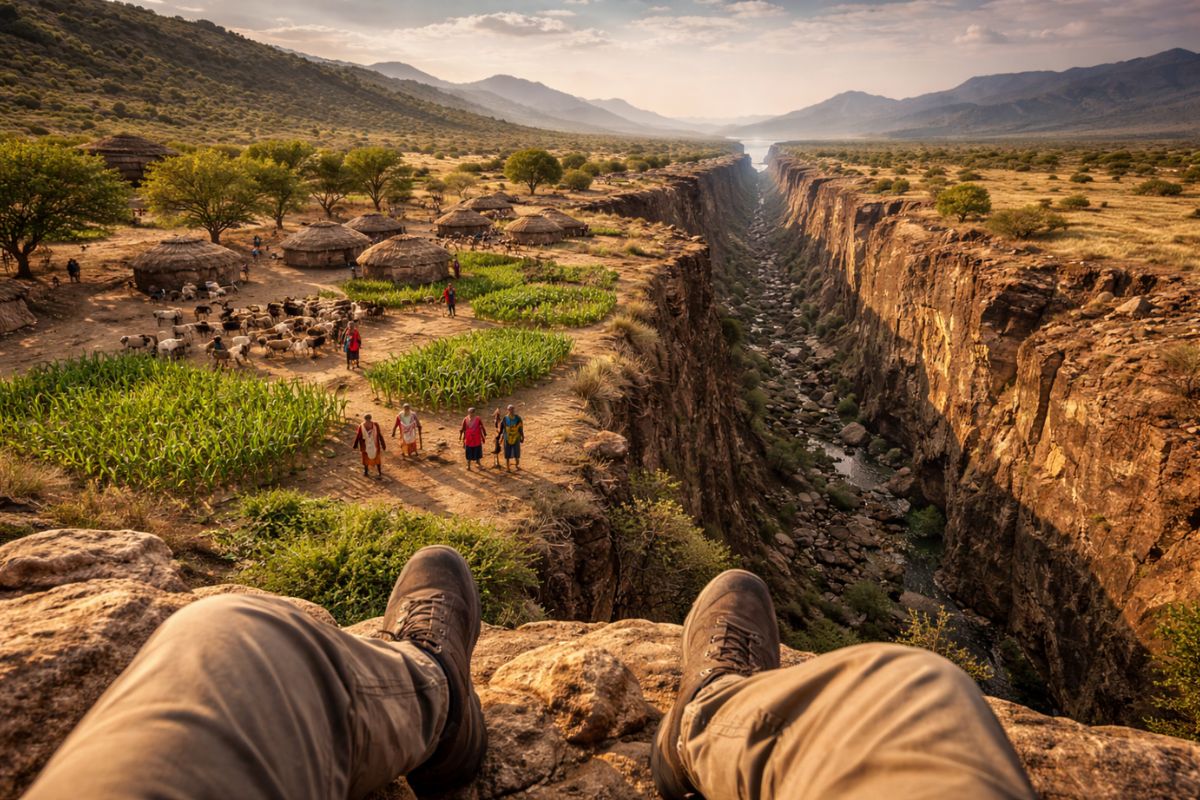

With about 840 thousand people scattered between northern Tanzania and southern Kenya, the Masai inhabit exactly over the Great Rift Valley, the fissure of more than 6,000 km where the Nubian and Somali tectonic plates pull apart year after year.
The ground where the Masai build their mud and cow dung houses is being stretched by forces coming from the Earth’s interior. Magma rises, pushes the crust, and the surface gives way, forming valleys, volcanoes, and lakes. The fissure grows about 7 millimeters per year, and scientists estimate that in a few million years, the waters of the Indian Ocean will flood this entire depression, creating a new ocean and separating East Africa from the rest of the continent. This information was published by the Geological Society of London and confirmed by studies in the journal Nature Geoscience in 2025.
The Masai do not worry about millions of years. They worry about cattle, rain, and their children. They are semi-nomadic, pastoralists by vocation, and believe that the god Enkai gave them all the cattle in the world. They live in family units called bomas, where each wife has her own mud house around a central enclosure with the animals.
How do the Masai organize their life on soil that does not stop moving?

The Masai society is patriarchal and polygamous. Men evolve in age groups, taking on responsibilities as they grow older. Women take care of the home, children, and animals. Marriages are celebrated with open festivities for the entire village.
-
Billionaire says the most valuable skill will help overcome job elimination caused by AI, following Bill Gates’ fears

-
A Dutchman created a ‘box’ that makes trees grow in the desert almost without water and without irrigation: the invention has already brought seedlings to dozens of countries and achieves up to 90% survival where common planting did not exceed 10%.

-
Abandoned warehouse hid a giant collection of rare computers, with over 2,000 artifacts from the 1930s to the 1980s.
-
Scientists warn that melting ice is triggering an alarming chemical transformation in preserved areas, and the first signs are already concerning researchers worldwide.




Houses are built with a mixture of mud, cow dung, and grass, materials that the volcanic soil and herds provide.
The soil in the region is extremely fertile due to volcanic activity. Outside conservation areas, the Masai plant corn, beans, and other foods for community consumption. Inside conservation areas, they can only raise animals.
This combination of raising and planting on volcanic soil allows the Masai to live abundantly, even without the luxuries of urban life. They have many heads of cattle, goats, and productive land. Poverty is different from simplicity.
Why is the Oldoinyo Lengai volcano sacred to the Masai and unique on the planet?

The Oldoinyo Lengai, which in Maa language means “mountain of God,” is an active volcano in Tanzania with just over 3,000 meters in altitude.
The Maasai offer community prayers at the base of the volcano when facing serious problems, asking for forgiveness and guidance from the god Enkai, who according to tradition resides in the Lengai.
The volcano is the only one in the world that emits carbonatite, a type of lava with such a different chemical composition that when it cools, it resembles glass scattered on the ground.
The last major eruption was in 2007. Seismic equipment installed at the base monitors vibrations to alert about new activities. For geologists, the Lengai is living evidence that the interior of the Earth continues to shape the surface of the region. For the Maasai, it is the house of God.
What happens to the Maasai if the Rift Valley continues to open?

No living Maasai today will witness the formation of the new ocean. The process takes millions of years. But the effects are already real. Low-intensity earthquakes are frequent in the region. Cracks appear in the ground.
The crater of the Empakaa volcano, where the Maasai raise cattle around, has a lake so salty and alkaline that it cannot support fish.
These are marks of a land that is being stretched and thinned from below, where the continental crust has already begun to transform into something resembling oceanic crust.
Studies published in Nature Geoscience in 2025, conducted by the universities of Southampton and Swansea, showed that rhythmic pulses of molten rock rise from the interior of the Earth beneath the Afar region in Ethiopia, at the extreme north of the same rifting system.
The researchers analyzed over 130 samples of volcanic rocks and found chemical patterns that repeat like geological heartbeats. The Rift Valley is alive, pulsing, and growing.
The Maasai have lived over this pulsation for centuries, and they continue there, with their herds, their spears, and their prayers at the mountain of God.
And you, did you know that there is an entire people living on the fissure that will divide Africa in two? Tell us in the comments if you would dare to spend a week in a Maasai village or if you prefer to admire from afar.





