






 Portuguese
  Spanish




The feeling of sleepiness next to a loved one involves emotional security, emotional bond, and the body’s responses to relaxation, according to studies on sleep and relationships, but it does not work as a direct measure of love.
Feeling sleepy near a loved one may be linked to emotional security, relaxation, and the quality of the bond, according to research on sleep and relationships.
What studies indicate is that relationships perceived as safe and welcoming can reduce the body’s alertness and favor rest in certain situations.
The desire to nap on the couch, rest next to the partner, or relax when the person comes close does not necessarily mean a lack of interest.
-
Kenyan Company Recycles Over 10 Million Flip-Flops from Indian Ocean Beaches into Elephant and Giraffe Sculptures Sold for Up to $1,200

-
Kenyan Brothers Recycle Old Newspapers Into 100,000 Pencils Daily, Aiming to Donate to 1 Million Children in Underprivileged Schools
-
China’s Water Project in Southern Chad Delivers Over 500 Wells and 57 Stations, Aiding Over 600,000 Residents

-
Frustrated by Floods Damaging His Power System, Brazilian Man Builds His Own Dam and Micro-Hydroelectric Plant to Live Off-Grid



Experts in behavior and sleep associate this effect with physiological responses that appear when the body interprets the environment as protected.
A scientific review published in 2024 in the Sleep Advances journal, by Oxford University Press, analyzed mechanisms that may explain the relationship between romantic experiences and sleep quality.
The study, conducted by researchers from Carnegie Mellon University in Pittsburgh, points to five main groups of factors: emotional responses, self-perception, social perception, self-regulation, and biological functioning.
Sleep near a loved one may be linked to security
Sleeping involves a natural reduction of vigilance.
To enter rest, the body needs to reduce part of its attention to the environment and accept a state of lesser control.
Therefore, the presence of someone associated with trust can facilitate relaxation in some people.
Psychotherapist Tasha Bailey told Glamour UK magazine that feeling sleepy near the partner can be a sign of enough trust to fall asleep in their presence.
According to her, the explanation is related to the feeling of security, as the body tends to relax more easily when it does not identify a threat in the environment.
This response helps explain why sleepiness may appear more frequently in already established relationships.
At the beginning of a bond, the body may still maintain higher levels of attention, even when there is emotional interest.
With coexistence and the repetition of positive experiences, the presence of the other becomes interpreted as more familiar.
The nervous system participates in this process.
The sympathetic system is linked to alert responses, such as increased heart rate and readiness to react.
On the other hand, the parasympathetic system acts in functions associated with rest, digestion, and recovery.
When there is a perception of safety, the body can move closer to this second state.
Oxytocin and sleep appear in studies on emotional bonds
Oxytocin, popularly called the “love hormone,” is one of the substances analyzed in research on emotional bonds, touch, and social behavior.
The review published in Sleep Advances cites oxytocin among the biological mechanisms associated with romantic experiences, but emphasizes that more studies are needed to confirm its direct role in the relationship between relationships and sleep quality.
Drowsiness near a loved one does not depend on a single hormone.
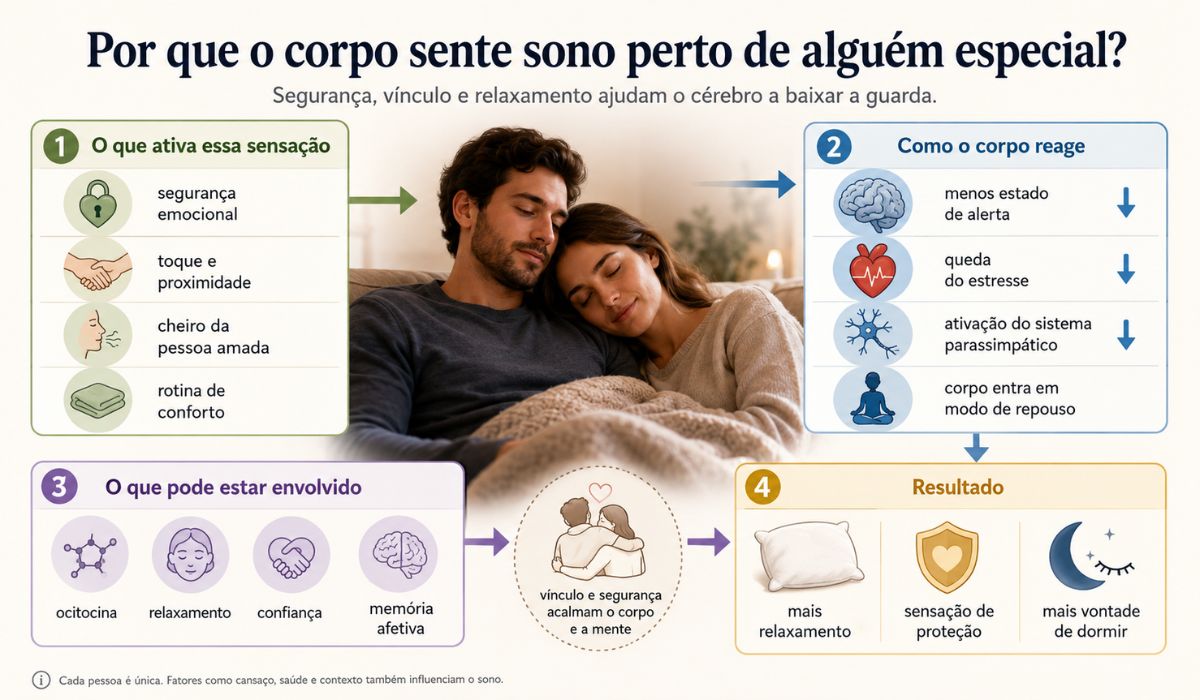
The response may involve emotional memory, stress reduction, a sense of protection, shared routine, physical contact, smell, and expectation of comfort.
In an interview published by Metrópoles in 2024, neurologist Márcia Assis stated that oxytocin can stimulate sleep and contribute to less interrupted rest.
In the publication, she was identified as vice-president of the Brazilian Sleep Association.
The interpretation, however, should not be applied as a general rule.
Some people feel sleepy near their partner, while others become more alert, talkative, or emotionally active in moments of closeness.
The response varies according to personal history, stress level, relationship quality, routine, and sleep conditions.
Partner’s scent can influence sleep quality
The sense of smell also appears in studies on sleep and emotional bonds.
Researchers from the University of British Columbia in Canada released a study in 2020 with 155 participants who slept with t-shirts used as pillowcases.
One had been worn by the romantic partner; the other was clean or had been worn by an unknown person.
The volunteers did not know which shirt they were wearing each night.
Even so, the university reported that there was an improvement in the objective quality of sleep when participants were exposed to the partner’s scent.
The perception of rest was also greater when they believed they were sleeping with the scent of their loved one.
According to Marlise Hofer, the principal author of the study, the data indicated an improvement in sleep efficiency with the presence of the partner’s scent.
Researcher Frances Chen, an associate professor in the university’s Department of Psychology, stated that sleep watch records showed fewer movements during the night when participants were exposed to the partner’s scent.
This finding helps explain why objects with the scent of someone close, like a shirt, pillow, or sheet, can be perceived as comforting by some people.
The aroma acts as a sensory cue associated with the presence of the other person and can trigger memories of closeness, routine, and safety.
Positive relationships and rest can walk together
The relationship between affection and sleep also involves daily life.
In relationships with less conflict and greater perception of support, the routine can include habits that favor rest, such as more predictable schedules, reduced stimuli before sleeping, and a sense of companionship.
The review by Sleep Advances points out that negative experiences in relationships, such as conflicts and less perceived support, are associated with poorer sleep quality.
On the other hand, positive interactions, intimacy, and perception of support are described in the literature as factors that can contribute to a more favorable rest dynamic.
For this reason, the idea that “the more you love, the more sleep you feel” needs to be treated with caution.
What the available scientific sources indicate is an association between emotional security, quality of the bond, and relaxation.
Love without a sense of security, in relationships marked by anxiety or frequent conflicts, can have a different effect and harm sleep.
The phenomenon is also not limited to couples.
People can relax next to family members, close friends, or pets when they associate these presences with care and stability.
In these cases, the central element is not just the type of relationship, but how the brain interprets that environment.


Excessive daytime sleepiness requires attention
Feeling sleepy occasionally near a loved one can be a relaxation response.
However, excessive daytime sleepiness, uncontrollable naps, persistent fatigue, or difficulty staying awake during common activities require attention.
In these situations, the emotional bond may just coincide with the moment sleepiness appears.
Possible causes include sleep deprivation, apnea, hormonal changes, medication effects, and other health issues.
When fatigue interferes with work, study, driving, or routine, the guidance is to seek medical evaluation.
Curiosity about feeling sleepy near someone you love finds partial support in studies on emotional security, emotional bond, and sleep.
Even so, the available research points to associations, not a universal rule capable of measuring love by the desire to sleep.


