






 Portuguese
  Spanish


Video from the Terran Works channel tells the story of Ocean Sole: collectors earn per kilo of flip-flop collected, artisans who came from wood carving sculpt the colorful blocks, and the model has already attracted orders from India, Indonesia, and Brazil
The flip-flop sculptures from Kenya prove that even the world’s most stubborn trash can become an export product. In a video published on July 2, 2026, the Terran Works channel on YouTube shows the operation of Ocean Sole, a company that has already collected about 10 million flip-flops from Kenyan beaches, streets, and dumps, and has received orders from countries like India, Indonesia, and Brazil, where the same trash accumulates.
The villain of the story is a well-known one. According to the Terran Works channel, the world produces more than 1 billion pairs of flip-flops per year, and it is estimated that more than 200 million pairs are discarded annually. Made of synthetic rubber, plastic, or foam, a flip-flop can take decades or more than a hundred years to decompose, and a large part ends up stuck on the beaches of the Indian Ocean.
One billion pairs per year: the flip-flop as an environmental plague
The flip-flop dominates the feet of low-income communities because it is unbeatable in cost-benefit: cheap, lightweight, easy to wash, and perfect for hot weather, dirt roads, and sand. According to the Terran Works channel, in 2024 alone, Kenya imported more than 183,000 pairs in the rubber or plastic sandal category, not counting internal production and trade.
-
Kenyan Brothers Recycle Old Newspapers Into 100,000 Pencils Daily, Aiming to Donate to 1 Million Children in Underprivileged Schools

-
China’s Water Project in Southern Chad Delivers Over 500 Wells and 57 Stations, Aiding Over 600,000 Residents

-
Frustrated by Floods Damaging His Power System, Brazilian Man Builds His Own Dam and Micro-Hydroelectric Plant to Live Off-Grid
-
7,500-Year-Old Salt Production Traces in Bosnia Uncover Rare Prehistoric Technology and Shed Light on Food History



The problem starts when the pair costs about 1 dollar or less. When the strap breaks or the sole cracks in the sun, throwing it away and buying another is the obvious decision, and the disposal ends in ditches, channels, and rivers, from where the current takes everything to the sea. The question that Ocean Sole answered: is it possible to remove this material from the environment and transform it into something more valuable?
The idea that was born from children’s toys in 1997
The origin of the company has a cinematic scene. According to the Terran Works channel, in 1997 the conservationist Julie Church arrived at the Kenyan coast and found mountains of discarded flip-flops, but she noticed something else: the local children were using the old flip-flops to make their own toys.
Her reasoning turned into a business. If children could transform discarded flip-flops into toys, adults could transform them into works of art. Thus, Ocean Sole was born, a social model that combines three things that rarely go together: environmental cleaning, job creation, and artistic production.
30 cents per kilo: the waste that turned into income
The mechanism starts with collection. According to the Terran Works channel, the company set up a network of collectors who participate in weekly beach cleaning actions on the Kenyan coast and are paid per kilo: about 30 cents per kilogram of flip-flops delivered.
The amount seems small, but it creates the mechanism that sustains everything. When a discarded object can be exchanged for money, the local population has a reason to collect it before the waves take it away. The result: the collection groups deliver about 1 ton of flip-flops per week to the workshop, equivalent to more than 3,000 sandals, and this is still a fraction of what circulates in the environment.
From the beach to the workbench: washing, layering, and carving
In the Nairobi workshop, the material starts a new life. According to the Terran Works channel, the flip-flops are washed one by one, by hand, with water and detergent, and dry in just 2 to 3 hours thanks to the warm climate. The artisans then choose colors, thicknesses, and parts of each flip-flop for each detail of the work.
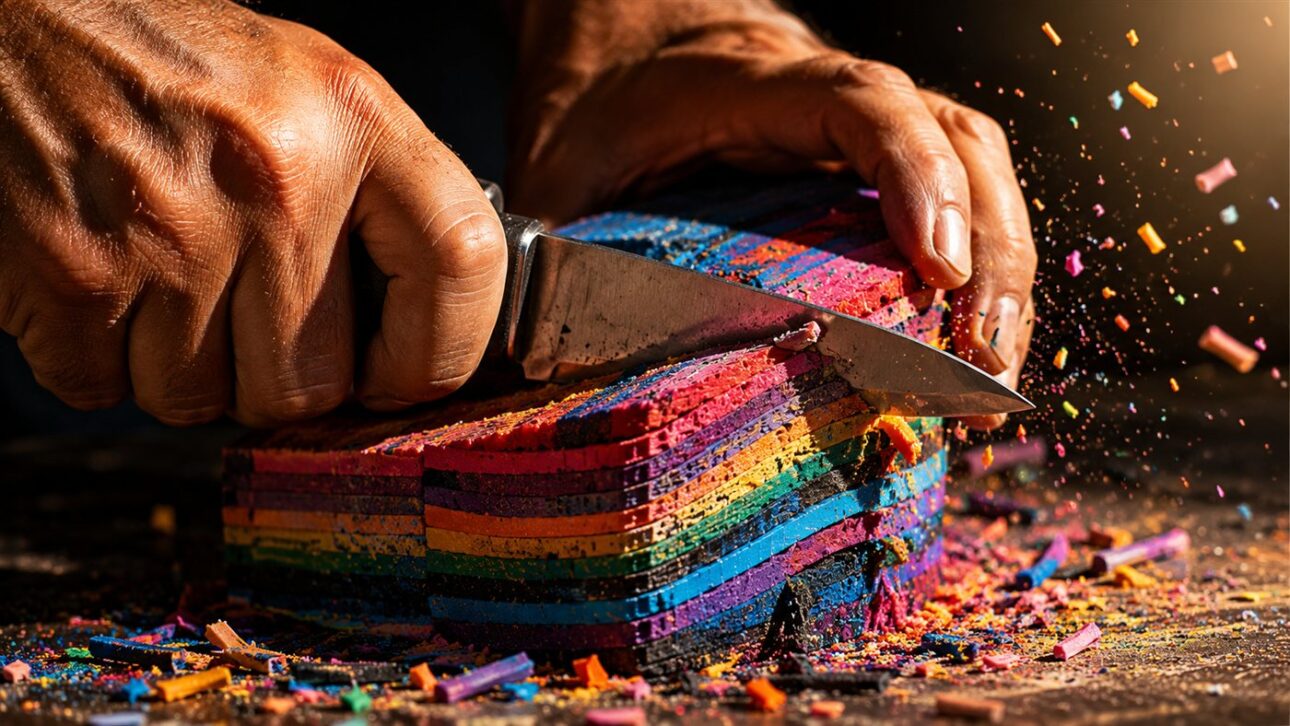
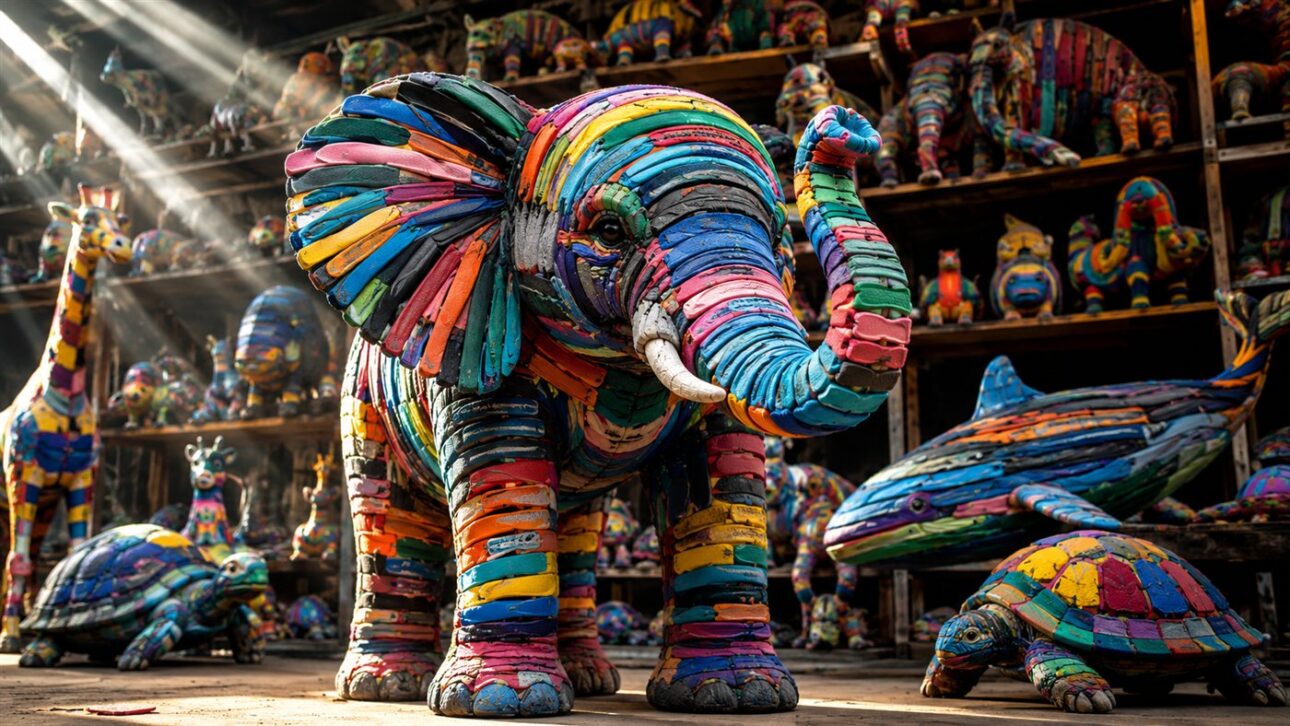
Since a flip-flop is too thin to become a sculpture, the technique is of inverted woodworking. The pieces are cut into molds, glued layer upon layer with non-toxic glue until they form blocks, and only then carved, as if the artisan were sculpting a trunk of colored wood. For an elephant, the blocks of the body, head, ears, legs, and trunk are first created; for a whale, the calculation is of the curve of the back, fins, and belly.
From wood carving to flip-flops: the workforce that migrated
A detail explains the quality of the finish. According to the Terran Works channel, many artisans of Ocean Sole came from the traditional wood carving of Kenya and migrated to the material when wood became scarce, following the policies restricting cutting.
The transition was almost natural. The knives, cutting tools, and sanders are the same as in the old craft, but the new material is softer, more colorful, and doesn’t splinter, according to the Terran Works channel. The result is flip-flop sculptures that look like handcrafted pieces, with factory-bright colors and an environmental story printed on their very surface.
Elephant for the Pope and car made of 4,500 flip-flops: the famous orders
The company’s portfolio has already made headlines. According to the Terran Works channel, an elephant sculpture made of flip-flops was gifted to the Pope during his visit to Kenya in 2015, proving that the product has surpassed the status of a souvenir.
There was an even crazier order: a life-sized car, assembled with about 4,500 flip-flops over 3 to 4 months of work, for a dealership in Alabama, USA. The large pieces in the regular catalog also require patience: some take up to 3 months to be ready, as almost the entire process is manual.
From US$ 26 to US$ 1,200: the price of recycled art
The price scale shows that trash has truly gained value. According to the Terran Works channel, in the Ocean Sole online store, a small elephant costs around US$ 26, the large ones exceed US$ 570, and giraffes can reach US$ 1,200, depending on the size and complexity.
Marine animals, like turtles and whales, carry the message of ocean protection, but the bestsellers are safari animals, elephants, and giraffes, closely tied to Kenya’s image in the international tourist’s imagination. It’s territorial marketing sculpted in recycled rubber: the product sells the country along with the cause.
The model that Brazil has already been invited to copy
International interest is the most promising chapter. According to the Terran Works channel, Ocean Sole has already received requests from countries like India, Indonesia, and Brazil, where flip-flop disposal is also a large-scale problem.
The lesson that travels along: not every model can be copied exactly, because each place has different waste, labor costs, and markets, but the principle is universal. Start with the most abundant waste in your region and find the product that the market is willing to pay for, and the collection sustains itself. For the Brazilian coast, where flip-flops are almost a national uniform, the challenge is set.
Watch: the flip-flop sculpture factory in video
The complete journey, from the dirty beach of the Indian Ocean to the flip-flop sculptures that decorate shop windows around the world, is in the video from the Terran Works channel on YouTube, which also showcases other recycling models in Kenya.


After seeing an elephant born from 30 cents per kilo of trash, the question remains: how much is the raw material that the sea returns every day on the beaches of Brazil worth? Tell us in the comments: would a Brazilian Ocean Sole have a market here?


