






 Portuguese
  Spanish


Unknown molecule on Pluto and Titan may explain a light signature at 5.11 micrometers detected by the James Webb Space Telescope.
A light signature recorded by the James Webb Space Telescope has placed two very different worlds at the center of a new chemical mystery. Data from Pluto and the moon Titan revealed an absorption around 5.11 micrometers that does not match, so far, the substances normally identified in other bodies of the Solar System or in exoplanets.
The researchers’ hypothesis is that an unknown molecule on Pluto and Titan is removing this specific radiation band from the spectrum reflected by the surfaces. The identity of the compound, however, remains uncertain, and the candidates considered by the team still need to be confirmed.
The results were presented in a study made available on June 11, 2026, on the preprint server arXiv. As the work has not yet been published in a peer-reviewed journal, the conclusions should be considered preliminary.
-
Global Population Estimates May Be More Inaccurate Than Thought: Study Finds Rural Areas Underestimated in 35 Countries, Sparking Debate Over Earth’s 8.2 Billion Inhabitants

-
From Space, a “Great Solar Wall” Spans 400 km of China’s Kubuqi Desert, Transforming the “Sea of Death” with Giant Panels to Combat Sandstorms and Revitalize the Land

-
New Study Finds Brief Stress Episodes Can Alter Blood and Increase Risk of Clot Formation

-
Ukraine Escalates War Efforts with Plan to Deploy 25,000 Ground Drones, Test Phantom MK-1 Humanoid Robot, Use Armed Mini-Tanks, and Expand Automated Attacks up to 15 km from Frontline


Unknown molecule on Pluto and Titan leaves mark at 5.11 micrometers
The clue emerged during the analysis of very short bands of the infrared spectrum obtained by James Webb.
The researchers observed that the light reflected by Pluto and Titan showed a specific drop around 5.11 micrometers. This absence is known as an absorption line or band.
Each substance interacts uniquely with electromagnetic radiation. Certain atoms and molecules absorb only some frequencies, leaving marks that function as a kind of chemical fingerprint.
By comparing the absorption observed in the two worlds with previous studies, the team did not find a recorded band that matched that position.
This lack of correspondence led scientists to consider the possibility that the unknown molecule on Pluto and Titan is a compound not yet recognized in planetary observations.
How James Webb identifies distant substances
Astronomers do not need to directly collect a sample to investigate the composition of a planet, moon, or object located at great distances.
The light reflected or emitted by the celestial body carries information about the materials it has come into contact with. When a substance absorbs a certain frequency, a dark region appears in its spectrum.
Molecular oxygen, for example, absorbs radiation around 230 nanometers. If this mark consistently appears in the spectrum of a distant planet, researchers can consider the presence of oxygen in its atmosphere.
The James Webb has instruments capable of separating light into different wavelengths and recording these signatures with high precision.
The technique is already being applied to the study of exoplanet atmospheres, distant stars, primitive galaxies, and objects located within the Solar System itself.
In the case of Pluto and Titan, the 5.11-micrometer range had been little explored, which opened the door to an unexpected discovery.
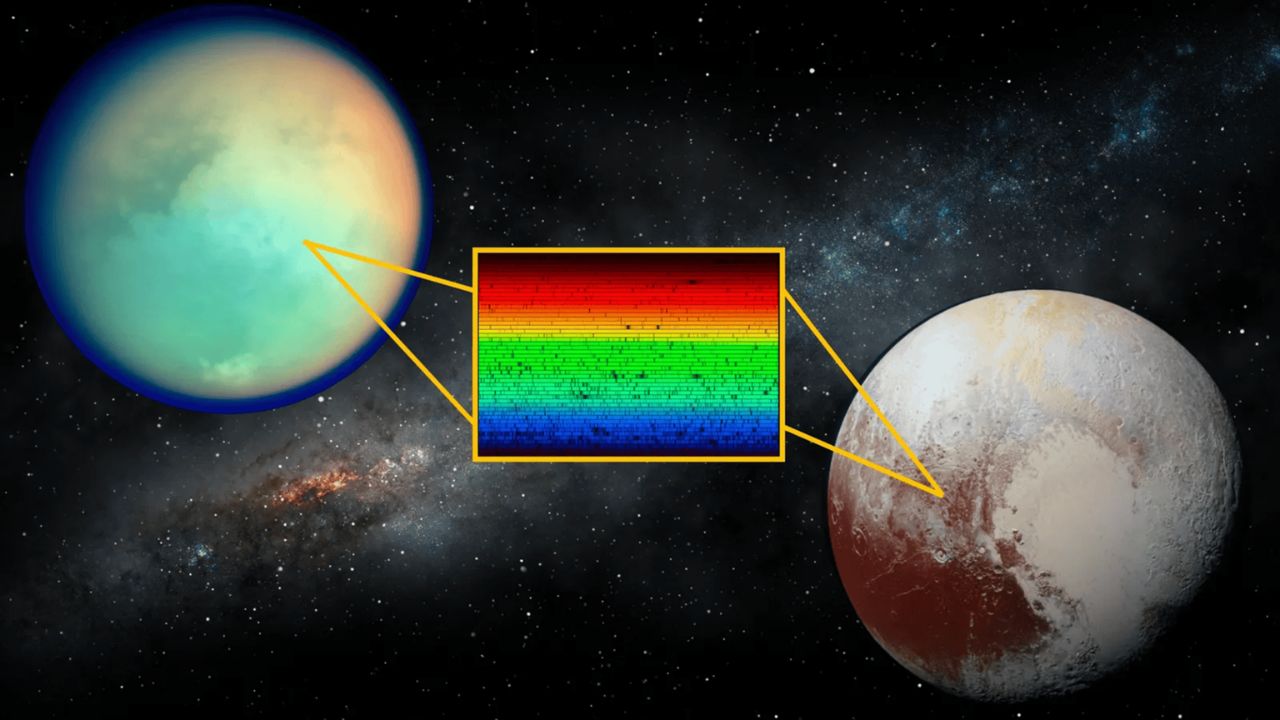
Unknown molecule on Pluto and Titan seems to be on the surface
Although both bodies have atmospheres mainly composed of methane and nitrogen, researchers believe that the absorption does not originate from the air surrounding them.
The characteristics of the data indicate that the material responsible for the signature is likely deposited or incorporated into the surfaces.
This conclusion makes the result even more intriguing because Pluto and Titan have quite different environments.
Pluto is a frozen dwarf planet, located approximately four times farther from the Sun than Saturn’s moon. Its size is about half the diameter of Titan.
Titan, on the other hand, is larger than the planet Mercury and has rivers, lakes, and liquid seas on its surface. Besides Earth, it is the only world in the Solar System known to maintain large surface liquid formations.
Despite these differences, both present the same absorption range, suggesting some shared chemical process or material.
Signature is more intense on Pluto
The concentration of the substance does not seem to be the same on both worlds.
On Pluto, the absorption line is approximately three times thicker than that observed on Titan. This may indicate that the compound appears in a higher quantity on the dwarf planet.
The comparison does not reveal by itself what the substance is, but it helps scientists estimate its relative abundance.
On Titan, the distribution also does not seem uniform.
The signature is more intense on the moon’s trailing hemisphere, the region facing the opposite direction of its orbital movement around Saturn. On the leading side, the absorption appears weaker.
This spatial difference may help identify how the material is formed, transported, or altered on the surface.
Unknown molecule on Pluto and Titan may involve hydrocarbons
The authors presented some possibilities to explain the 5.11-micrometer band, but none have been proven.
One of the hypotheses involves benzene, a hydrocarbon with a ring-shaped structure, combined with another yet unidentified substance.
Compounds related to acetylene and a possible form of ketene ice were also considered.
Main candidates analyzed
- benzene mixed with another molecule;
- some form derived from acetylene;
- ketene ice;
- a compound not yet included in the available comparisons.
The researchers emphasize that the simple proximity between a known signature and the Webb observation is not enough to confirm the composition.
New laboratory and spectral analyses will be necessary to verify if any of these candidates really absorb light in the same position and under conditions similar to those found on the two bodies.
Differences between the worlds make discovery harder to explain
The presence of the same chemical mark on Pluto and Titan raises a question: what process could produce a similar substance in such distinct environments?
The nitrogen and methane-rich atmospheres represent a common point. However, the team considers that the material is on the surface, not suspended in the atmosphere.
On Titan, the compounds may interact with liquids and a dense atmosphere. Pluto, on the other hand, remains dominated by extremely low temperatures and a frozen surface.
The discovery may indicate that reactions involving the same chemical elements can occur under different conditions.
Another possibility is that already known substances present an unusual signature when mixed, frozen, or subjected to the specific conditions of these locations.
Result does not yet confirm a new molecule
The expression “unknown molecule” describes the lack of identification of the signature, but does not mean that a new chemical compound has been officially discovered.
The absorption can also be caused by a combination of known materials that has not yet been adequately reproduced in the laboratory.
Therefore, scientists need to compare Webb’s data with experiments conducted under different temperatures, pressures, and compositions.
The preliminary nature of the research is another important point. The study available on arXiv may still receive corrections, questions, or new interpretations when evaluated by other experts.
Until these steps are completed, the unknown molecule on Pluto and Titan remains a hypothesis based on a spectral signature still without a match.
Dragonfly mission could investigate Titan up close
A future NASA mission may help solve part of the puzzle.
The Dragonfly is designed to fly through Titan’s atmosphere using a structure similar to a helicopter. Its launch is not expected before 2028, with arrival at Saturn’s moon expected by 2034.
Among the spacecraft’s instruments will be a spectrograph capable of examining the composition of materials found during the mission.
If the equipment identifies the substance associated with the 5.11 micrometers, scientists will be able to compare the result directly with the data obtained on Pluto.
This identification would also help assess whether the same compound can exist under the conditions of the dwarf planet or if the two absorption lines have different origins.
Unknown molecule on Pluto and Titan opens new research front
The result shows that even worlds observed for decades can still hide components difficult to recognize.
By exploring a region of the spectrum that had received less attention, the James Webb found an unexpected chemical similarity between a moon with surface seas and a frozen dwarf planet at the edge of the Solar System.
Now, the researchers’ work will be to separate the different hypotheses, reproduce possible materials in the laboratory, and search for the same signature in other objects.
Until a match is found, the unknown molecule on Pluto and Titan will continue to be represented by a small band of missing light — a 5.11-micrometer signal that connects two worlds separated by billions of kilometers.
With information from Olhar Digital


