Portuguese
  Spanish


Intervention in the Nova Avanhandava channel targets a sensitive section of the Tietê-Paraná waterway and involves the removal of submerged rocks, depth expansion, and the expectation of more regular operation for cargo.
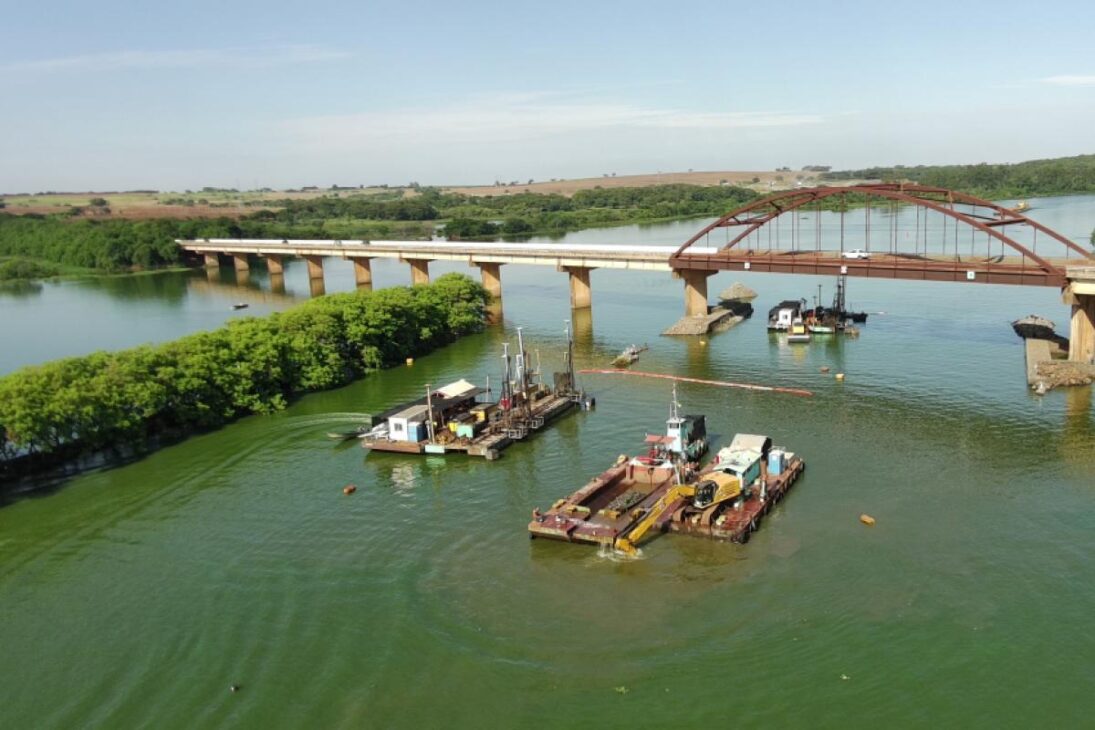
The Ministry of Ports and Airports reported that the rock removal works at Pedral de Nova Avanhandava, in Buritama, in the interior of São Paulo, have reached the final phase and are expected to be completed by June 2026.
The intervention, budgeted at R$ 293.8 million by the federal government, aims to expand navigation on the Tietê-Paraná waterway, a corridor used for transporting agricultural and industrial cargo between producing regions in the Midwest, Southeast, and the logistics system linked to the Port of Santos.
The project plans to deepen the channel by 3.5 meters over 16 kilometers, with the removal of approximately 552 thousand cubic meters of submerged rocks from the Tietê riverbed.
-
Brazilian Workers and Instructors to Train in China on Electric Car Technology Ahead of New Factory Opening in Brazil

-
Viral Message Claiming Government Will Deposit Money for Registering CPF as Pix Key Debunked

-
Embraer Acquires Full Control of Mexican Aircraft Interiors Manufacturer EAI to Reduce Supplier Dependence and Protect Margins Amid Global Aviation Competition

-
Controversial Amazon Highway BR-319 to Receive $1.3 Billion for Road Upgrades and $570 Million for Territorial Governance in Brazil


According to the MPor, the work should allow the circulation of larger convoys with greater regularity, even during drought periods when the reduction of reservoir levels can limit waterway operations.
The intervention is carried out through a partnership between the Ministry of Ports and Airports, the National Department of Transport Infrastructure, Dnit, and the Government of São Paulo.
According to official information released by the federal government, the work is part of the plan to expand the transport capacity on the Tietê-Paraná waterway and receives funds linked to the modernization of waterway infrastructure.
During a technical visit to the site, the Minister of Ports and Airports, Tomé Franca, stated that the expansion of the channel seeks to improve logistical integration and reduce costs in cargo transportation.
“This is a strategic work for the Tietê-Paraná waterway, which increases navigability and integrates different modes, reducing logistical costs and strengthening the competitiveness of Brazilian production, in addition to contributing to more efficient and sustainable transportation,” he said.
Rock removal in Nova Avanhandava seeks to reduce operational restriction
The rock removal in Nova Avanhandava addresses a section identified by public agencies as one of the restrictions on navigation in the Tietê-Paraná waterway.
The area is located near the Nova Avanhandava lock, between municipalities in the Northwest of São Paulo, where submerged rock formations limit the draft of vessels and can affect operations during periods of lower water availability.
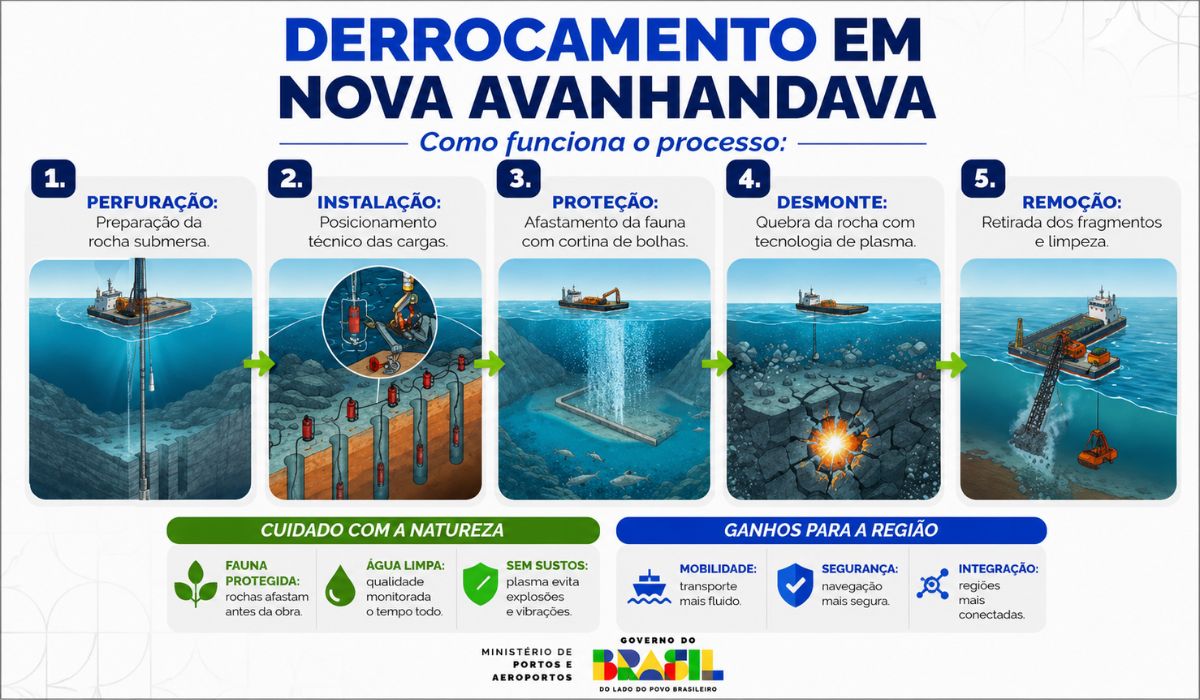
The work involves the controlled fragmentation and removal of existing rocks from the riverbed.
With a deeper channel, the government expects to expand the navigation margin and reduce risks of interruption associated with fluctuations in the levels of reservoirs also used for power generation.
Publications from the Government of São Paulo reported that the stretch had already faced stoppages and operational restrictions in previous years, especially in scenarios of water crisis.
In this context, the expansion of the channel has been addressed by federal and state agencies as a measure to increase the predictability of waterway transport.
The presence of rocks in the bed reduces the available depth for vessels when the water level drops.
According to the MPor, the removal of this material should allow convoys to transport more cargo per trip and operate with less exposure to seasonal river variations.
Tietê-Paraná Waterway can increase volume transported per trip
The Tietê-Paraná waterway is used for the transport of cargo such as soybeans, corn, sugar, meal, and inputs.
The corridor connects producing areas in the interior of São Paulo and states in the Midwest and Southeast to intermodal terminals, from where part of the cargo goes to the Port of Santos and other logistical destinations.
According to the Ministry of Ports and Airports, the expansion of the channel should reduce navigation bottlenecks and improve integration between different modes of transport.
The government’s assessment is that waterway transport can gain efficiency in large volume cargoes, especially when there is adequate connection with terminals, highways, and railways.
The Government of São Paulo also reported that the intervention could increase the annual transport capacity in the stretch.
This estimate, however, depends on the completion of the works, the availability of terminals, the regularity of operations, and the demand from companies that use the waterway to transport their production.
Compared to road transport, the waterway mode is often cited by sector agencies as an alternative for large volumes and long distances.
Even so, the effective use of the waterway depends on an integrated logistics chain, with loading, storage, and transshipment points functioning in a coordinated manner.
Removal of Submerged Rocks Occurs with Environmental Monitoring
The removal of submerged material is carried out in a controlled manner and with environmental monitoring, according to official information.
The process involves rock dismantling techniques on the riverbed and safety measures to maintain navigation and reduce impacts during the execution of services.
In publications about the work, the Government of São Paulo reported that the underwater detonations are accompanied by fauna protection procedures.
Among the measures mentioned is the use of a bubble curtain, as well as the suspension of explosions during the closed season, when fish reproduction occurs.
The material removed from the riverbed was also cited in official communications as being potentially reusable locally.
This measure reduces the need for additional displacements and decreases part of the truck movement associated with the transport of the removed rocks.
The execution without total interruption of navigation was highlighted by MPor as one of the characteristics of the intervention.
For this, the work fronts need to operate in a manner compatible with vessel traffic and with the safety requirements imposed on the stretch.
Investment in the Nova Avanhandava Canal is Informed by MPor
The Ministry of Ports and Airports reports an investment of R$ 293.8 million in the expansion works of the Nova Avanhandava canal.
In publications from the Government of São Paulo, there is mention of different values for the total cost of the intervention, indicating variation between official sources consulted.
As there is no sufficient detail in the available information to explain the difference between the values, the text maintains the amount informed by MPor, the agency cited in the federal announcement.
The discrepancy was recorded because it involves official numbers and may reflect different criteria for updating, counterpart, or composition of the investment.
Despite the difference in published values, the official sources consulted point to the same central objective: to remove the rocky area, increase the depth of the canal, and improve navigation conditions in the Nova Avanhandava stretch.
The work is presented by the federal and state governments as part of the strategy to strengthen the Tietê-Paraná waterway.
The intervention is also related to the operation of the reservoirs used for energy generation.
According to MPor, variations in water levels can affect navigation and reinforce the need to increase depth at restriction points.
For the Director of Waterway Management, Eliezé Bulhões, the work should increase the predictability of operations throughout the year.
According to him, the expansion of the channel favors the transport of cargo “with more regularity and efficiency,” even during drought periods.
With completion expected by June 2026, the work enters a stage monitored by shippers, logistics operators, and public agencies related to waterway transport.