






 Portuguese
  Spanish
  4 min of reading
  0 comments


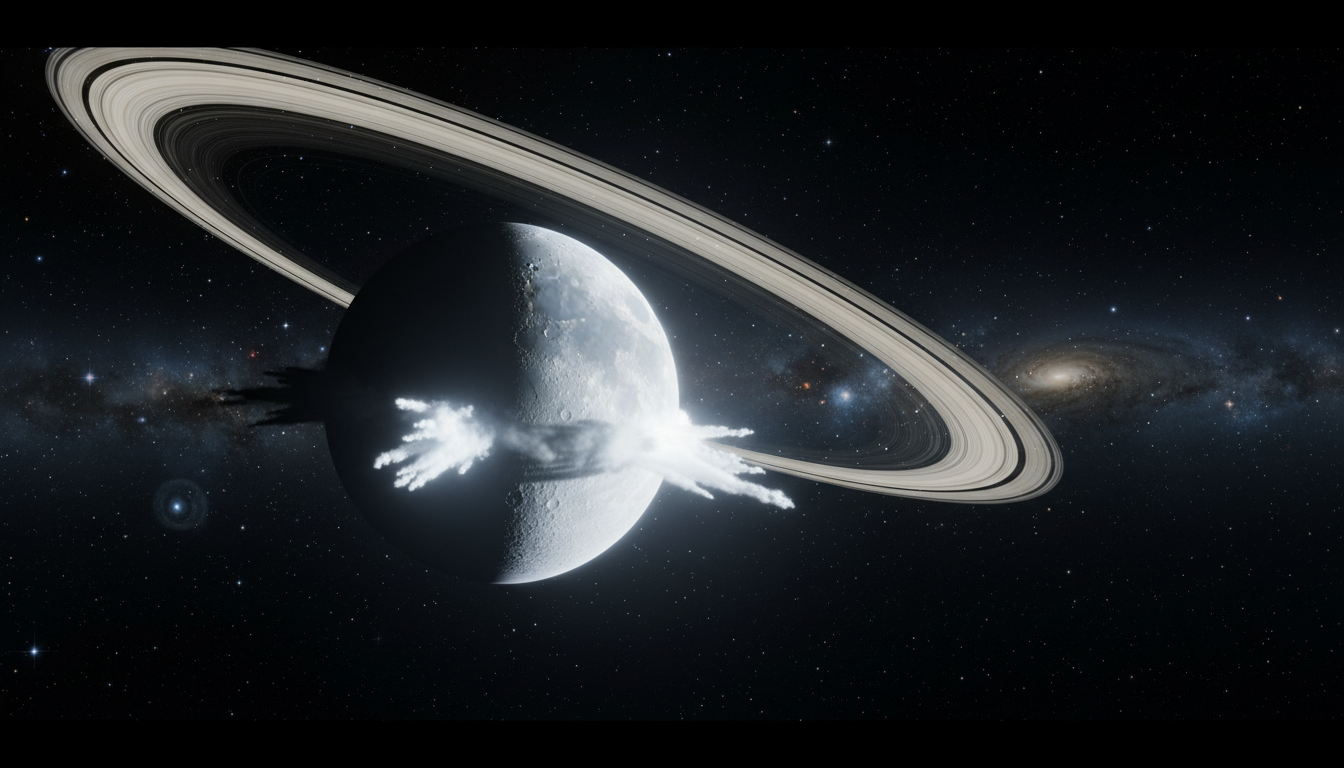
Reanalysis of Cassini probe data reveals ethers, esters, and chains of up to 15 carbon atoms in ice grains expelled from Enceladus’ subsurface ocean — the strongest evidence yet found of prebiotic chemistry beyond Earth
The NASA has just confirmed something extraordinary. Old data from the Cassini probe, reprocessed with modern techniques, revealed complex organic molecules in the geysers of Enceladus, Saturn’s moon.
The molecules have up to 200 atomic mass units. They contain chains of 7 to 15 carbon atoms, along with hydrogen, nitrogen, and oxygen.
They are the most elaborate organic molecules ever found beyond Earth in a liquid water ocean.
-
Brazilian Company Launches Retro Smartphone with 48 MP Camera, T9 Keyboard, and Privacy Features for Social Media-Free Use

-
Self-Taught Chinese Farmer Builds 5-Ton Submarine from Scrap, Launches It in Anhui River
-
Invisible Induction Technology Enables Wireless Power for Blenders, Coffee Makers, and Air Fryers, Reducing Countertop Cables

-
Smart Outdoor Lighting Transforms Gardens into Living Spaces with Weather Resistance and App-Controlled Scenes





This discovery elevates Enceladus to the position of number one candidate in the Solar System to harbor extraterrestrial life.
“The moon expelled its organic inventory in high concentrations directly into the Cassini probe. It’s a spectacular find,” said Frank Postberg from the University of Heidelberg.

The Cassini probe captured the data nearly 20 years ago
In 2005, Cassini flew over Enceladus and discovered geysers at the south pole. Columns of ice were shooting from the subsurface ocean into space.
In 2009, the probe collected samples of the particles. At the time, it detected only simple molecules like methane and ethane, with masses of 15 u.
In 2018, deeper analyses revealed macromolecules with masses of 80 to 200 atomic mass units.
Organic particles made up 25% of the material in the geysers and in Saturn’s E Ring, formed by the jet from Enceladus.
There were even indications of molecules with 8,000 mass units. They fragmented upon colliding with the probe at 30,000 km/h.
In October 2025, new reprocessing confirmed ethers, esters, aldehydes, and aromatic compounds in fresh ice grains.
The compounds coming from the hidden ocean
- Ethers and esters: organic compounds with oxygen, typical of biochemical processes
- Aldehydes: reactive molecules that participate in metabolic cycles
- Nitrogenous fragments: precursors of amino acids
- Aromatic compounds: carbon ring structures
- Chains of 7 to 15 carbons: unprecedented complexity beyond Earth
- Masses of 80 to 200 u: far above the 15 u detected in 2009
“When there is complexity, it means that the potential of Enceladus is increasing at this moment,” stated Nozair Khawaja from the Free University of Berlin.
The compounds were found in fresh ice grains. This proves they come directly from the ocean, not from exposure to space.

Why this matters in the search for life
The presence of complex organic molecules in liquid water is one of the fundamental requirements for life as we know it.
Enceladus has a global ocean of liquid water beneath its ice crust. Hydrothermal vents at the bottom provide chemical energy.
Now, the confirmed organic chemistry completes the trifecta: liquid water + energy source + complex organic molecules.
Enceladus even surpasses Europa, Jupiter’s moon, as a candidate for life. The difference is that Enceladus ejects its material into space.
A future mission would not need to land and drill. It would just need to fly through the geysers and collect samples.
Those following space exploration know that science continues to rewrite what we know about origins, both on Earth and beyond.

What the involved scientists say
“We cannot answer the million-dollar question, but this demonstrates that something is happening there,” said Frank Postberg.
“It was a needle-in-a-haystack type of problem,” Postberg described regarding the difficulty of identifying the molecules in the data.
“The molecules we found in the newly expelled material prove that the organic compounds are not a product of exposure to space,” he added.
“They are available directly in the ocean of Enceladus,” Postberg confirmed in a study published in the journal Nature.
Morgan Cable, a scientist at NASA’s JPL, specializes in the search for life in extreme environments. Her studies reinforce that Enceladus is unique.
Complex molecules do not mean life — yet
It is essential to remain cautious. Organic molecules are not living organisms. They are necessary ingredients, but not sufficient.
The Cassini data comes from quick flybys. The probe was not designed for this type of detailed chemical analysis.
Some of the molecules may have fragmented in the collision at 30,000 km/h. The real complexity may be even greater — or lesser.
A dedicated mission to Enceladus would be necessary to confirm or refute the presence of life. There is no concrete launch schedule.
The information in this article was compiled from studies published in Nature and reports from National Geographic. The data reflects reanalyses of completed missions and may be updated with future research.


Be the first to react!