






 Portuguese
  Spanish
  4 min of reading
  0 comments


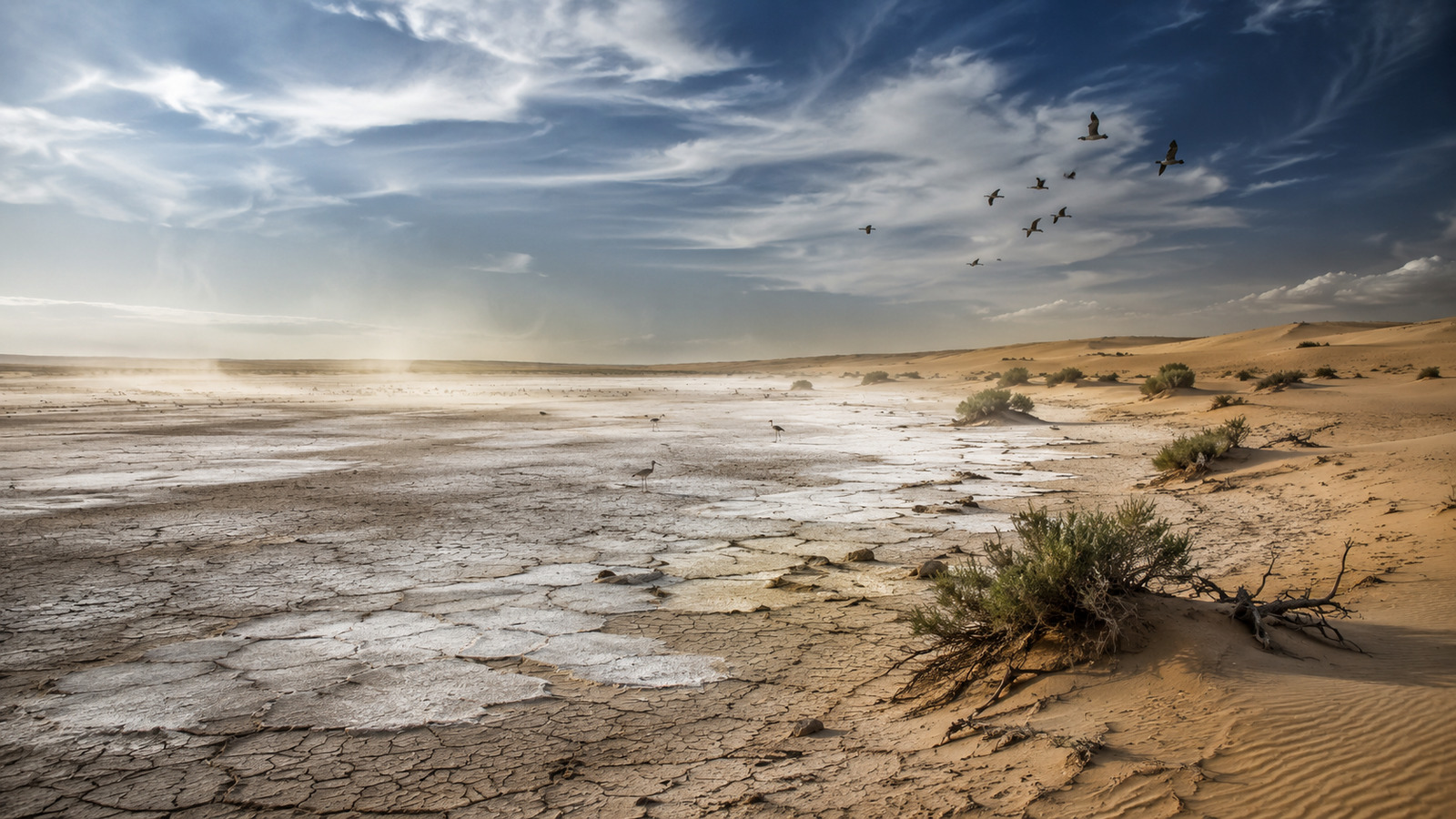
Formed on the ancient bed of the Aral Sea, the Aralkum desert has become an extreme and salinized area where 91 bird species reveal how fauna adapts to water scarcity
The Aralkum desert, formed on the ancient bed of the Aral Sea, hosts 91 bird species in an arid and salinized area, where researchers monitor the adaptation of fauna to extremes.

Recent desert in the ancient sea
The Aralkum desert emerged with the retreat of the Aral Sea, a water crisis linked to human activities since the second half of the 20th century. The loss of water exposed areas of the ancient seabed.
With this process, the terrain began to dry out, accumulate salt, and acquire desert characteristics. The result was an unusual landscape, marked by strong winds, little available water, and salinized soils.
-
Helicopter Drops 180 Tons of Sand and Gravel on Swedish River to Revive Ecosystem Damaged by Decades of Exploitation

-
Brazilian Company Launches Retro Smartphone with 48 MP Camera, T9 Keyboard, and Privacy Features for Social Media-Free Use

-
Self-Taught Chinese Farmer Builds 5-Ton Submarine from Scrap, Launches It in Anhui River
-
Invisible Induction Technology Enables Wireless Power for Blenders, Coffee Makers, and Air Fryers, Reducing Countertop Cables





The area brings together sectors with salt, sandy zones, rocky stretches, and points where pioneering vegetation tries to establish itself. This mosaic altered dust circulation, the local climate, and fauna occupation.
The change weighs on neighboring communities. Salinized dust storms carry old residues of fertilizers and pesticides, affecting human health and influencing agricultural productivity.
Birds indicate transformation
Birds are among the most used indicators to evaluate rapidly changing ecosystems. In the Aralkum desert, ornithological surveys identified 91 species, across 12 orders and 26 families.
The number is significant for a recent landscape subjected to strong environmental stress. With water scarcity and difficult soils, the region has become a natural laboratory.
Among the 91 species recorded, 13 appear on Uzbekistan’s Red List. Some also feature on international conservation lists, broadening global interest and guiding protection priorities.
There are resident birds, which remain year-round, and migratory birds, which use Aralkum as a stopover on intercontinental routes. Threatened species depend on remaining wetlands and rocky elevations.


Six habitats sustain diversity
To understand bird ecology, researchers divided Aralkum into six major types of biotopes. Each one presents its own soil, relief, humidity, and vegetation.
This classification allows for relating species groups to specific environments. It also helps identify priority conservation zones, especially where there is still water, vegetation, or shelter against extreme events.
Even in a desert landscape, the variety of environments explains part of the recorded bird diversity. Water patches and vegetated areas function as refuges during heatwaves and prolonged droughts.
Saline biotopes, called solonchak, maintain salt crusts over the ancient seabed. Vegetation is scarce and adapted to salinity, but some shorebirds explore soil invertebrates during humid periods.
Sandy sectors, formed by dunes and sand fields, shelter creeping plants and spaced shrubs. They are used by birds that nest on the ground or in small thickets and by species that hunt insects.
Stony and gravelly regions have firm soil, covered by stones and fine gravel. This environment favors terrestrial birds that rely on camouflage and species that use crevices between rocks.
Water and escarpments maintain Aralkum desert routes
Clay deserts offer compact, smooth, or undulating surfaces. In these stretches, birds that travel long distances on foot find more stable terrain to search for food.
Elevations and chinks, the escarpments of Aralkum, are essential for birds that nest on cliffs. These reliefs also favor species that use ascending air currents to glide and hunt.
Aquatic areas include remnant lagoons, channels, temporary puddles, and rivers. Although fragmented, these patches sustain aquatic birds and attract migratory ones seeking rest and food.
Research monitors nests and migration
Teams from the Institute of Zoology conduct field campaigns at different times of the year to monitor the evolution of the new environment. The work combines transects, direct observation, and acoustic recording of species.
In a stage in the autumn of 2025, researchers covered about 140 kilometers in the Muynak district, in Karakalpakstan. The action focused on bird recording, nest mapping, and habitat measurement.
The data feeds long-term databases and supports conservation measures for the avifauna of the Aralkum desert. These include the delimitation of key areas and the control of human activities that degrade sensitive biotopes.
The actions also include wetland restoration in cooperation with international initiatives. Reforestation with salt-tolerant shrubs, ecological corridors, and telemetry help monitor migratory routes.
With information from Revista Oeste.




-

-

-

-

12 people reacted to this.