






 Portuguese
  Spanish
  5 min of reading
  0 comments


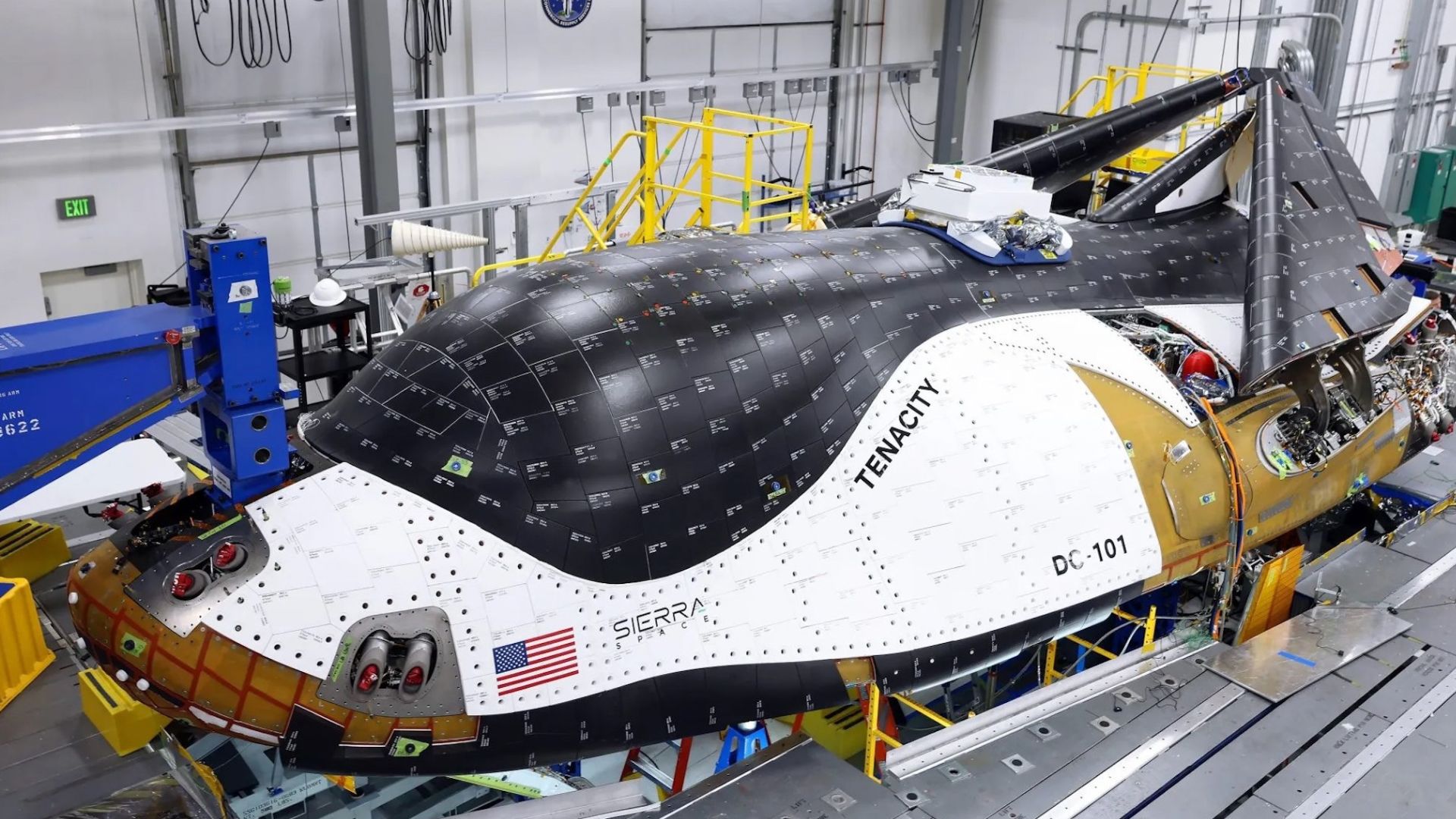
Dream Chaser can carry more than 3.6 tons to orbit and return to Earth landing on a runway like a reusable space minibus.
Since the retirement of NASA’s space shuttles in 2011, practically all cargo returning from Earth’s orbit has relied on capsules that descend under parachutes and land in the ocean or remote regions. Now, an American company wants to bring back a feature that disappeared with the end of the Space Shuttle era: bringing experiments, equipment, and space cargo back to Earth landing directly on a runway. The space minibus is called Dream Chaser and is developed by Sierra Space.
Unlike conventional capsules, the spacecraft has a space minibus shape with wings and a lifting body, allowing controlled atmospheric reentry and horizontal landing.
The proposal is to combine reuse, quick cargo return, and smooth landing at airports, something the company considers essential for future commercial and scientific operations in orbit.
-
Brazilian student creates a cheap formula that makes plants grow up to 90% faster and wins an award in a global scientific competition.

-
Europe unveils armored tank with remote turret, 1,500 horsepower, and 120-millimeter cannon

-
Old hard drives may hide neodymium, dysprosium, praseodymium, and terbium, and a United States company is expanding its network with a new 93,000-square-foot facility to recover rare earths used in electric cars, artificial intelligence, defense, and renewable energy.

-
Giant crane lifts up to 3,000 tons, requires special logistics to reach the site, and can transform 18-hour operations into just 3 hours, speeding up the hoisting of oil platforms, refineries, and plants in giant industrial projects.




Dream Chaser was designed to return from space landing like an airplane
The concept of the space minibus immediately recalls NASA’s old space shuttles. After being launched into space by a conventional rocket, the Dream Chaser performs its operations in orbit and then returns to the atmosphere using aerodynamic lift during descent.

According to NASA and Sierra Space, the spacecraft was designed to land on conventional runways after reentry, without relying on splashdown or maritime recovery. This feature reduces the time needed to access sensitive scientific experiments right after returning from orbit.
Ship can carry more than 3.6 tons of cargo to Earth’s orbit
The Dream Chaser is part of NASA’s Commercial Resupply Services program. Sierra Space reports that the cargo system will be able to transport approximately 8,000 pounds, about 3,629 kg, to destinations in low Earth orbit.
The ship works in conjunction with the disposable module Shooting Star, significantly expanding the mission’s total capacity.


According to the company, the complete system was designed to transport pressurized and unpressurized cargo, as well as scientific equipment, supplies, and experiments destined for the International Space Station.
Smooth return of the Dream Chaser is considered one of the project’s greatest advantages
One of Sierra Space’s main bets is not just on the ascent to space. The difference lies in the return.
NASA states that the Dream Chaser will be able to return up to 3,500 pounds, about 1,588 kg, of cargo to Earth using a smooth runway landing. This type of return reduces vibrations and impacts during recovery.
Therefore, the vehicle is of interest for transporting biological, pharmaceutical experiments, and materials produced in microgravity that can be damaged in more aggressive re-entries.
Reusable project tries to recover part of the operational logic of space shuttles
The Dream Chaser is not a disposable vehicle. According to NASA, the ship was designed to be reused up to 15 times, following a logic similar to what made reuse a strategic priority in the modern space industry.
Reuse is considered one of the most important technologies for reducing operational costs of access to space.
It was precisely this strategy that helped SpaceX profoundly change the sector by recovering rocket stages that were previously discarded after each mission.
Dream Chaser was born from a concept created by NASA decades earlier
The origins of the project date back to the HL-20 program. NASA developed this experimental lifting body concept at the Langley Research Center to study future reusable orbital transport spacecraft.
According to the agency, the Dream Chaser was derived from this work and adapted for modern commercial missions.

The result is a spacecraft much smaller than the old space shuttles but capable of performing some of the functions that disappeared after the Shuttle program ended.
Vehicle will be able to land at airports that receive commercial airplanes
Another point that draws attention is operational flexibility. According to materials released by Sierra Space and experts linked to the program, the Dream Chaser was designed to use conventional runways compatible with large commercial aircraft.
This reduces the dependence on extremely specialized infrastructures. Instead of requiring exclusive facilities similar to those used by the old space shuttles, the spacecraft will be able to operate in a much larger network of airports and aerospace centers.

The first operational unit of the fleet was named Tenacity. According to NASA, the spacecraft was sent to Florida in 2024 for launch preparation, structural tests, and integration with the Vulcan Centaur rocket.
Sierra Space states that Tenacity will be the first of a series of reusable vehicles planned for orbital missions.
Other units have already been announced, including the Reverence vehicle and future versions aimed at different space applications.
Program also aims at crew transport in the future
The current model was developed for cargo. But the company has already presented plans for crewed versions.
According to information released by Sierra Space, future variants may transport between three and seven people to low orbit destinations.
If it progresses, the project could become one of the few reusable space vehicles in the world capable of combining vertical launch and horizontal landing on a runway.
Recent changes delayed the operational debut of the spacecraft
Despite technological advancement, the program faced schedule adjustments. In 2025, NASA and Sierra Space modified part of the agreements related to the International Space Station resupply missions.
According to the agency, the focus shifted to include an independent orbital demonstration mission before entering regular operational service. The change aims to expand the validation of the spacecraft’s systems and generate more operational flight data.
Technical specifications of the Dream Chaser Tenacity
- Company: Sierra Space
- Country: United States
- Category: reusable lifting-body spacecraft
- Current configuration: unmanned cargo
- Payload capacity to orbit: about 8,000 pounds (3,629 kg)
- Return capacity to Earth: about 3,500 pounds (1,588 kg)
- Reuse goal: up to 15 missions per vehicle
- Complementary system: Shooting Star cargo module
- Landing type: horizontal on runway
- Launch vehicle: Vulcan Centaur
- Planned future version: crew transport between 3 and 7 people
While much of the new space race focuses on increasingly larger rockets, the Dream Chaser bets on a different idea: recovering the ability to bring cargo from space by landing smoothly on a runway.
If it works as planned, the vehicle could bring back an image that disappeared with the end of the space shuttles: an orbital spacecraft returning home like an airplane





Be the first to react!