






 Portuguese
  Spanish


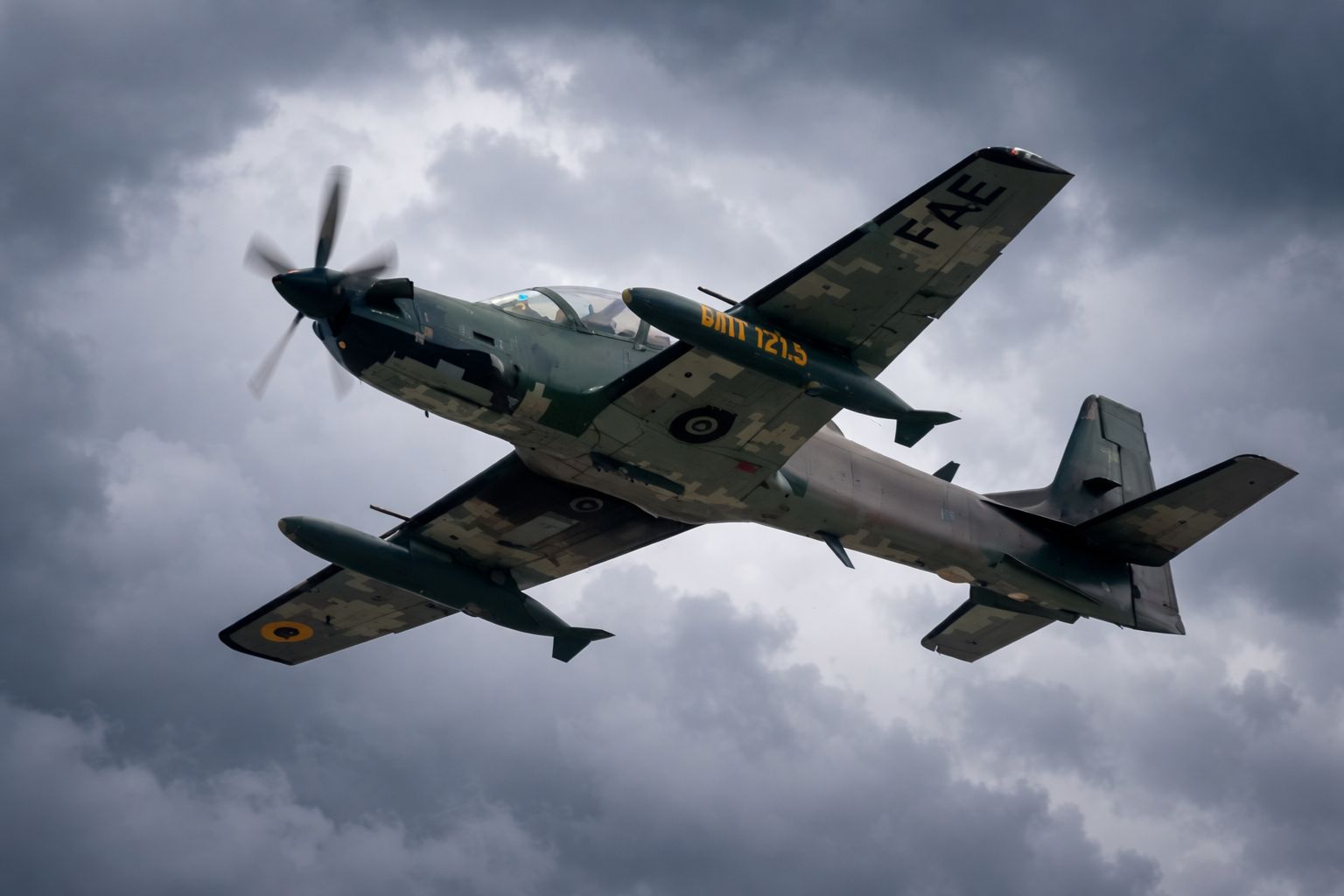

The United States confirmed the donation of intelligence, surveillance, and reconnaissance (ISR) sensors to Uruguay, in an agreement valued at US$ 5 million that strengthens American military presence in Latin America. The equipment will be installed on aircraft such as the Super Tucano and will allow real-time monitoring of borders and maritime areas, day and night.
The United States has just taken another step to consolidate its military influence in the Latin America. The American government confirmed a new cooperation agreement with Uruguay that includes the donation of advanced intelligence, surveillance, and reconnaissance (ISR) sensors, valued at approximately US$ 5 million. The equipment will be integrated into Uruguayan military aircraft, including the Embraer A-29 Super Tucano light attack aircraft, and will allow the country’s armed forces to monitor borders, detect illicit activities such as smuggling and illegal fishing, and surveil strategic maritime areas in real-time, 24 hours a day.
The announcement was made by the United States Embassy in Uruguay and details the scope of a bilateral collaboration that goes beyond a simple provision of equipment. The donation positions Uruguay as a privileged partner of the United States in security in Latin America, at a time when the competition for influence in the region intensifies between Washington and Beijing. For Uruguay, ISR technology represents a qualitative leap in territorial control capability that the country would not be able to acquire with its own resources. For the United States, it is another piece on the strategic presence board in Latin America.
What are the ISR sensors that the United States will donate to Uruguay
According to information from the portal El Cronista, ISR (Intelligence, Surveillance, and Reconnaissance) systems are essential technologies for modern military operations and represent the difference between monitoring a territory in a limited way and accurately surveilling it. The equipment that Uruguay will receive includes electro-optical sensors for high-resolution visual observation, infrared systems for night detection, and possibly surveillance radars that extend the operational range of the equipped aircraft.
-
China Develops Custom 140-Ton Electric Mining Truck with 770 kWh Swappable Battery, Deploys 290 Units in Xinjiang’s Largest Zinc Mine

-
Meta to Launch Arena, a New Prediction App Targeting 3.56 Billion Users, Competing with Polymarket and Kalshi

-
Scientist Challenges Famous Human Evolution Theory, Argues Homo Sapiens Evolved Gradually Over Thousands of Years
-
15-Year-Old American Builds Ocean Generator with PVC Pipe and 3D-Printed Propeller for $12, Wins National Prize, Presents at White House, and Makes Forbes 30 Under 30 List




In practice, this means that an aircraft equipped with ISR sensors can fly over an area and identify movements on the ground or at sea from kilometers away, even at night or in reduced visibility conditions. The technology allows for the detection, identification, and tracking of targets in real-time, providing armed forces with accurate information to make operational decisions without relying on direct visual observation. For a country like Uruguay, which has extensive land borders and an Exclusive Economic Zone in the South Atlantic, this type of capability has until now been inaccessible.
How American sensors will be used in Latin America

The main stated objective of the cooperation is to strengthen Uruguay’s monitoring and patrolling efforts in areas considered strategic. ISR sensors will be installed on aircraft of the Uruguayan military aviation, particularly the A-29 Super Tucano, a light attack aircraft manufactured by the Brazilian company Embraer that already operates in more than a dozen air forces around the world and is considered ideal for surveillance and counterinsurgency missions.
With American technology, Uruguayan forces will be able to monitor airspace and maritime areas in real-time, detect illegal activities such as drug and goods smuggling or illegal fishing in the Exclusive Economic Zone, improve land border control, and optimize responses to risk situations such as unauthorized incursions or humanitarian emergencies. The ability to operate both day and night significantly expands surveillance coverage, eliminating the windows of opportunity that criminals traditionally exploit during darkness.
Why the United States chose Uruguay in Latin America
The choice of Uruguay as a recipient of American military technology in Latin America is not accidental. The country is considered one of the most stable democracies in the region and maintains a balanced foreign policy stance that does not automatically align it with either Washington or Beijing, making the acquisition of its strategic partnership particularly valuable for the United States. By strengthening Uruguayan military capabilities, Washington gains an operational ally in the Southern Cone without the political baggage that accompanies similar agreements with larger and more polarized countries.
The investment of $5 million may seem modest in terms of the American military budget, but for Uruguay, it represents a significant enhancement in capabilities that would take years and considerable resources to develop domestically. The American strategy in Latin America has been to offer technology and training as a way to build operational dependence and institutional loyalty, a model that directly competes with the Chinese approach of investing in civil and commercial infrastructure. The two powers are competing for influence in the region with different tools.
The geopolitical context of American presence in Latin America
The donation of sensors to Uruguay occurs at a time of military repositioning by the United States on a global scale. The arrival of the aircraft carrier USS George HW Bush in the Mediterranean Sea, after crossing the Strait of Gibraltar, demonstrates that Washington is mobilizing military assets in multiple regions simultaneously, maintaining the capability for force projection in both the Middle East and the Americas. The carrier strike group includes Arleigh Burke-class destroyers such as the USS Ross, USS Donald Cook, and USS Mason.
In Latin America, the American presence competes with Chinese expansion that includes projects such as solar parks in Cuba, agricultural trade agreements with South Africa aimed at the Asian market, and investments in port infrastructure in several countries in the region. For the United States, each military cooperation agreement like the one made with Uruguay is a way to maintain strategic relevance in Latin America without the political cost of establishing permanent bases, an approach that Washington has preferred in recent decades.
What the donation means for regional security in Latin America
Beyond the bilateral relationship between the United States and Uruguay, the donation of ISR sensors has implications for regional security. A Uruguay with advanced monitoring capability can share intelligence with neighboring countries and contribute to joint operations against drug trafficking, illegal fishing, and smuggling that affect the entire Atlantic coast of Latin America. The interoperability of American systems with equipment from other regional allies facilitates this type of cooperation.
For neighboring countries like Argentina and Brazil, the presence of American surveillance technology in Uruguay can be seen as an opportunity for cooperation or as a reason for caution, depending on the political context of each government. Latin America is experiencing a moment where external influence increasingly manifests through defense agreements, technology, and infrastructure, and each new move by Washington or Beijing alters the balance of a region trying to navigate between the two powers without fully committing to either.
The United States will donate advanced surveillance sensors to Uruguay to monitor borders and maritime areas in Latin America. Do you think this American military presence is positive for the region? Leave your opinion in the comments.






