






 Portuguese
  Spanish


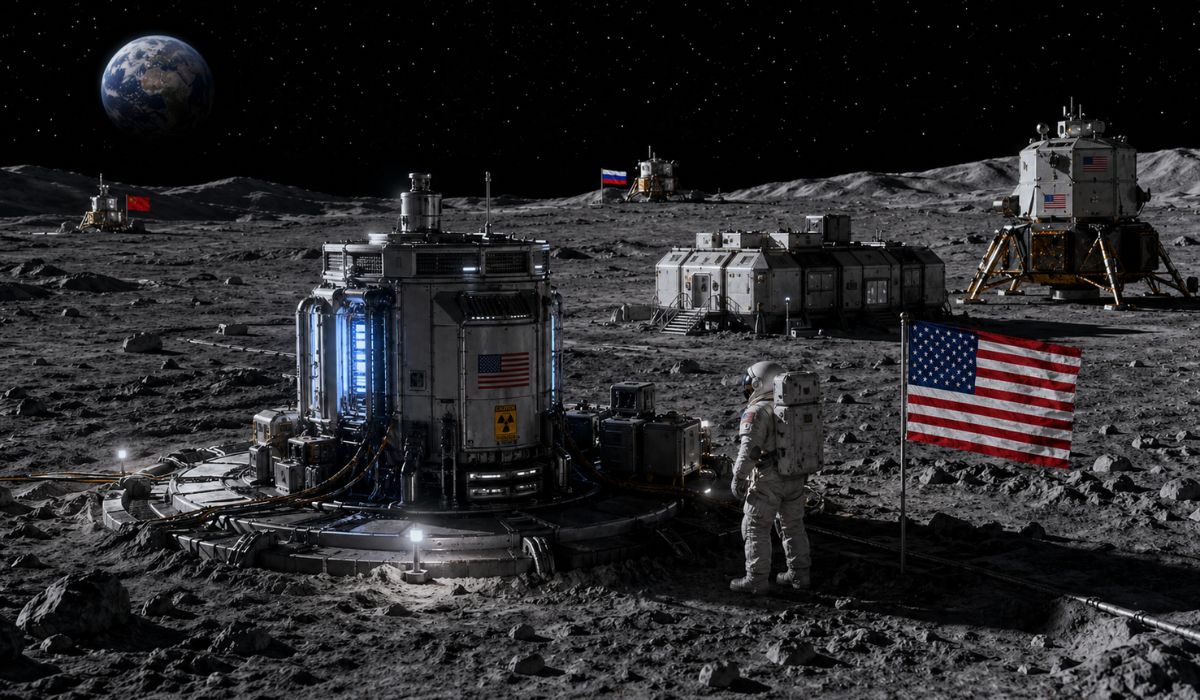

American plan foresees nuclear reactors to sustain Moon missions, test nuclear electric propulsion, and compete in space with China and Russia’s projects, still dependent on authorizations, suppliers, and technical schedules.
The United States intends to develop and test, in the coming years, nuclear reactors aimed at space use and have a fission system ready for launch to the Moon by 2030.
The goal is stated in a White House memorandum that directs NASA to create a medium-power space reactor, with one version intended for the lunar surface and another for demonstrating nuclear electric propulsion in missions beyond Earth.
The directive is part of the National Initiative for American Space Nuclear Power, signed on April 14, 2026, by Michael J. Kratsios, Director of the White House Office of Science and Technology Policy.
-
Brazilian Researcher Develops Protein Supplement from Tilapia Waste, Combining Innovation and Sustainability with Economic Potential

-
Women in São Paulo Unknowingly Tracked by Coin-Sized Tags Hidden in Cars and Belongings, Raising Stalking Concerns
-
Near a $750 million AI data center in Brazil, a resident’s well runs dry, leaving her unable to afford the $25,000 needed for repairs.

-
16-Year-Old from Brazil’s Sertão Wins Young Scientist Award for AI Predicting Rainfall with 94.5% Accuracy to Aid Farmers


The document links the program to the Donald Trump administration’s strategy to expand American presence in space and foresees reactors in orbit starting in 2028, in addition to a lunar surface reactor by 2030.
According to the White House text, nuclear power should support long-duration missions, providing stable supply for habitats, vehicles, communication systems, and operations that do not rely solely on sunlight.
In January 2026, NASA and the U.S. Department of Energy had already announced an agreement to develop a fission system for the Moon and future missions to Mars.
NASA’s Space Nuclear Reactor Program
NASA will work with different private suppliers and conduct projects at least until the preliminary design review and the ground testing phase.
These tests should demonstrate hardware performance, although the memorandum does not mandate a terrestrial test of the complete system.
The White House also directs that projects for the Moon and for nuclear electric propulsion share components whenever technically feasible.
Among the items cited are the reactor, nuclear fuel, and parts of the hardware platform, provided that common use does not increase risks, costs, or delays.
Another point foreseen in the directive is the use of mature and already demonstrated technologies.
According to the document, this choice aims to reduce technical uncertainties and facilitate compliance with the established deadlines for development, testing, and launch.
Medium-power reactors should provide at least 20 kWe for a minimum of three years in orbit and five years on the lunar surface.
NASA may also select a smaller alternative, of 1 kWe, if this option reduces costs and schedule risks.
At least one of the chosen projects must allow expansion to 100 kWe or more.
This power level is cited by the White House as necessary for missions with higher energy demand on the Moon, Mars, and in deep space.
The agency will have to narrow the competition to a maximum of two projects within one year, considering each proposal’s ability to meet cost, schedule, and performance goals.
The memorandum also allows NASA to choose the same suppliers, or different teams, for the lunar surface and nuclear electric propulsion versions.
Nuclear Power on the Moon and Long-Duration Missions
Nuclear power appears in American plans as a way to provide continuous electricity in environments where solar generation may be limited.
According to NASA, surface fission systems can operate on the Moon and Mars regardless of environmental conditions, which helps sustain robotic and human missions for longer periods.
Before the new White House directive, NASA was already developing, in partnership with the Department of Energy and industry, a 40 kW class system to operate on the Moon in the early 2030s.
The agency stated that this power level could support habitats, rovers, backup networks, and scientific experiments.
The most recent memorandum sets a floor of 20 kWe for the first medium-power reactors and maintains the scalability requirement.
In practice, the program envisions initial smaller-scale systems, while also preparing technologies that can meet higher demands in the 2030s.
Participation of federal agencies and private suppliers
The strategy involves parallel competitions led by NASA and the United States defense sector, with support from the Department of Energy.
The space agency will lead systems for civil exploration, while the defense sector is expected to develop a medium-power space reactor for its own mission by 2031, subject to resource availability.
The Department of Energy was tasked with assessing, within 60 days, whether the American nuclear industrial base can produce up to four space reactors in five years.
The analysis must consider design, long-term components, and fuel availability.
When commercial sources are insufficient or unavailable, the agency may also supply uranium for the reactors.
This provision is included in the memorandum and is part of the measures to enable the timeline defined by the American government.
Coordination will be handled by the White House Office of Science and Technology Policy, responsible for developing a roadmap to identify regulatory, technical, and industrial obstacles.
Mentioned points include nuclear safety, environmental assessments, transportation, launch, ground testing, materials, power conversion systems, and specialized training.


China and Russia in lunar nuclear energy projects
The American plan advances in a context where China and Russia are also developing projects related to human presence and robotics on the Moon.
China is working to send astronauts to the satellite by 2030 and intends to build, with Russian support, a basic model of the International Lunar Research Station by 2035.
The future China-led lunar station may include a nuclear reactor as a power source on the surface.
The information was disclosed by Chinese space authorities and aligns with the country’s plans for permanent research infrastructure beyond Earth.
Russia also maintains its own projects for lunar nuclear energy.
In March 2026, the Chinese state agency Xinhua reported that the nuclear power plant planned by Rosatom, Kurchatov Institute, and Roscosmos would have at least 5 kW of power, a lifespan of up to ten years, and assembly planned between 2033 and 2035.
In April 2026, the Russian agency Tass reported that a prototype of the Selena station is expected to be built in 2032.
The project is cited within Russian plans for the use of nuclear energy in lunar facilities and associated space technologies.
The timelines disclosed by the countries indicate that the development of reactors for the Moon still depends on technical, industrial, and regulatory stages.
In the American case, there is no public confirmation regarding final suppliers, detailed total budget, or the exact launch date of the lunar reactor.
Authorization, safety, and integration processes with the launch vehicle and the module that will carry the system to the surface also remain pending.
These points are relevant because they involve the transport of nuclear material, operation in a space environment, and continuous functioning under extreme conditions.
According to NASA, fission systems can be one of the foundations for prolonged missions beyond Earth, by offering stable power generation in locations where solar panels face limitations.


