






 Portuguese
  Spanish


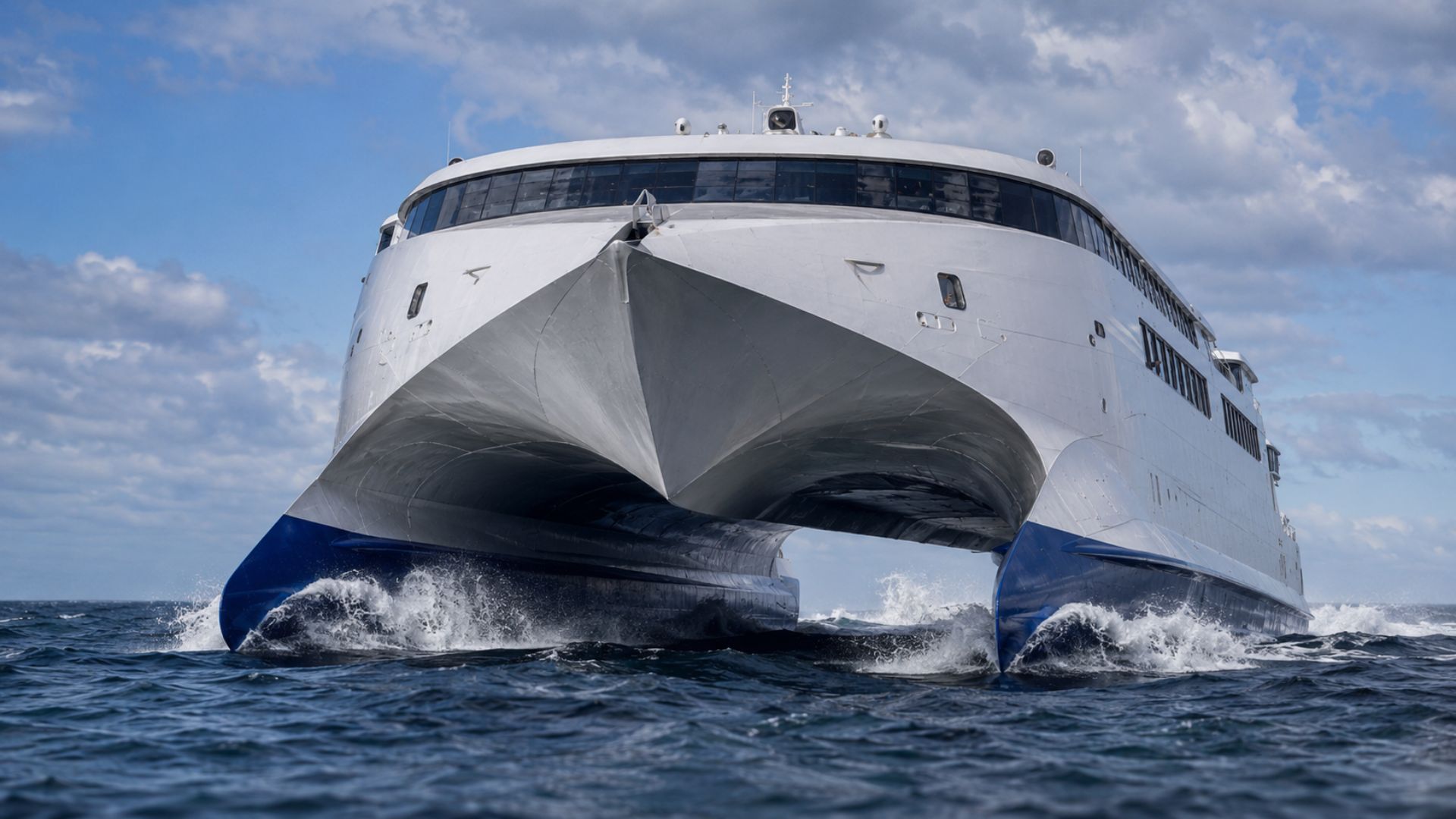


The Francisco, a catamaran built by Incat in Tasmania for the operator Buquebus, is the fastest passenger ship in the world in service: it reached 58.1 knots, about 107 kilometers per hour, during tests in light ship conditions. According to GCaptain, its wave-piercing hull, made of aluminum, cuts through the water instead of climbing over it, reducing drag and wasted energy. The same design logic appears in American Navy ships like the Spearhead and the Independence.
The Francisco is not just a speed record; it is an engineering demonstration that connects civilian passenger transport to military shipbuilding. Built by Incat Tasmania as hull number 069, the catamaran 99 meters long and weighing 450 tons entered service on the Buenos Aires–Montevideo route, crossing the Rio de la Plata in about two hours, a journey that would take eight hours by road. What makes the Francisco relevant is not just the speed, but the principle that made it possible: the wave-piercing hull design, which divides the displacement work between two narrow hulls and uses a central bow to cut through the waves instead of climbing them.
This architecture was not restricted to civilian transport. The same logic of multiple aluminum hulls, shallow draft, and high-speed propulsion was adopted by the United States Navy in at least two classes of ships: the Spearhead-class Expeditionary Fast Transport, a 103-meter catamaran built by Austal USA, and the Independence-class Littoral Combat Ship, a 127-meter trimaran. The connection between the Francisco and these warships is not direct, but the technical language is the same.
How the wave-piercing hull works

Francisco uses a wave-piercing catamaran design, with two long, narrow main hulls connected by a wide deck structure. At the bow, a central arch penetrates the water’s surface instead of being lifted by the waves. This geometry allows the ship to cut through the wave with controlled movement, reducing impact, uncomfortable rolling, and the energy that would be wasted by repeatedly rising and falling.
-
World’s Largest Particle Accelerator Begins Four-Year Hiatus for Magnet Overhaul, Aiming to Hunt Dark Matter by 2030

-
“Sahara Dust Turns Rain Red, Startling Residents Across Europe”
-
Stanford Scientists Develop 20-Cent Paper Centrifuge Inspired by Ancient Toy, Spins at 125,000 RPM Without Electricity, Separates Plasma in 1.5 Minutes, Aiding Diagnostics in Remote Areas

-
World’s Largest Vaccine Manufacturer, Immunizing Two-Thirds of Global Infants, Originated in a Pune Horse Farm





In a conventional monohull ferry, the entire mass of the ship pushes the water ahead. Francisco divides this work between two narrow hulls, which reduces the wetted area and improves hydrodynamic efficiency. For a ferry carrying 1,024 passengers and 150 cars, the extra width of the catamaran also offers more deck space without increasing the length. Each hull has nine watertight compartments separated by transverse bulkheads — a structure that distributes loads during high-speed operation and contains damage if a section is compromised.
Gas turbines, water jets, and the speed of 58 knots
Francisco’s propulsion combines two GE LM2500 gas turbines, each with 22 megawatts of power, connected to two Wärtsilä LJX1720 SR water jets. The principle is similar to that of a jet engine: water enters from below the ship, is accelerated within the unit, and expelled backward, propelling the vessel forward. For maneuvers, the jet changes direction; for braking, the system redirects the flow.
Francisco was the first high-speed vessel from Incat equipped with a dual-fuel gas turbine installation, operating with liquefied natural gas as the main fuel and marine diesel as a backup. In tests under light ship conditions, the catamaran reached 58.1 knots — approximately 107 kilometers per hour. Three elements worked together to achieve this result: the wave-piercing hull reduced drag, aluminum kept the weight low, and the two 22-megawatt turbines powered water jets sized for the intended speed. If any of these factors were out of balance, Francisco would not have the same performance.
Weight as the silent enemy of a fast ferry
In a ship that seeks speed, every kilogram matters. Francisco carries within its aluminum hull a duty-free shop of over a thousand square meters, first-class and executive seating, bars, bathrooms, vehicle ramps, and all service infrastructure. For engineers, these items are not just amenities — they are weight that needs to be controlled with discipline.
Incat manages these concessions from the design phase. Air conditioning has weight, glass has weight, paint has weight, water tanks, insulation, cables, and every accessory count in the final sum. Fast ships rarely lose performance because of a single heavy item. They lose when hundreds of small items accumulate without control. Aluminum is the structural choice precisely because it weighs less than steel — a direct advantage for a vessel that needs to maintain daily commercial speed, not just set a record in a test.
From Francisco to American Warships
The technical language of Francisco — aluminum, multiple hulls, shallow draft, large capacity, high speed, responsive propulsion — is the same that appears in United States naval programs. Austal USA, which operates a shipyard in Mobile, Alabama, has built ships that apply this same reasoning for military purposes.
The United States Navy describes the Spearhead as a 103-meter aluminum catamaran, built by Austal USA, with a speed of 35 to 40 knots and a range of about 1,200 nautical miles. Its function is to move troops, vehicles, equipment, and humanitarian aid supplies to locations that require a quick response — and it can operate with simpler port facilities than larger ships require. Francisco transports passengers and cars; the Spearhead transports soldiers and cargo. But the design logic is recognizable.
The Combat Trimaran and the Limits of Speed
There is also the Independence-class Littoral Combat Ship, built by Austal USA. Contrary to what many assume, the Independence is not a catamaran; it is a trimaran, with a main central hull and two smaller side hulls. The difference matters because the hull shape affects stability, space, load, and behavior in the water. The ship is 127 meters long, has a speed of over 40 knots, and uses two GE LM2500 turbines, the same as Francisco, combined with two MTU diesel engines.
The Independence LCS program also brought a lesson that Francisco did not have to face: speed does not replace armor, sensors, maintenance, or crew training. In a combat ship, all these systems need to work together. The debate over the LCS in the United States lasted for years precisely because of the trade-offs between speed, modularity, survivability, and operational cost. Francisco proved that aluminum and multiple hulls work for speed. The LCS showed that speed alone does not solve the problems of a combat theater.
What Francisco Teaches About Naval Engineering


The story of Francisco goes beyond a speed record. It shows how decisions made at the shipyard, the hull shape, the choice of aluminum, the type of propulsion determine what a ship can or cannot do over decades of operation. In the commercial route, Francisco competes not only with other ferries but with regional flights between Buenos Aires and Montevideo. If the crossing is fast enough, the passenger chooses the ship over the plane.
On military ships, the same logic translates into mobility, load capacity, and access to ports with limited infrastructure. The principle of the wave-piercing hull, born in Tasmanian shipyards to transport tourists across the Rio de la Plata, ended up serving the American Navy to move troops in crisis scenarios. Engineering does not ask if the use is civilian or military, it answers the same question in both cases: how to move the maximum load, in the shortest time, with the least energy expenditure.
Did you know that the same technology used in the world’s fastest ferry appears in warships? What impresses you most about the Francisco: the speed of 107 km/h, the hull that cuts through the waves, or the connection with the US Navy? Share in the comments.


