Portuguese
  Spanish


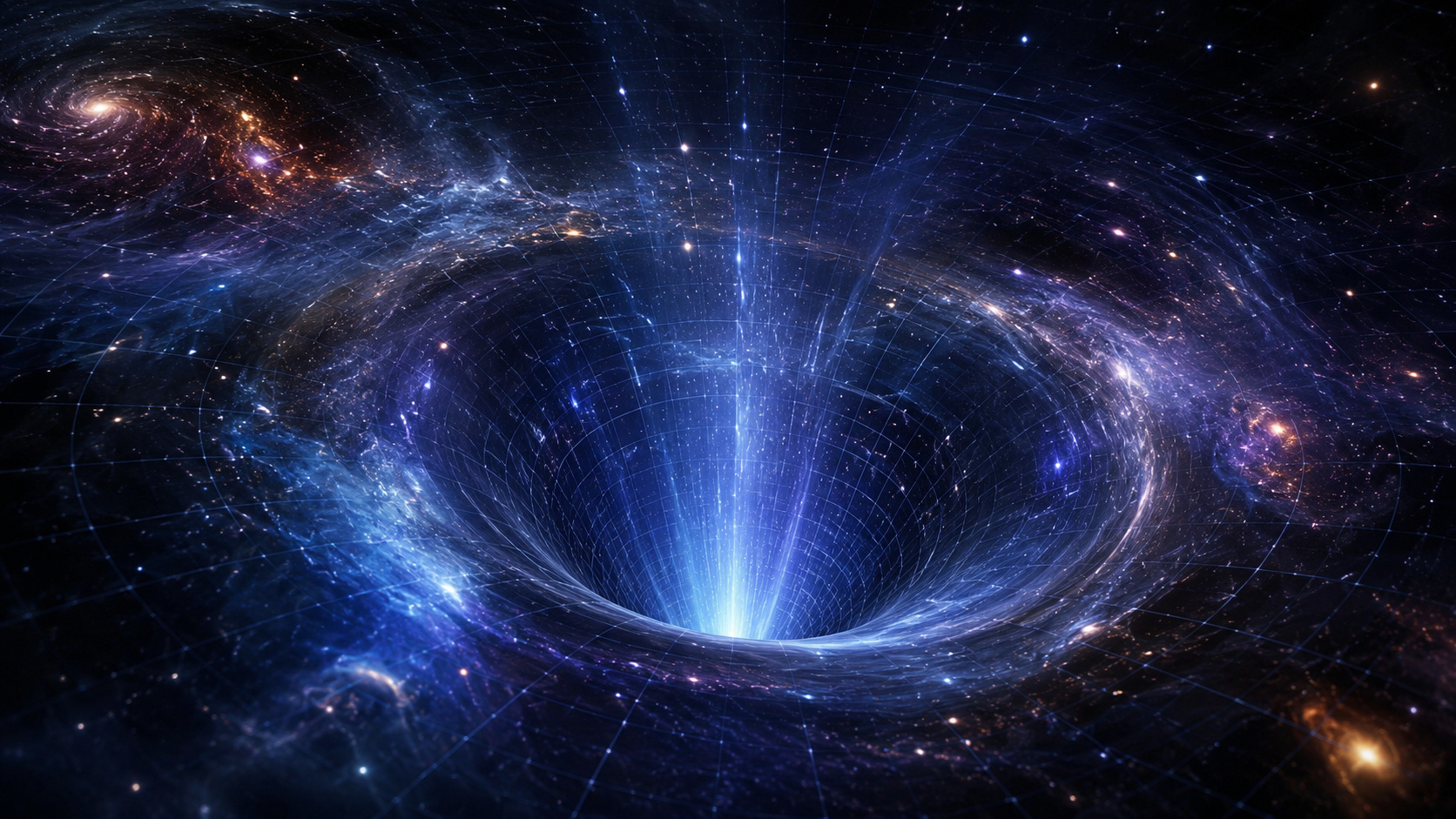


Scientists investigate a microscopic anomaly in the “fabric of time” and reveal a scientific discovery that challenges theories of physics.
Modern physics has gained a new topic of debate after an international study suggested that time may not be as stable as we imagined. A study published in ScienceDaily on May 3rd indicates that quantum processes associated with gravity may introduce a minimal, almost imperceptible uncertainty in the way time passes.
The investigation was developed with support from the Foundational Questions Institute (FQXi) and led by Nicola Bortolotti, a researcher affiliated with the Enrico Fermi Museum and Research Centre in Rome. The work also included participation from names like Catalina Curceanu and Kristian Piscicchia. The most intriguing aspect is not in visible effects in everyday life, but in the possibility of a hidden microscopic anomaly in the fundamental structures of the Universe.
Although the hypothesis is far beyond the capability of current equipment, the research is already sparking interest because it touches on one of science’s greatest questions: the attempt to unite gravity and quantum mechanics into a single explanation of reality.
-
The Trap of Modern Technology: How Screen Overload and Digital Connections Can Impact Your Mental Health and Well-being

-
Wyoming Couple Grows Tropical Fruits Year-Round in -40°C Using Geothermal Greenhouse, Demonstrating Earth’s Heat Can Produce Oranges and Lemons in Snow Without Traditional Heating

-
Ship Returns from Brazilian Coast with Thirty Newly Discovered Life Forms
-
Nigerian Professor Invents Electricity-Free Refrigerator Using Clay Pots and Wet Sand, Extending Shelf Life of Vegetables to 27 Days; 7,000 Units Distributed in Energy-Deprived Villages



Scientists investigate possible hidden limits in the fabric of time
The scientists responsible for the study sought to understand if quantum phenomena could generate small imperfections in the very functioning of time. The proposal arose from theoretical models that try to explain microscopic events that are still poorly understood.
Among the main systems analyzed were the Diósi-Penrose and Continuous Spontaneous Localization models. Both suggest that the collapse of quantum states can happen spontaneously, without necessarily depending on the presence of an external observation.
The team began to investigate how these models could interact with gravity. The result drew attention because it pointed to the possibility of a natural limitation hidden in the fabric of time.
According to the researchers, this does not mean that the Universe is “failing,” but it may indicate that there is a maximum precision allowed by nature itself. This scientific discovery began to attract attention precisely because it suggests something that until recently seemed unlikely: time may have small fundamental imperfections.

The microscopic anomaly emerged at scales smaller than current technology can observe
The research makes it clear that the possible microscopic anomaly identified is on an extremely small scale. So small that not even the most advanced clocks on the planet would be able to register this effect.
Catalina Curceanu, a participant in the work, highlighted that the technology available today remains distant from this level of precision. This means that modern applications continue to function normally.
Among them are:
- GPS systems;
- Global telecommunications;
- Digital networks;
- High-precision computers;
- Advanced atomic clocks.
In practice, everyday life continues exactly the same.
Even so, the hypothesis opens up new questions. After all, if there is a small temporal flaw, it may indicate that there are still fundamental aspects of the Universe awaiting explanation. The scientists emphasize that the discovery is linked to fundamental physics and does not represent any risk or perceptible change to society.


The conflict between gravity and time remains one of the greatest challenges in physics
For decades, researchers have been trying to solve a well-known problem in modern science: making quantum mechanics and general relativity work together.
Separately, both work extraordinarily well. General relativity describes the behavior of massive objects, stars, galaxies, and gravitational phenomena. Meanwhile, quantum mechanics explains the functioning of the subatomic world.
The problem arises when these theories need to coexist. In quantum mechanics, time is often treated as something fixed, external, and constant. In relativity, the scenario changes completely. The temporal flow can be altered by the presence of mass, speed, or energy. This difference has created a deadlock that remains without a definitive solution.
The scientists involved in the study decided to investigate precisely this meeting point between the two models. It was during this analysis that the possible temporal flaw began to emerge as a relevant theoretical consequence.

Scientific discovery broadens debates about the structure of the Universe
The new scientific discovery does not provide definitive answers, but strengthens important discussions.
Nicola Bortolotti led the investigation that connected models of quantum collapse with space-time fluctuations related to gravity. The work proposed a simple yet profound question: if gravity influences fundamental structures of the Universe, could it also affect the very definition of time?
Kristian Piscicchia participated in the research highlighting the importance of this type of analysis for future unified theories. The investigation suggests that there may be a natural physical limitation hidden in the most extreme measurements.
Among the main points observed by the researchers are:
- Small temporal fluctuations may exist;
- The effect remains undetectable currently;
- Modern clocks remain reliable;
- The hypothesis may aid future gravitational theories;
- New tests may emerge in the coming decades.
This type of work gains relevance because many great discoveries began as hypotheses seemingly impossible to prove.
Fabric of time and temporal flaw may redefine future research
The idea that the fabric of time may contain small irregularities changes the way many researchers view the Universe.
For decades, the prevailing concept considered time a stable and perfectly predictable magnitude. The new study introduces a different scenario. Perhaps there are small oscillations hidden in extremely reduced scales.
This possible microscopic anomaly would be so small that it would completely escape current measurements. Still, the conceptual impact is enormous.
If future research confirms this behavior, entire areas could be affected:
- Cosmology;
- Particle physics;
- Quantum gravity;
- Studies on the origin of the Universe;
- Unifying theories.
Scientists believe that understanding these effects may reveal still unknown aspects of reality. The search for the so-called Theory of Everything precisely depends on such answers.
What makes this microscopic anomaly so relevant to modern physics
Throughout history, science has shown that almost invisible phenomena can completely transform human understanding.
Gravitational waves are a well-known example. Predicted by Albert Einstein in 1916, they were only officially detected in 2015, almost a century later. The comparison helps to understand the current context.
Today, the possible microscopic anomaly seems distant from practical observation. However, technological evolution may change this scenario. The same has happened several times throughout the history of physics.
The very scientific discovery reinforces this possibility. What seems unattainable today may become observable tomorrow. The scientists involved in the research see precisely this perspective: opening paths for future experimental tests.
An invisible detail that can change our understanding of time
The investigation published in Physical Review Research does not claim that our clocks are wrong nor does it suggest immediate changes in everyday life. What it does is present a new possibility about the deep structure of the Universe.
The existence of a temporal flaw, still purely theoretical, raises important questions about the limits of current physics. The hypothesis of a microscopic anomaly embedded in the fabric of time also reinforces the need to expand research on gravity and quantum phenomena.
More than ready answers, works like this show something essential: science continues to advance precisely when it questions concepts considered absolute. And perhaps the greatest mystery is realizing that time itself, something so familiar to all of us, may still hide fundamental secrets.
With information from ScienceDaily