Portuguese
  Spanish


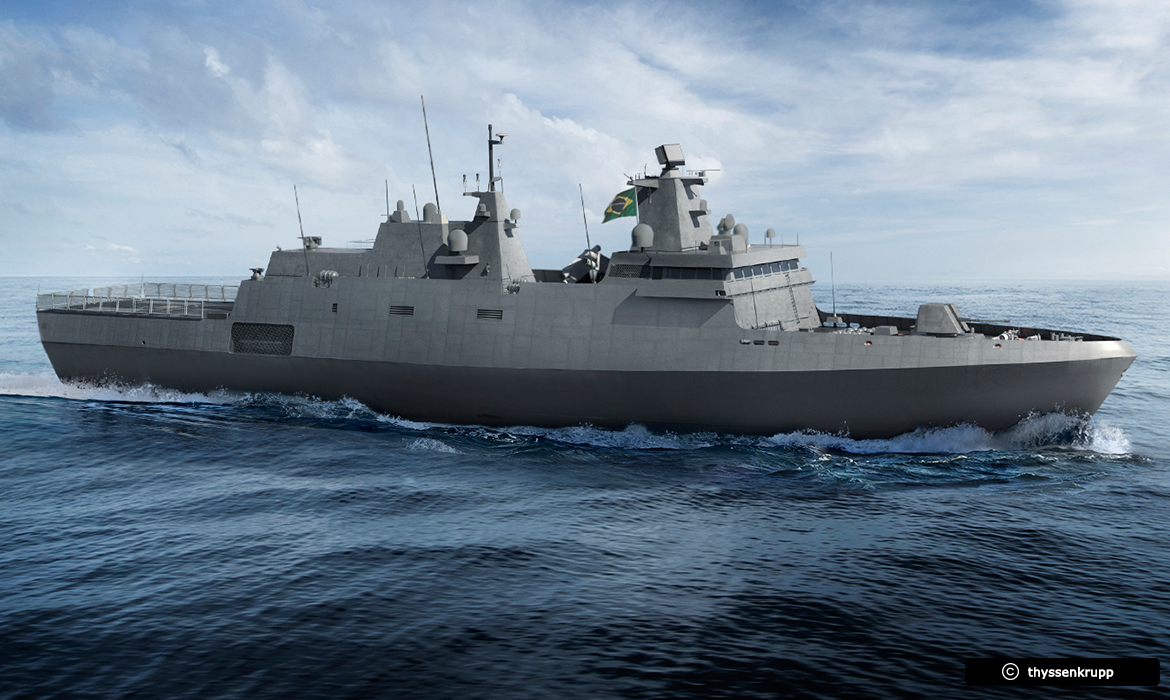

The Thyssenkrupp Estaleiro Brasil Sul Is the Setting for One of the Largest Technology Projects in the Country, in the Modernization of the Navy’s Ships with New State-of-the-Art Features.
The project at Thyssenkrupp Estaleiro Brasil Sul, considered the most innovative ever developed in the country, involves the construction of Tamandaré Class frigates for the Navy. There will be four defense vessels, equipped with the largest and best existing technologies, which will break traditional methods to include unprecedented technologies for the application of this project on ships.
See the Tamandaré Class Ships


For Thyssenkrupp Estaleiro Brasil Sul: The Environment and Technology Must Go Hand in Hand
The Brasil Sul shipyard was acquired in 2020 by Thyssenkrupp and is one of the most modern in our country. It covers an area of 310,000 m² and has a high level of automation and cutting-edge technology.
The shipyard boasts significant achievements such as ships for offshore operations of approximately 90 meters in length and 19 meters in breadth.
-
French Brand Transforms 6 Million Brazilian PET Bottles into Sustainable Sneakers for Global Fashion Market

-
Abandoned Factory in Rio’s North Zone Becomes Urban Hazard with Standing Water and Debris

-
The U.S. Navy Conducts Submarine Tests in Idaho Lake to Detect Underwater Noises Hidden by the Ocean
-
British Factory Transitions from Mechanical Parts to Producing 420,000 Electric Power Units Annually, Supplying 70% of Ford’s Electric Cars Sold in Europe


Following more traditional means, all projects were developed from a large volume of printed documents: drawings, procedures, and manuals that required numerous copies and regular updates.
Thus, a new scenario was created that promotes environmental benefits, in addition to being a completely innovative project.
The shipyard, with the support of Thyssenkrupp Marine Systems’ headquarters in Germany, implemented an engineering project named “Paperless,” which aims to eliminate paper drawings in production lines.
It’s worth noting that the construction of ships without printed drawings is entirely new in the South American shipbuilding industry, completely innovating the Brasil Sul shipyard to make it a reference in frigate production.
Moreover, João Aldo Filho Hoffmann states that the model of the vessel presented in June has been 100% built in a paperless manner, that is, without printing paper drawings.
Innovation of Technology in Naval Means
For better deployment of technology in the Navy’s vessels, over 20 kiosks with computers were installed in the production area of the shipyard, along with about 25 tablets.
With this equipment, workers responsible for the project can access systems, drawings in 2D and 3D formats, procedures, manuals, and checklists. Best of all, all these options are updated in real time by the engineering team in Brazil and Germany.
As a result, labor tracking, internal consumable requests, traceability of plates, profiles, piping, and quality checks are all done digitally.
The next challenge to be tackled is the use of Augmented Reality, which is even more innovative.
Through this device, it will be possible to overlay holograms onto the physical part, verifying the assembly positioning, layout of compartments, sector interferences, and quality checks.
And the best part is that all of this can be carried out by professionals here in the country or by Thyssenkrupp specialists in Germany.
Project Leadership
The leaders are confident and hope that the project is just the beginning of great technological innovation in naval means.
The CEO of Águas Azuis, Fernando Queiroz, says: “The delivery of a technological product begins in its production. These investments in innovation will ensure the delivery of the frigates with the highest standards of quality and excellence, within the deadlines established in conjunction with EMGEPRON and the Brazilian Navy.”
Currently, the project is led by naval engineer Letícia Bodanese, who has been working at Thyssenkrupp Estaleiro Brasil Sul for two years.
For her, it has been a challenge, especially in innovative projects like the paperless: “People naturally tend to resist the process of change. But after a stage of awareness, they learn to work in the new scenario and contribute to the process, incorporating changes into their habits, thus contributing to the personal development of each collaborator and the development of the company,” explains the leader.
The Companies Behind Great Innovations
The relationship between SPE Águas Azuis and Brazil is long-standing.
Thyssenkrupp Marine Systems, a company of the Thyssenkrupp Group, is one of the major suppliers of systems for submarines and surface naval vessels, as well as maritime security technologies with a centuries-old shipbuilding history.
Thyssenkrupp, on the other hand, is an international group of companies employing around 96,000 people in 48 countries. In the fiscal year 2021/2022, it recorded a revenue of 41 billion euros, being responsible for creating value with innovative products, technologies, and services that help improve life for future generations.