Portuguese
  Spanish


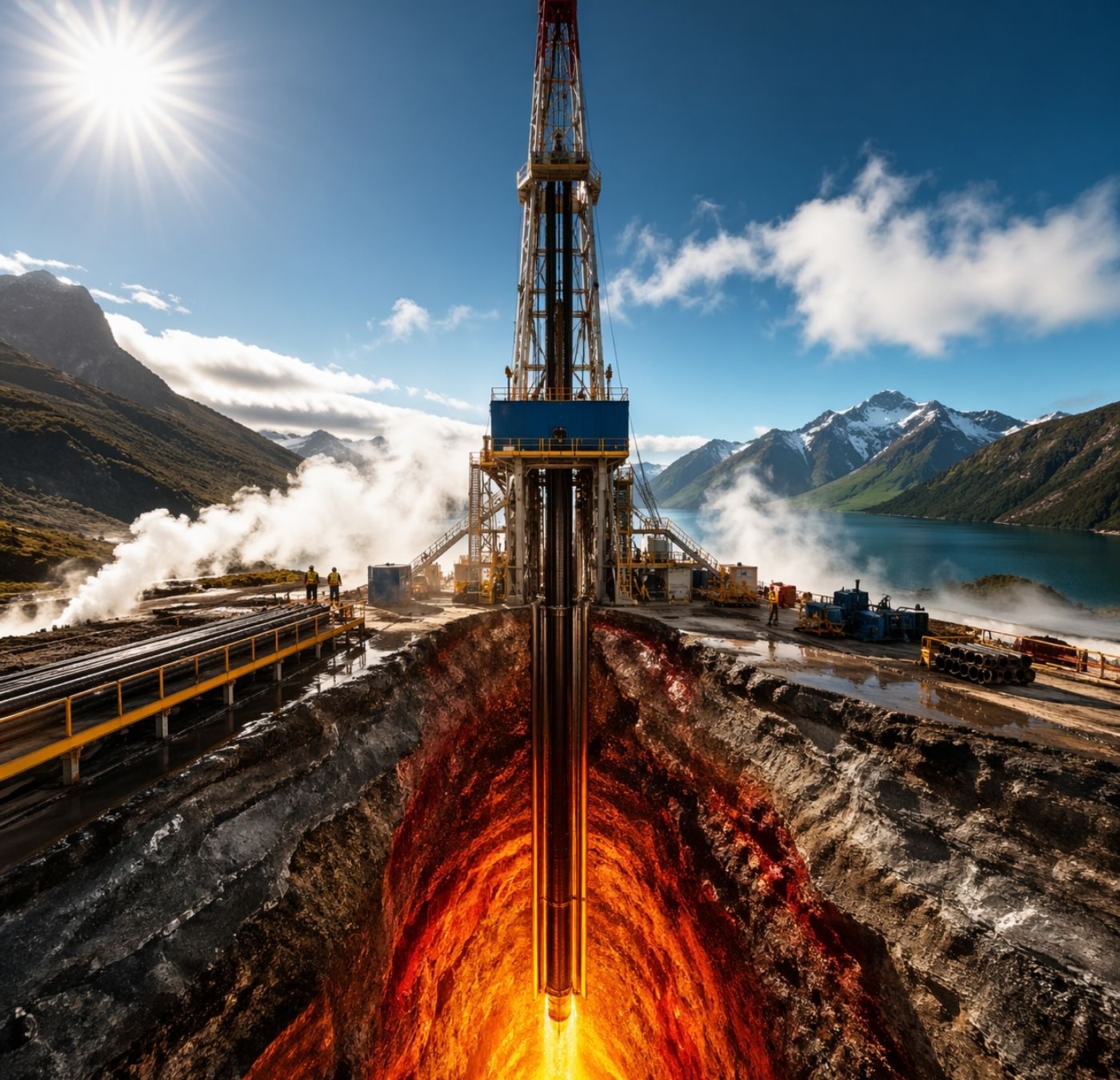

Project to drill New Zealand’s first super-deep, super-hot geothermal well will be led by Todd Energy, at the Rotokawa field, near Taupō, with an anticipated start in mid-2027 and the goal of accessing superheated fluids capable of expanding the country’s renewable energy supply
Todd Energy has been chosen to drill New Zealand’s first super-deep, super-hot geothermal well, at the Rotokawa field, near Taupō, with an anticipated start in mid-2027. The project aims to access superheated fluids at depths of up to 5 or 6 kilometers, almost double that of conventional geothermal wells.
The initiative, coordinated by MBIE in partnership with Earth Sciences New Zealand, Tauhara North No.2 Trust, and Mercury, aims to test a still largely unexplored renewable source. If the well successfully generates a flow of superhot fluids, it could significantly expand the country’s knowledge of extreme geothermal energy and open a new energy frontier.
Project aims to drill beyond conventional limits
The initiative aims to drill a geothermal well under extreme conditions, reaching depths rarely explored in this type of operation. According to project coordinator Tim Groser, this represents a significant technological advance.
-
Couple Converts 1925 Detroit Bank into Home, Earns $40,000 Annually on Airbnb

-
Tired of Seeing People Sleep in the Cold, London, Canada Opens First Modular Shelter for Homeless with 60 Cabins, Heating, Meals, and Dog Area
-
Brazil’s $1.3 Billion, 870-Meter Immersed Tunnel to Be Latin America’s First of Its Kind, Featuring Special Public Facilities and Information Center
-
Brazilian Innovator Develops Concrete Blocks from Recycled Plastic, Eliminating Mortar and Reducing Construction Costs


“The goal is to drill up to 5 to 6 km, almost double that of traditional wells, to access a still unexplored renewable energy source,” he highlighted.
This approach seeks to reach the so-called supercritical geothermal system, where high temperatures and pressures drastically increase energy efficiency. In practical terms, this means extracting much more energy with fewer resources, making the model highly attractive.
Technical challenges: extreme heat, pressure, and corrosion
Drilling in superhot environments is not just a matter of depth, but of operational survival. The project will face:
- Extremely high temperatures
- Intense pressures at great depths
- Presence of highly corrosive fluids
These conditions make drilling technically complex and high-risk, requiring rigorous planning, robust equipment, and advanced safety systems.
Todd Energy’s selection was based precisely on its ability to handle this type of scenario, with a proven track record in drilling campaigns completed on time and within budget.
Todd Energy takes the lead with a complete structure
The selected company will be responsible for the entire drilling operation, including:
- Project management
- Subcontractor coordination
- Complete technical planning
- Execution in a high-risk environment
Furthermore, Todd Energy has its own equipment, local team, and an established supply chain in New Zealand, factors that reduce logistical risks and strengthen the regional economy.
Investment and strategic energy impact

The project received a US$60 million investment from the government, through the regional infrastructure fund, reinforcing the strategic priority of the initiative.
If the well successfully produces a flow of superhot fluids, the impact could be significant. Estimates indicate that this technology has the potential to:
- Generate clean energy on a large scale
- Triple the country’s current energy capacity
- Reduce dependence on fossil fuels
Chosen location and next steps
Drilling will be carried out at the Rotokawa geothermal field, near Taupō, an area already known for its geothermal activity.
The schedule foresees the start of operations in mid-2027, after the conclusion of contractual negotiations and preparatory stages.
This will be the first of three planned wells, indicating that the project is not just exploratory, but part of a long-term strategy.
New frontier of geothermal energy
New Zealand was already a pioneer in geothermal energy in the 20th century, and now seeks to regain that prominence by drilling in search of the next generation of clean energy.
The success of this initiative could redefine the role of geothermal energy on the global stage, positioning the country at the forefront of energy innovation.
Now the question remains: do you believe that drilling in such extreme conditions is the most promising path for the future of clean energy?