Portuguese
  Spanish


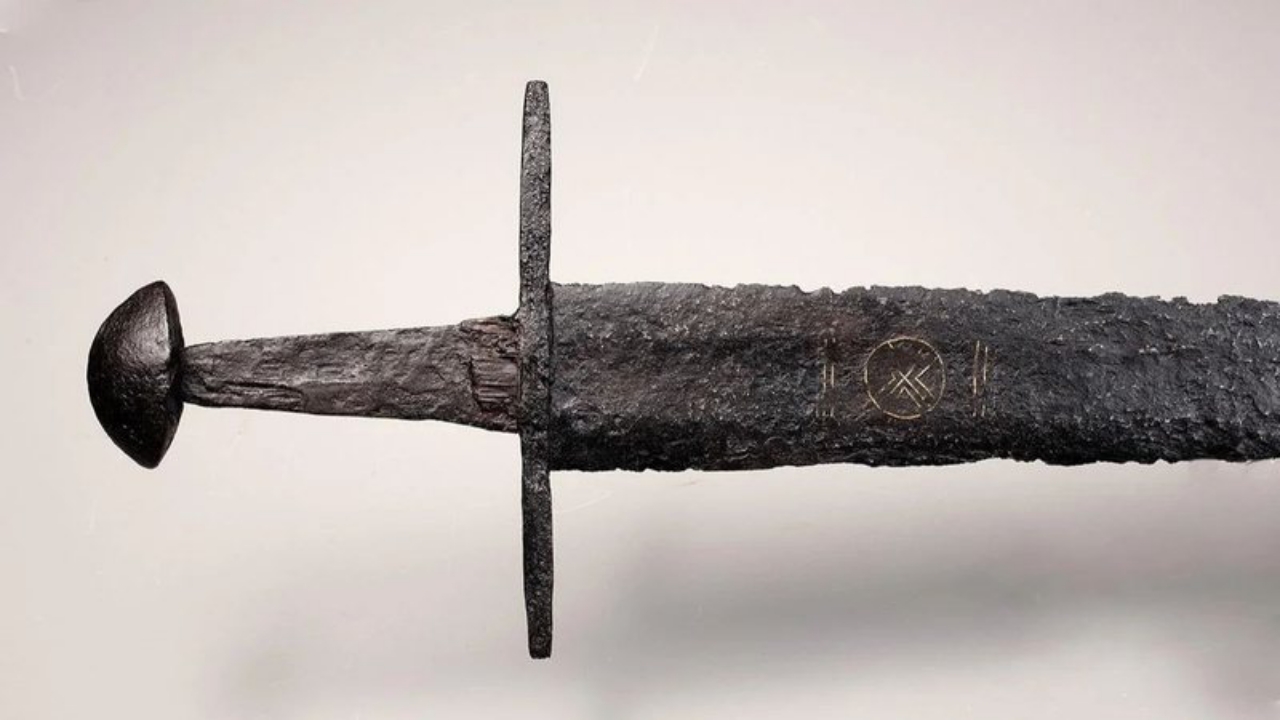


Rare Medieval Sword of the XI Century Resurfaces in River Extraordinarily Preserved, a Legacy in Iron and Copper that Crossed Almost a Thousand Years Without Losing Details Intrigues Archaeologists
In March 2024, a medieval sword emerged from the riverbed of Korte Linschote, near Montfoort, in The Netherlands, revealing signs of rituals and important symbols for European archaeology. The rare artifact, dated from the period between 1050 and 1150 AD, remains extraordinarily preserved: a legacy in iron and copper that crossed almost a thousand years without losing details.
The Blade That Emerged from the Mud
Construction workers were removing clay blocks from the riverbed when they saw what appeared to be metal remains. The sword was immediately handed over to the authorities of Montfoort and then to ODRU (Environmental Service of Utrecht), where archaeologists confirmed its origin: between 1050 and 1150 AD, under the influence of the local Bishopric. Named Linschoten Sword, the piece is a rare example of medieval European weaponry, a true gift to the community of archaeology scholars and enthusiasts of ancient history.
Thousand Years of Silence Preserved in the Clay
Forged in iron, it measures about one meter and weighs 900 grams. Its design is typical of the Central Middle Ages, with a 17 cm cross guard and a pommel shaped like a Brazil nut, a characteristic feature of Frankish blacksmiths of the 11th and 12th centuries. X-ray examinations revealed traces of leather and wood on the handle, remnants of the original covering.
-
Bruno Guimarães, 28, Misses Crucial Penalty Against Norway in World Cup After Replacing Vinicius Jr.

-
Two-Bedroom Home Built in a 40-Foot Shipping Container Delivered and Ready for Same-Day Living in São Paulo Countryside

-
Inspired by a school lesson on Africa’s water crisis, a young boy raised money through chores to fund a well that transformed a Ugandan community.

-
China Constructs Artificial Island 32 km Offshore for Yangshan Port, Connected to Shanghai by 32 km Bridge, Unloading 3,000 Containers in 20 Hours




According to specialists from the Rijksmuseum van Oudheden, where the item is currently on display, what really stands out is the state of preservation of the sword. The clay and anaerobic soil of the river acted as a natural preservation chamber, protecting the blade from corrosion for centuries. Once exposed to oxygen, however, a delicate restoration process began: ten weeks of desalination, followed by mechanical cleaning, controlled drying, and stabilization of tannins to prevent structural damage.
Engraved Symbols: Between the Sacred and the Pagan
A singular detail reinforces the ceremonial character of the sword: its symbolic decoration. On both sides of the blade, archaeologists identified inlays of copper alloy wire, carefully shaped into two distinct figures.
On one side, there is a solar wheel (sonnenrad), a Christian symbol associated with divine light and commonly used in sacred ceremonies of the time. On the other, the endless knot composed of five interwoven squares within a circle, a symbol present in Viking iconography, associated with loyalty and protection.
Offering to the River? The Ritual Hypothesis
The absence of the sheath and the position of the sword in the riverbed raised an intriguing hypothesis: the object may have been deposited there intentionally, as part of a ritual offering. This type of practice was common during the transition between the pagan world and Christianity, periods marked by cultural and symbolic syncretisms.
According to Dutch archaeologist Marieke van Dinter, cited by DutchNews.nl, “the offering of weapons to the waters was a spiritual act in various medieval and Germanic traditions. They were not lost: they were given.” This interpretation fits perfectly within the political-religious context of the 11th century, when the Bishopric of Utrecht still exercised feudal dominance over that region.
Where to See the Sword Today?
Since May 2025, the Linschoten Sword has been under the care of the Rijksmuseum van Oudheden, the National Museum of Antiquities of the Netherlands, in Leiden. It can be viewed by visitors until August as part of an exhibition on medieval ceremonial weapons.
The institution is internationally recognized for its collection and for conservation initiatives that follow the strictest European protocols. The exhibition of the sword is accompanied by explanatory panels, scanning videos, and even digital reconstructions of the original piece, a bridge between the medieval past and modern technologies of forensic archaeology.
Why This Sword Matters?
Discoveries like this are not just historical curiosities; they reconstruct how we understand the habits, conflicts, and symbols of entire societies. A sword, especially in such good condition and with such evident symbolic weight, offers clues about religious alliances, warrior identity, and transition rituals in medieval times.
Moreover, finding this type of piece outside of a direct military context (like a battlefield or fortress) reinforces the anthropological value of the find. It shows us that the object was more than a weapon: it was part of a cosmology, a narrative of power and faith.
At a time when so much history is lost or erased by poorly conducted works, finding such an artifact, accidentally, is almost an archaeological miracle. The Linschoten Sword, more than a piece of old iron, is an invitation to reflect on how medieval Netherlands was a meeting point for cultures, beliefs, and practices that still echo today.