Portuguese
  Spanish


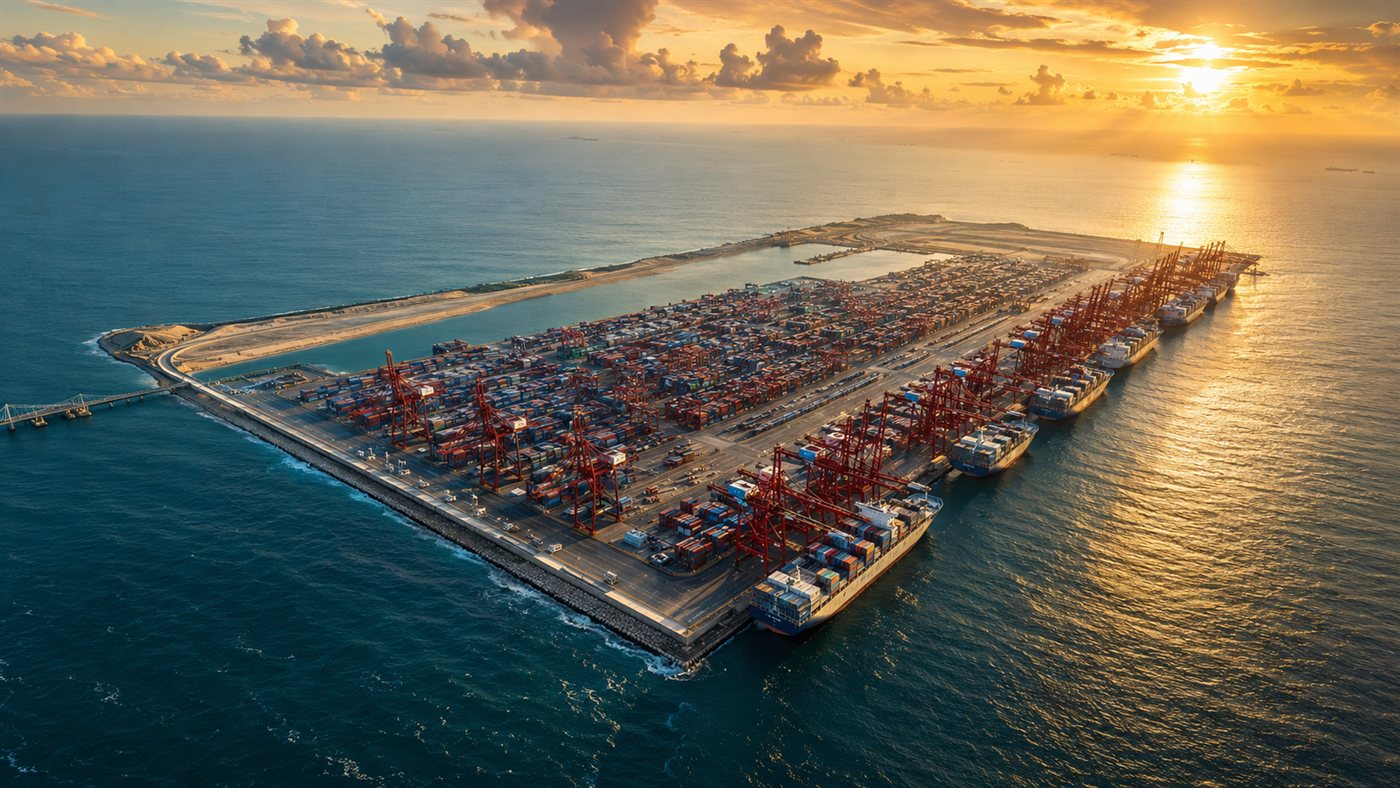

The Big Engineering documentary tells how engineers overcame mud, typhoons, and 6-meter waves to build from scratch the largest deep-water port on the planet
When the engineers in Shanghai chose the site for the world’s largest container port, more than 60% of it didn’t even exist: it was open sea and a handful of islets with a fishing village. The saga of the Yangshan port, built 32 km off the Chinese coast, is told in a documentary by the Big Engineering channel, published in June 2026, which records the construction carried out in the 2000s.
The project’s numbers remain astonishing decades later. The plan envisioned a 20 km quay with 50 berths, capacity for 25 million containers per year, 70 thousand in a single day, at an estimated cost of US$ 18 billion, as detailed by Big Engineering. The construction began in 2002 and, in less than 4 years, transformed a 15-meter deep ocean into 10 km² of port, an area larger than 20 thousand basketball courts.
Shanghai’s bottleneck: mud, tide, and a jammed river
The giant port was born out of a squeeze. According to Big Engineering, China’s foreign trade was growing by almost 30% per year at the beginning of the century, the cargo descending the Yangtze River jumped from 300 million tons in 2001 to about 800 million in 2005, and Shanghai, the busiest port in the world, was physically jammed.
-
China’s $70 Billion River Diversion Project, the World’s Largest, Moves 44.8 Billion Cubic Meters Annually, Crosses Under the Yellow River, and Displaced 330,000 People

-
Indian Driver Spends 14 Years Digging 10-Meter Tunnel Through Mountain to Connect Isolated Village to the World

-
72 m² Prefabricated Home Arrives in a Container and Assembles in About an Hour
-
Brazilian Architect Patents Styrofoam House 20% Cheaper, Maintains 23°C Year-Round; Client Builds 280 Meters of Wall in 40 Days
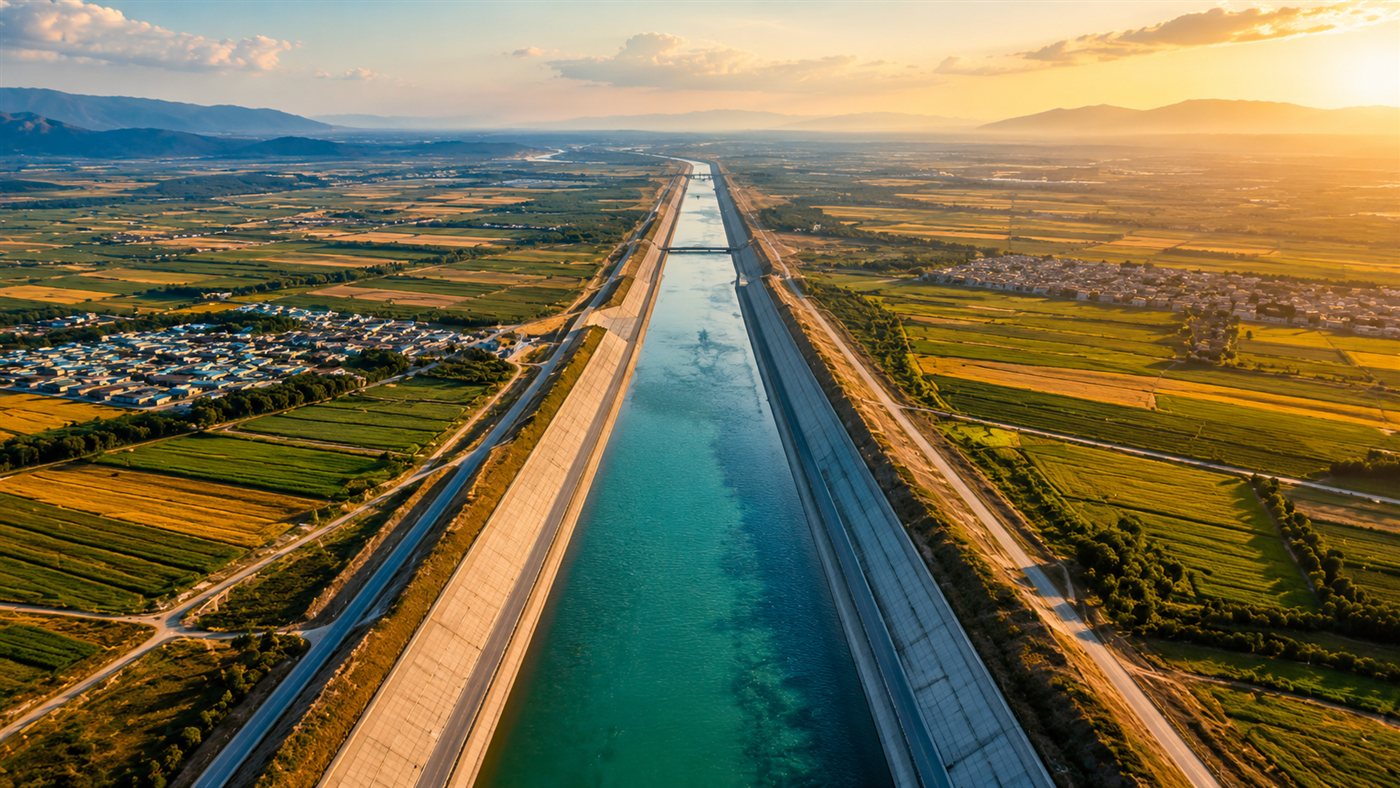


The problem was the geography itself. Millions of tons of mud descend the Yangtze every year and form sandbanks at the port’s entrance, which at low tide was only 7 meters deep, while the largest ships required 12 meters, as explained by Big Engineering. On the Huangpu River, more than 100 ships of 5 thousand tons entered and another 100 left every 24 hours through a navigable channel with stretches of just over 200 meters wide, and bridges with a 48-meter clearance blocked the giants. The Post-Panamax ships, too wide even for the Panama Canal, over 300 meters long, simply did not fit.
The island that didn’t exist: 60% of the Yangshan port is artificial
In 2002, Shanghai’s leadership bet everything on a radical solution. According to Big Engineering, the chosen location was Yangshan, 32 km off the coast, where the sea is 15 to 20 meters deep, sufficient for any existing ship. Engineers even considered flattening the hills of the islets but decided to preserve the natural topography and build the missing area.
The construction site was a logistical nightmare. The team worked 32 km off the coast without power, without water, facing typhoons, fog, and currents of 2 meters per second, as Big Engineering records in the words of experts, who compare the task to tying a ribbon in the middle of a raging river. Delay was not an option: Shanghai’s container traffic was growing 30% per year, and competitors like Hong Kong and Singapore had none of these problems.
The Sea Dragon dredger that fills its own belly in 1 hour
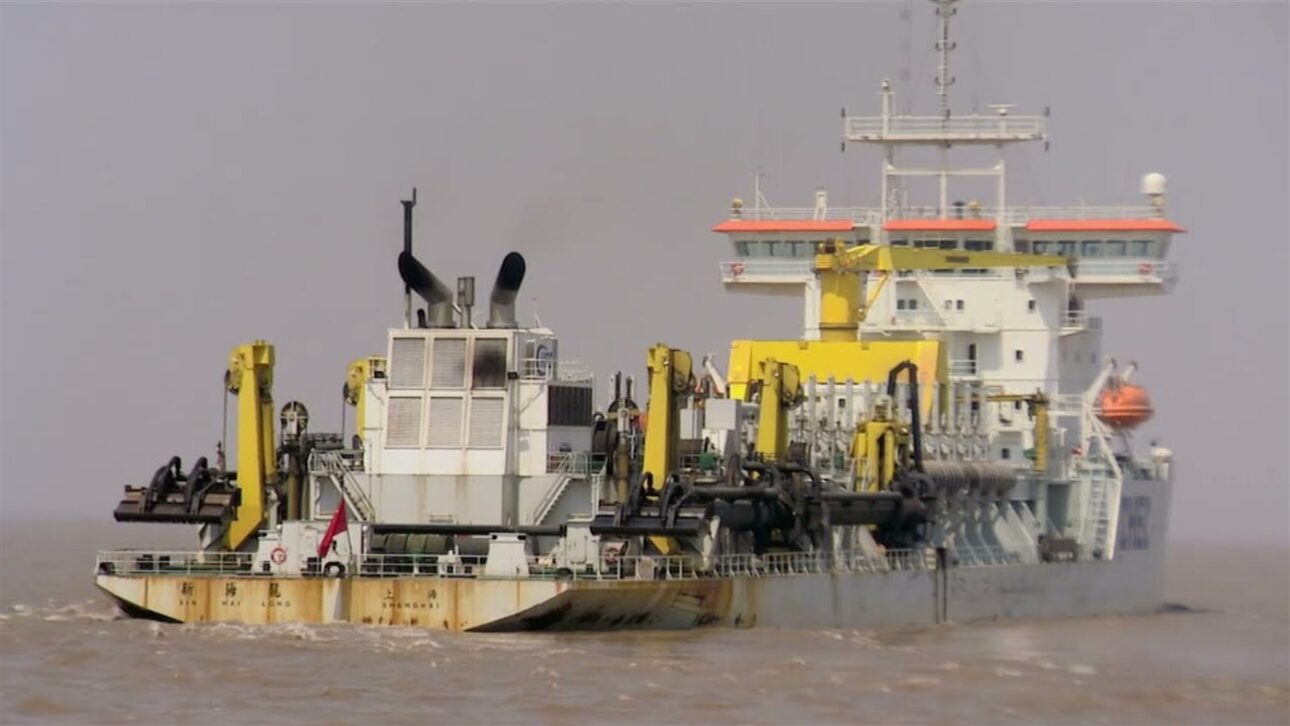
The protagonist of the marine land reclamation came from the Netherlands. According to Big Engineering, the Sea Dragon dredger sucks mud from the seabed up to 45 meters deep with two suction arms, powered by two turbocharged 12-cylinder diesel engines with 9,000 kW of power each.
The machine’s appetite set the pace of the work. The Sea Dragon needs only 1 hour of pumping to fill the hold of 12,888 m³, a volume equivalent to more than 200,000 barrels of beer, and can still blow or spray sand where the project requires, as Big Engineering describes. The dredger worked almost an entire year just on phase 1, dumping a volume of mud that the documentary compares to more than a million Olympic swimming pools, to create the artificial island in a sea over 15 meters deep.
The 13 cranes the size of Godzilla
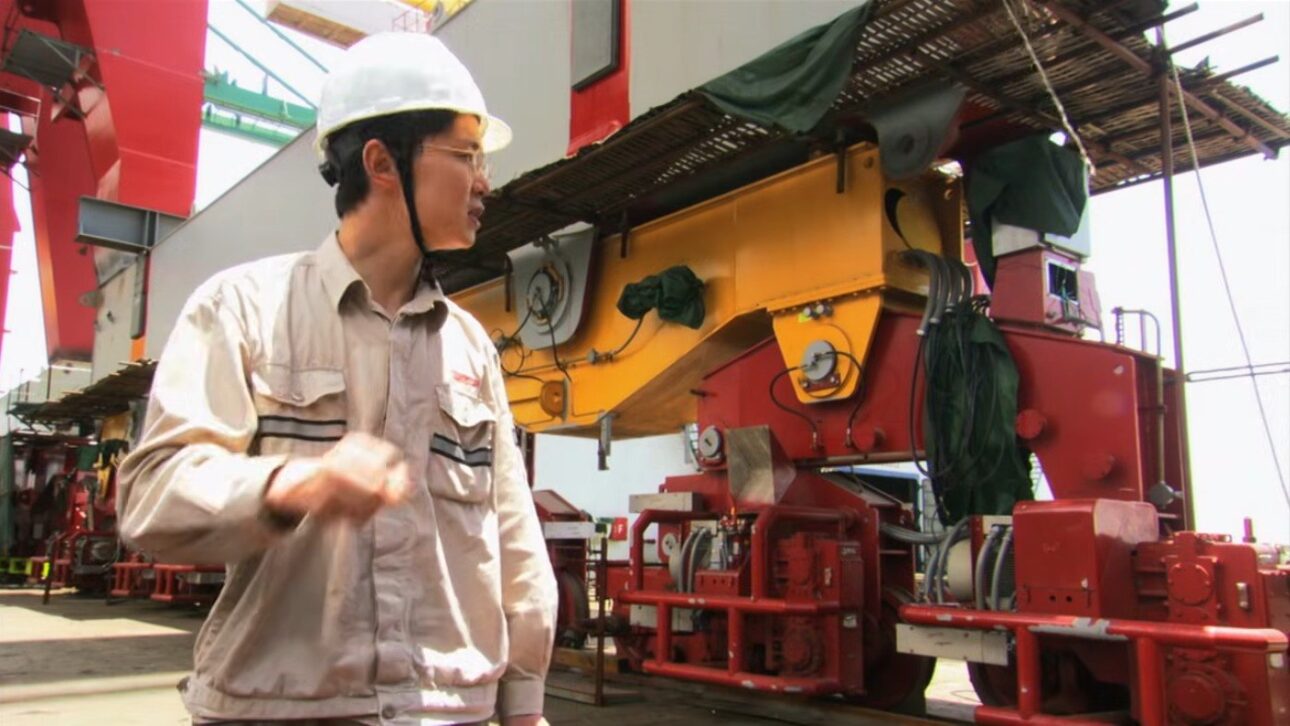
A deep-water port requires muscles to match. According to Big Engineering, the Yangshan port ordered 13 ship-to-shore cranes 50 meters high, compared in the documentary to Godzilla, capable of lifting twice the common cranes: two 40-foot containers at once, reaching the top of the largest ships in the world.
The factory was nearby, and the delivery became a spectacle in itself. The manufacturer on Changxing island, 125 km away, responsible for more than 70% of the world’s container cranes and over 200 units per year, designed the colossi to travel ready, without the up to 6 months of reassembly that common cranes require, as Big Engineering tells. During shipment, a sailor pumped water ballast from one side to the other while 10,000 tons of steel descended onto the ship, and the structure was designed to lower its own height during transport.
3 thousand containers in 20 hours and a world record
The documentary’s trial by fire is the arrival of one of the largest container ships in the world, in the spring of 2007. According to Big Engineering, the vessel, over 300 meters long, longer than the Eiffel Tower, docked with 3 thousand containers to unload, and the team had 20 hours to remove everything and still load another 2 thousand.
Productivity explained the result. While most ports move about 30 containers per hour per crane, the operators at the port of Yangshan exceed 50, and a local team set the world record of 5,812 containers moved in a single day, as recorded by Big Engineering. The shifts are 11 hours during the day and 13 at night, positioning 2.5-ton empty boxes with precision compared in the documentary to balancing an elephant on a coin 50 meters high.
The Donghai Bridge: 32 km of road over the open sea
There’s no point in unloading quickly if the cargo gets stuck on an island. According to Big Engineering, the answer was the Donghai Bridge: 6 lanes, 32 km long, more than 12 times the Golden Gate, the second longest ocean bridge in the world at the time, only behind the nearby bridge crossing Hangzhou Bay, 80 km to the west.
The foundation challenged the impossible. More than 6 thousand piles were driven into soft mud with a precision of 3 to 5 millimeters, guided by GPS and 7 satellites, crossing more than 20 meters of water and another 40 meters to the rock, as detailed by Big Engineering. Since the sea only allows construction 6 months a year, the more than 600 concrete spans, some weighing over 2 thousand tons, were prefabricated on land and towed by a custom-built barge with a capacity of 1,600 tons. Pillars served as dormitories for the workers, and the bridge, opened on December 10, 2005, after 42 months of construction, draws an S over the sea for ships to pass underneath at a safe angle against the current. In 2006, the super typhoon Chanchu hit head-on, and the structure didn’t even budge.
The brain of the port and the measure of rivals
Muscle without brain would lose the competition. According to the Big Engineering channel on YouTube, the port operates with a cutting-edge control system developed by the port of Shanghai: surveillance cameras, wireless orders for trucks, screens in crane cabins, and computers that define the exact position of each container on the ship, as a container loaded in the wrong place can mess up the next port and destabilize the vessel at sea.
The competition’s measure is unforgiving. Hong Kong and Singapore moved more than 20 million containers per year with an error rate below 1%, and by mid-2007 Yangshan had already brought Shanghai to the position of the 2nd largest container port in the world, just 1 million boxes behind Singapore, as recorded by Big Engineering. The documentary’s prediction was confirmed in history: the complex became a world reference for deep-water ports.
What the Giant Port Says to Brazil
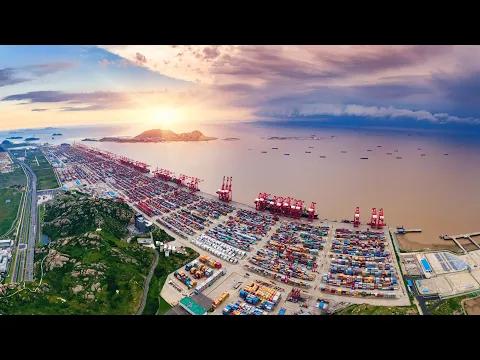

The documentary is about China, but the lesson crosses the Pacific. China is Brazil’s largest trading partner, and a large portion of Brazilian exports land precisely at terminals in the Shanghai complex, so the efficiency of the Yangshan port directly affects the cost of Brazilian foreign trade.
The comparison of scale helps to understand the size of Chinese ambition. The Yangshan project anticipated 25 million containers per year, several times the movement of the Port of Santos, the largest in Latin America, a difference that shows what it means to compete in 21st-century global logistics. For Brazilian engineers and public managers, the saga of the artificial island is a case study of long-term vision applied to infrastructure.
The Yangshan port sums up the Chinese method of solving bottlenecks: when geography said no, the engineers built another geography. Tell us in the comments: which Brazilian project would deserve this same ambition?