






 Portuguese
  Spanish


Passenger Train Project Promises to Transform Mobility Between Strategic Regions and Invests in International Model to Attract Investors and Stimulate Urban Areas.
The first railway concession for passenger transport in Brazil is moving forward, with the aim of benefiting up to 25,000 passengers daily and drawing inspiration from successful models in countries like England and Singapore.
The most advanced pilot project will be implemented between Brasília, in the Federal District, and Luziânia, in Goiás.
This initiative is part of a package from the Ministry of Transport that aims to modernize and expand access to passenger rail transport, with a public consultation announcement expected later this year and an auction estimated for 2026.
-
Railway returns to prominence in Brazil after STF approval: a R$ 25.2 billion project promises to save R$ 9 billion in freight, transport 50 million tons per year, and transform Sinop into a logistics powerhouse for agribusiness.

-
Retired trains leave European tracks and become tons of steel, aluminum, and copper in dismantling yards where recycling exceeds 90%, but batteries, composites, and electronics create a new frontier of railway waste.

-
The strategic railway of Santa Catarina will receive R$ 608 million, will undergo historic modernization, and could transform logistics between Mafra and the Port of São Francisco do Sul.
-
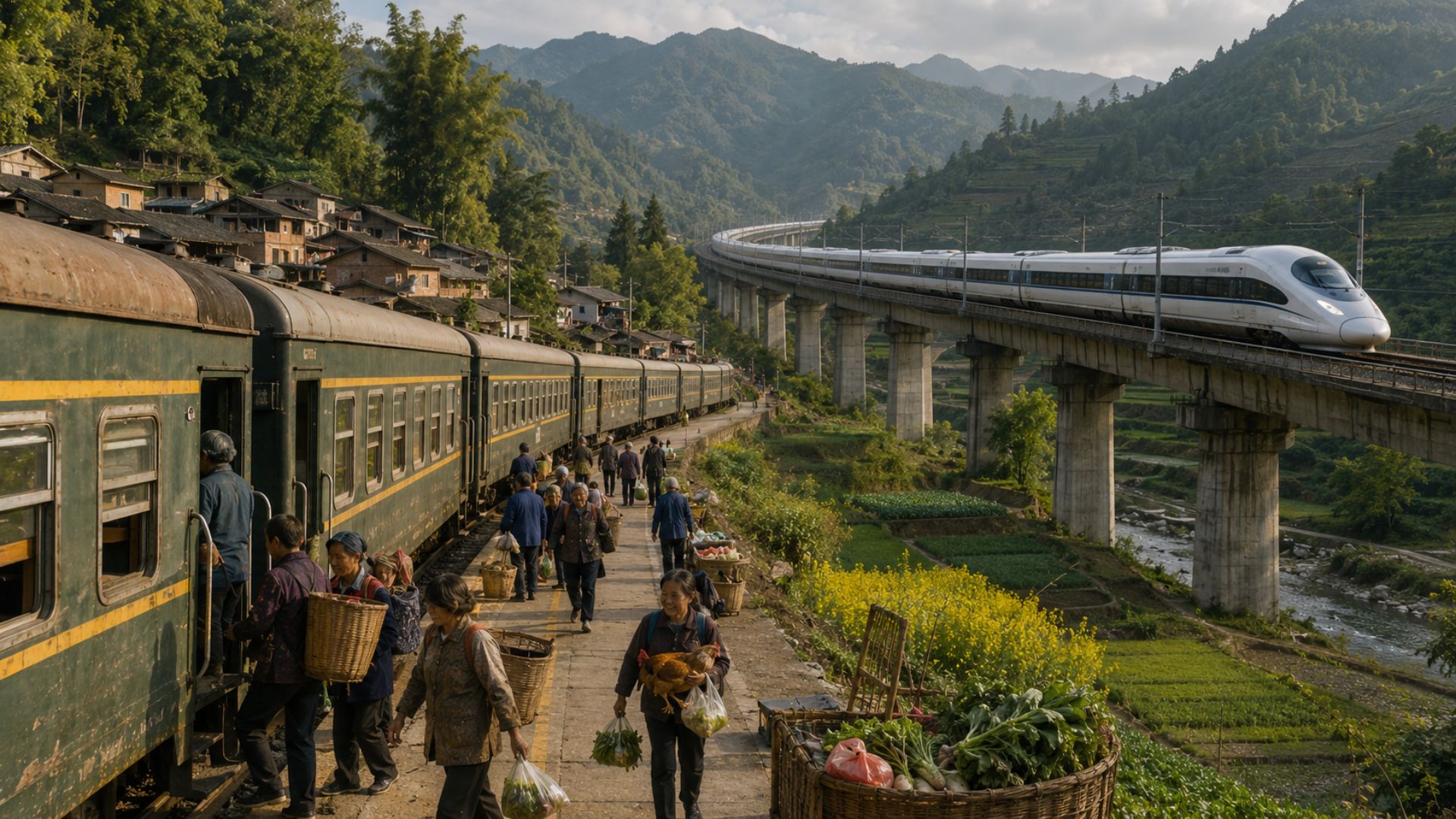
While showcasing bullet trains traveling at over 300 km/h, China maintains about 81 slow train lines that travel at 40 km/h, charge less than R$ 2 for a ticket, and cross remote villages carrying residents, students, and even chickens and vegetables to the market.


Passenger Train and Expansion of the Railway Network
In addition to the Brasília-Luziânia stretch, other projects are already in advanced planning stages, such as connections between Salvador and Feira de Santana in Bahia, and between Maringá and Londrina in Paraná.
Studies conducted by LabTrans, the transportation lab at the Federal University of Santa Catarina, also highlighted potential regional connections in Fortaleza-Sobral (Ceará), Pelotas-Rio Grande (Rio Grande do Sul), and São Luís-Itapecuru Mirim (Maranhão).
The selection of these routes took into account factors such as potential passenger demand, economic viability, and private sector interest.
Challenges of Passenger Rail Transport in Brazil
In the current scenario, only two railway lines — the Vitória-Minas Railway and the Carajás Railway — serve the regular transport of the population, operated by the Vale company, but without a specific concession for passengers.
These lines meet contractual requirements related to cargo transport and were not designed to prioritize the mobility of people in their daily lives.
The main barrier to the advancement of passenger railway concessions in Brazil lies in the high cost of implementation and maintenance, along with the difficulty in ensuring sufficient financial return solely from ticket sales.
Strategies Inspired by England and Singapore
To enable new projects, the federal government adopts strategies based on international experiences.
Among them, the utilization of currently underutilized or inactive railways stands out, reducing the investment needed for new construction.
Inspired by the models of countries like England and Singapore, the Ministry of Transport intends to associate railway concession with real estate operations along the tracks.
The proposal anticipates that winning companies from the auctions can commercially explore areas adjacent to the railway line, building logistics warehouses, commercial and residential buildings.
This diversification of revenue, as explained by sector specialists, aims to balance the financial equation and reduce reliance on direct public funding.
Advantages and Challenges of the Real Estate Model in Passenger Train
According to an analysis by André Paiva, a consultant at Tendências Consultoria, integrating railway concessions and real estate businesses represents a economically efficient alternative.
This is because it expands sources of revenue and shares the investment risks, which are considered high and long-term in the railway sector.
Paiva emphasizes, however, that implementing this model requires constant dialogue with regulatory bodies in the areas of transport, urban planning, and the environment, as Brazilian legislation is still in the early stages of integrating these competencies.
Passenger Train Between Brasília and Luziânia: Impact and Expectations
In the specific case of the stretch between Brasília and Luziânia, the choice for modernizing the line is explained by the high passenger flow and the historical integration between the federal capital and neighboring Goiás municipalities.
Currently, public transport between these cities is mainly done by buses, which are considered expensive and slow by a large part of users.
According to data from the Goiás state government, the bus trip can take up to two hours, at an average cost of R$ 12 per trip, with a daily movement of 20,000 to 25,000 people.
The federal government plans to adapt the stretch for operation with Light Rail Vehicle (LRV), an urban train model known for offering greater speed, comfort, and lower environmental impact compared to other public transport modes.
There is a freight line in the region, currently operated by Ferrovia Centro-Atlântica (FCA), but with usage below capacity and the possibility of returning the concession, which would open space for restructuring the service aimed at the population.
Consortium, Subsidies, and Regional Integration
To enable the concession, the Ministry of Transport seeks to reduce the need for National Treasure resources by integrating revenues from the real estate sector, a process that already has support from banks and private investors.
In addition, Goiás and the Federal District announced the formation of a consortium to improve system management, currently under the responsibility of the National Land Transport Agency (ANTT), and to implement subsidy policies for fares, expanding access for the population to the new service.
The estimated daily flow of 20,000 to 25,000 passengers highlights the relevance of the project not only for mobility but also for the urban development of the serviced regions.
The expectation is that by enhancing areas close to the tracks, the concession will generate positive effects on the local real estate market, replicating the success seen in England and Singapore, where railway advancements boosted the economy around the tracks.
Regulatory Challenges and Next Steps for Passenger Train
However, the adoption of the model requires overcoming regulatory hurdles and integration between different levels of government, which is still considered a significant challenge in Brazil.
Among the recent measures, meetings have already been scheduled between representatives of the federal, state governments, and sector companies to discuss adjustments in the existing network and the modeling of the concession project.
The new passenger train, inspired by international experiences and adapted to Brazilian reality, could represent a revolution in urban mobility, quality of life, and regional economic development.
But given the technical, regulatory, and financial challenges, will the initiative be able to transform passenger railway transport into a truly efficient, accessible, and sustainable alternative for millions of Brazilians?







Be the first to react!