Portuguese
  Spanish


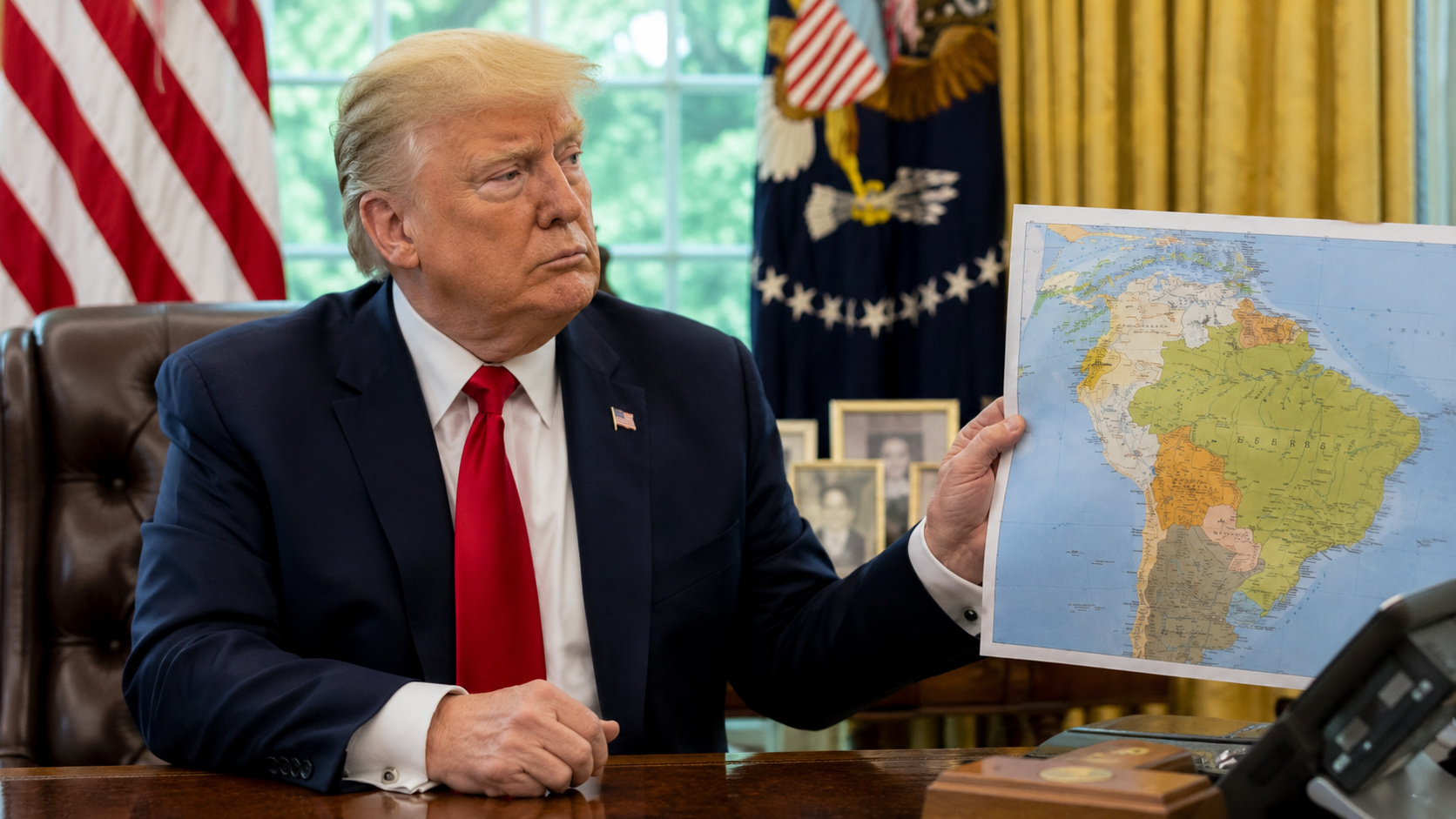

Donald Trump’s publication on Truth Social positions Venezuela as a possible “51st state” of the United States, increasing diplomatic tension in Latin America, reinforcing strategic interests linked to Venezuelan oil, intensifying debates on national sovereignty, and reigniting expansionist discourses involving Canada, Greenland, and Cuba amid the Republican’s return to the White House and the advancement of negotiations between Washington and Caracas in the energy, mining, and international security sectors
The President of the United States, Donald Trump, posted on Tuesday, May 12, an image showing Venezuela as the 51st American state. The post was made on the Truth Social network. Subsequently, the content appeared just one day after the Republican publicly suggested the annexation of the Latin American country.
According to correspondent John Roberts from Fox News, Trump is “seriously considering” the possibility. Even so, the president stated that “Venezuela loves Trump.” According to the American broadcaster, the Republican cited the Venezuelan oil reserves, valued at $40 trillion, as the main reason for the proposal.

Venezuelan oil enters the center of rapprochement between Washington and Caracas
Meanwhile, since the capture of Nicolás Maduro in January 2026, members of the White House have frequently traveled between Washington and Caracas. Thus, negotiations with American companies in the energy and mining sectors have gained momentum. Simultaneously, U.S. representatives are trying to strengthen relations with interim president Delcy Rodríguez.
-
European Parliament Approves Digital Euro, Aiming to Challenge Visa and Mastercard’s Dominance and Transform Payments Across Europe by 2029

-
Israel finds Hezbollah militarized tunnel over 200 meters long under village, with 4 missile launch shafts, 12 chambers, anti-tank missiles, drones, and weapons depots at a depth of 25 meters.

-
Ukraine launches largest drone attack on Moscow since 2022, Russia claims to have intercepted nearly 200 aircraft near the capital, Kapotnya refinery targeted again, and offensive reignites alert about war reaching the Russian energy heart just a few kilometers from the Kremlin.

-
Truck drivers, freight, and fines from 2022 take center stage in politics: Chamber approves MP with amnesty, mandatory tracking by CIOT, million-dollar penalties, and new minimum wage for those who spend more than 24 hours on the road.


In an interview aired on May 10 on the program Full Measure, by journalist Sharyl Attkisson, Trump stated that Venezuela is experiencing a positive moment. According to him, the country “is being well managed.” According to the president, Venezuelan oil production has grown significantly in recent months.
“The amount of oil being extracted is enormous,” stated Trump. Subsequently, he also highlighted the role of major American oil companies in extraction platforms in the country.
On the other hand, after the statements, Delcy Rodríguez rejected any possibility of annexation. According to the interim president, Venezuela will continue to defend its sovereignty and independence. In this regard, she stated that the country’s history was built by men and women who fought to prevent the nation from becoming a colony.
Trump expands expansionist rhetoric involving other territories and reinforces pressure on strategic allies of the United States
Since returning to the White House, Trump has made statements involving other foreign territories. Initially, the president directed comments at Canada. In May 2025, the Republican stated that the country could access the “Golden Dome” missile defense system for free if it agreed to become the 51st U.S. state.
According to Trump, if Canada remained independent, the country would need to pay $61 billion to join the system. In a publication on Truth Social, the president declared that Canadians were “considering the offer.”
In the same vein, Trump also pressured NATO to support plans for the annexation of Greenland, an autonomous territory linked to Denmark. According to the Republican, the island is “vital” for the United States’ missile defense system.

“The United States needs Greenland for national security purposes,” wrote Trump. According to him, Russia and China could expand their influence in the region if Washington did not advance over the territory.
Cuba re-enters the center of Trump’s statements amid energy crisis and diplomatic tensions with Washington
In March 2026, Trump stated that it would be an “honor” to “take Cuba.” The statement occurred during a period of energy crisis faced by the island. In this scenario, the Cuban government began negotiations with Washington.
Besides the Venezuelan case, Cuba had already been targeted by the Republican’s measures since his first term, between 2017 and 2021. During that period, Trump reversed rapprochement policies previously adopted by former President Barack Obama and tightened economic sanctions against the country.
Thus, the recent statements by the American president have expanded debates on geopolitics, energy, national sovereignty, and the strategic influence of the United States in territories considered priorities for security and the exploitation of natural resources.