






 Portuguese
  Spanish
  6 min of reading
  0 comments


Ship Interceptions in the Caribbean, Ordered by the Trump Administration, Reduce Venezuela’s Oil Exports and Increase Economic Pressure on Nicolás Maduro’s Regime.
The tightening of the United States’ actions against Venezuela gained momentum in December, following the announcement of a blockade on vessels entering or leaving the country. The measure is part of President Donald Trump’s strategy to increase political and economic pressure on Nicolás Maduro’s regime, targeting oil as the main focus.
Since then, at least three large oil tankers have been targeted for interception attempts by U.S. authorities. The actions took place during the first half of December and are already showing concrete effects on Venezuelan export flow, according to maritime tracking data.
Large Vessels Come Under the Radar of U.S. Authorities
All the vessels involved in the operations are large-capacity oil tankers used for transporting crude oil. According to official information from the U.S. government and maritime tracking data, the ships have capacities exceeding 300,000 tons.
-
Bank of Japan raises interest rates to 1%, reaching the highest level in over three decades

-
ANP halts LPG reform, and Sindigás sees technical caution as a decisive point for safety, investments, and the future of the cylinder in Brazil.

-
Oil spill in the Caribbean raises environmental alert and increases tension between Venezuela and Trinidad and Tobago

-
More than 40 Petrobras platforms enter the decommissioning queue and open up a billion-dollar industry in Brazil for cranes, special ships, underwater cutting, and offshore recycling.



The interceptions were reported between December 10 and 21 and involved ships sailing under flags of Guyana and Panama. In the maritime sector, the flag indicates the country of registration of the vessel, which does not necessarily represent the origin of the cargo or the responsible company.
Nonetheless, the use of these flags raised questions. The maritime authority of Guyana stated that one of the vessels was using the country’s registration irregularly and was not listed in the official records.
Skipper Was Seized and Raised Alerts About Irregular Flag Use
Among the intercepted ships is the Skipper, a large oil tanker. The vessel is approximately 333 meters long, equivalent to more than three football fields lined up, with a maximum estimated capacity of around 310,000 tons of crude oil.
The interception of the Skipper was reported on December 10, following the ship’s seizure by the United States near the Venezuelan coast. Although it appeared in tracking systems sailing under the flag of Guyana, the Guyanese government stated that the use of the registration was irregular.
In a statement, the country’s maritime authority reported having identified an “unacceptable trend” of unauthorized use of the national flag by vessels not officially registered.
Centuries Identified as Part of the So-Called Ghost Fleet
Another relevant case involves the oil tanker Centuries. The ship was reported sailing under the flag of Panama and its interception was noted on December 20, during the early hours of a Saturday, in an operation conducted by the United States near Venezuela.
According to the White House, the Centuries was operating under a forged flag and was part of the so-called “ghost fleet” of Venezuela. This term is used to describe vessels that hide their identity or disable tracking systems to transport oil deemed irregular by U.S. authorities.
Bella 1 Escapes the Siege After Conflicting Reports
On Sunday (21), officials reported an attempted interception of the oil tanker Bella 1. Throughout the day, however, conflicting versions regarding the incident emerged.
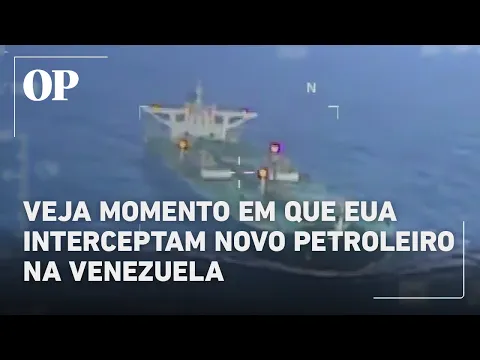

Bloomberg reported that the United States had boarded the ship, identified as a vessel under the flag of Panama. However, sources quoted by Reuters claimed that, despite the pursuit in international waters in the Caribbean, the oil tanker had not yet been boarded at that time.
The following Monday, it was confirmed that the Bella 1 managed to escape the U.S. blockade. Data from the MarineTraffic website indicated that the ship was sailing under the flag of Guyana and was headed for Curaçao, a Dutch island in the Caribbean. The vessel is approximately 333 meters long, 60 meters wide, and has a capacity exceeding 318,000 tons of crude oil.
Tanker Traffic Decreases and Exports Are Affected
The effects of the interceptions began to appear rapidly. Data from specialized maritime monitoring companies indicate a sharp decline in the traffic of oil tankers in Venezuelan waters following increased enforcement actions in the Caribbean.
Surveys from Kpler, a platform specialized in vessel tracking data and global oil flows, show that a significant portion of vessels began to avoid routes associated with Venezuela or remained idle.
It is estimated that more than 16 million barrels are stored in tankers stopped in Venezuelan waters or nearby. The number includes ships that are already loaded and others awaiting loading authorization.
Loading Rate Decreases in Recent Weeks
Additionally, the loading rate of oil has significantly decreased in recent weeks. According to Kpler, volumes have been around a quarter below the recent export levels observed in previous months.
Information compiled by Reuters, based on data from the Refinitiv Eikon platform, indicates that the movement of ships entering and leaving Venezuelan waters has practically stopped following the first interceptions.
According to the agency, only vessels operating under specific licenses granted by the U.S. government continue to export Venezuelan oil.
Venezuelan Oil Attracts Strategic Interest from the U.S.
Venezuela holds the largest proven oil reserves in the world, with around 303 billion barrels, equivalent to approximately 17% of the known global volume, according to the Energy Information Administration (EIA), the official energy statistics agency of the United States.
The country surpasses producers such as Saudi Arabia, with 267 billion barrels, and Iran, with 209 billion. Despite this, much of Venezuela’s oil is extra-heavy, which requires advanced technology and high investments for extraction.
In practice, the potential remains underutilized due to poor infrastructure and international sanctions that limit access to capital and technology.
Economic Interest and Political Pressure Go Hand in Hand
According to the EIA, Venezuela’s heavy oil “is well-suited for U.S. refineries, especially those located along the Gulf Coast.” In this scenario, the Trump administration’s strategy serves two simultaneous objectives.
On the one hand, it seeks to benefit the U.S. economy. On the other hand, it directly pressures Venezuela’s oil production and exports, which are central to the country’s economy and to sustaining Nicolás Maduro’s government.
The initial effects of this policy have already begun to materialize. Bloomberg News reported that Caracas is facing difficulties in storing oil, amid Washington’s measures to prevent ships from docking or leaving Venezuelan ports.
Ghost Fleet and China’s Role in the Oil Market
Since sanctions were imposed on Venezuela’s energy sector in 2019, traders and refineries purchasing oil from the country have increasingly resorted to the ghost fleet. These vessels hide their location and have often been sanctioned for transporting oil from Iran or Russia.
China remains the largest buyer of Venezuelan crude oil. This volume accounts for about 4% of China’s imports. In December, shipments are expected to average over 600,000 barrels per day, according to analysts consulted by Reuters.
Currently, the global oil market remains well-supplied. Millions of barrels are stored on tankers off the Chinese coast, awaiting discharge.
If the blockade extends, analysts predict that the withdrawal of nearly one million barrels per day from the global supply is likely to pressure international oil prices.
Operations Expand Amid Military Actions in the Caribbean
The interceptions of oil tankers occur alongside an order from Trump to the Department of Defense to carry out attacks against vessels in the Caribbean and the Pacific Ocean. According to the U.S. administration, these ships are involved in smuggling fentanyl and other illegal drugs.
Since early September, at least 104 people have been killed in 28 known attacks, according to information released by authorities and international media.
In an interview with Vanity Fair published this week, White House Chief of Staff Susie Wiles stated that Trump “wants to keep blowing up boats until Maduro screams ‘uncle.’”







-

1 person reacted to this.