





 Portuguese
  English
  Spanish
  3 min of reading


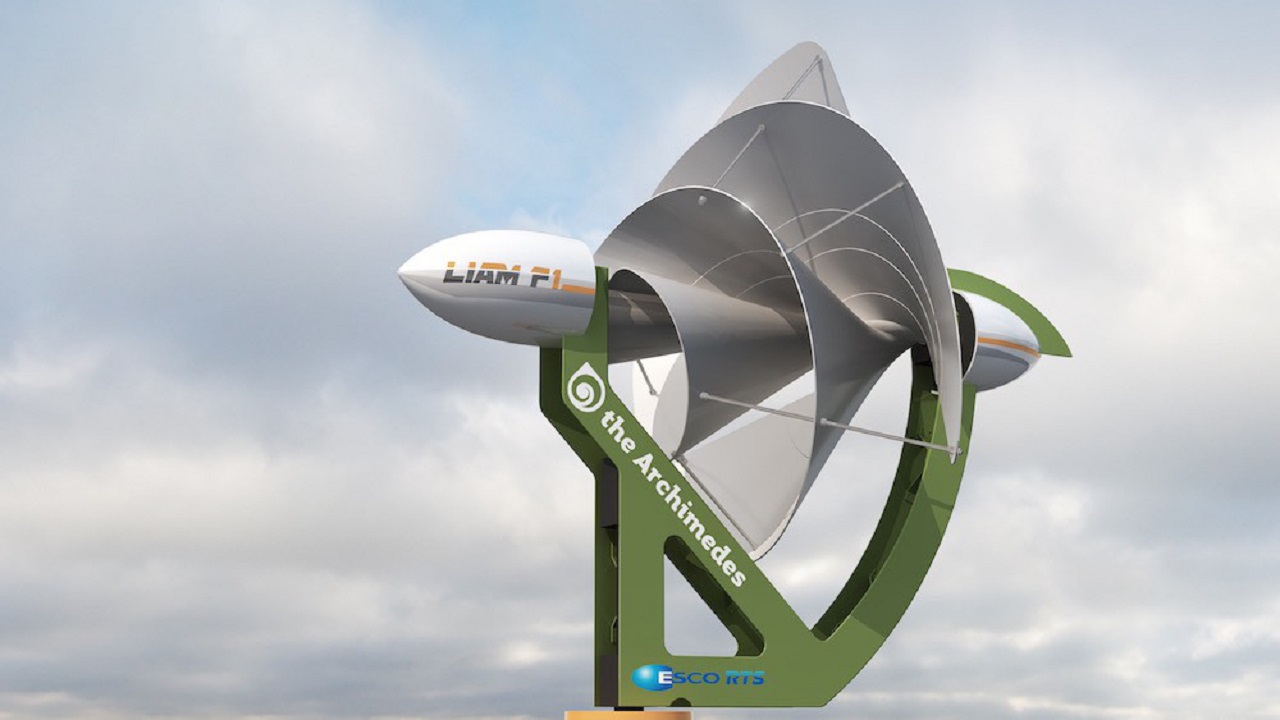
The Archimedes, a company based in the Netherlands, has developed a wind turbine for residential use. The model resembles a screw and its main highlight is its silent operation, not exceeding 48 dB.
The greatest and most influential innovations and discoveries in science happen when uncomplicated projects become functional objects. In this way, the company The Archimedes, from the Netherlands, developed an innovative wind turbine that can be installed in conventional homes, with the capacity to produce 1,500 kilowatt-hours (kWh) of energy per year at a wind speed of 5 m/s, which is 18 kilometers per hour. The equipment is named Liam F1 Urban Wind Turbine (UWT), an intelligent windmill energy generator.
Understand How the Residential Wind Turbine Works in Practice
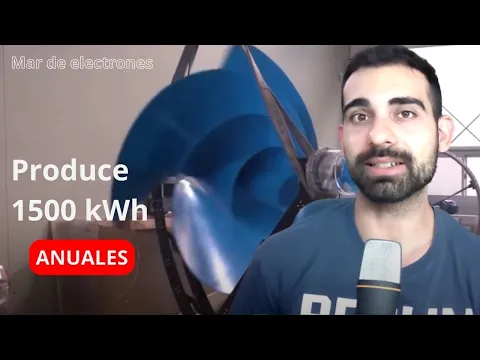

To give you an idea of its scale, an average family uses about 30 kWh per day, or 900 kWh monthly and 11,000 kWh annually. Accordingly, a single Liam F1 wind turbine could supply more than 10% of the energy demands of a household in areas with medium to strong winds.
The largest model available on the market is double the size, generates more energy, reaching an average of 7.5 kWh per year, and is a wind turbine for residential use focused on supplying many homes around the world. What is truly amazing about this compact wind turbine is its innovative design.
-
Canada is preparing a billion-dollar megaproject with 3.5 GW of wind energy, up to 530 turbines, green hydrogen, and ammonia for export, in a bid that could place the country at the center of the new global race for clean fuels.

-
France launches tenders for 12 GW in renewable energy, bets on offshore wind and imposes restrictions on Chinese components to accelerate energy sovereignty, protect European factories, and reduce dependence on oil and gas amid global pressure.
-
Advancement in renewable energy: researchers from UFPB and UNI of Peru create an unprecedented digital twin for a green hydrogen plant; Model is capable of simulating real-time operations and reducing industrial failures in strategic clean energy projects in Latin America.

-
At 4,400 meters of altitude in the Himalayas, where the air is so thin it makes breathing difficult, India’s state oil company drilled a thousand meters of rock to reach a 240-degree subsoil and set up the country’s first geothermal plant.


The spiral or screw-shaped rotor of the model always points in the direction of the wind and converts all the kinetic energy generated into mechanical energy. The inspiration for developing the wind turbine for residential use comes from the famous Archimedes’ screw principle and the windmill, one of the most common structures in the Dutch landscape.
Equipment Weighs About 100 kg
The company responsible for manufacturing the equipment emphasizes that it is more efficient than a standard propeller blade and its low noise operation is always kept below 48 decibels (dB), making silence one of the most attractive points of the equipment, due to its blades, produced using flat sheets that create less noise.
The overall appearance of the wind turbine for residential use resembles a flower that can be easily installed on the rooftops of any building. The model, designed for installations on houses and buildings, has a diameter of only 1.5 meters.
In total, the winds turbine weighs 100 kg and the company emphasizes that the technology can be combined with other renewable energy sources, such as solar energy and electricity storage systems. The company’s ultimate goal with the wind turbine for residential use is to make homes energy autonomous by integrating other energy sources.
Other Sustainable Solutions Involving Clean and Renewable Energy
The company Power Collective, from Canada, developed a rooftop wind turbine named RidgeBlade, well known for being innovative and efficient simultaneously. The equipment from the company can fit perfectly on the top of residential and commercial rooftops.
The equipment, which can generate renewable energy, is almost “invisible” to many people, but efficiently captures wind energy to generate electricity. The sloped surface of the rooftops is highly utilized by the technology to concentrate and direct the wind.
Then, it travels across the rooftop surface forming a compression point at the top of the roof, propelling the airflow through the turbine. The wind speed, as it returns to the top of the roof, is three times stronger than the actual ambient wind, making it a great location for energy production.







-

-

-

-

-

21 people reacted to this.