Portuguese
  Spanish


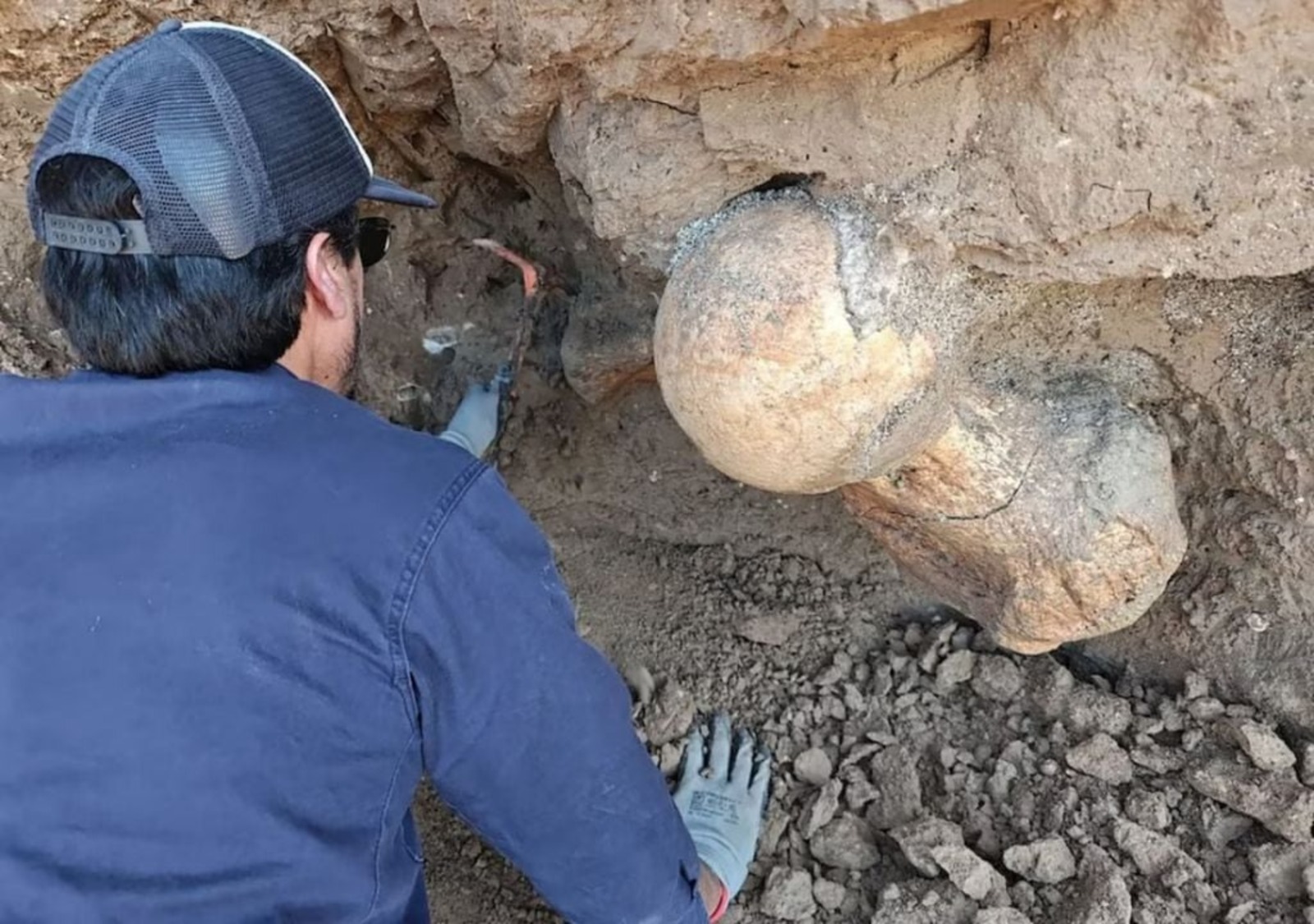

Tourists Find 80 Cm Femur of Megatherium About 400 Thousand Years Old in Cliffs on the Coast of Buenos Aires and Discovery Mobilizes Paleontologists
An unexpected find in cliffs south of Santa Clara del Mar, in the province of Buenos Aires, revealed a femur of megatherium about 80 centimeters long, belonging to an animal that lived approximately 400,000 years ago.
Discovery of Megatherium in Cliffs on the Argentinian Coast
The discovery occurred last Saturday when Mario Cianciola and Lumar Ávila González were exploring the area of the cliffs.
The tourists, from the northern zone of Greater Buenos Aires, noticed something unusual protruding from the sediment.
-
The industrial waste that even recyclers didn’t want has gained value in the interior of Bahia: two entrepreneurs invested R$ 2.8 million to transform 350 tons per year of foam, rubber, and plastic into boards that can replace wood and MDF.

-
What is a red flashlight used for, after all? See why it is so commonly used at night.

-
He has never read a line of code, but he already knows how to work: the French company UMA presented in Paris the Northstar, its first AI-powered humanoid robot designed for factories and warehouses, capable of copying tasks just by observing an employee in action.

-
A young Kenyan engineer collects plastic waste from the streets and transforms it into robots that translate physics lessons into sign language in real-time, a machine made with old bottles that teaches what was missing to deaf children left out of science.




They observed a rounded surface of orange coloration emerging from the ground. The object was roughly the size of a football, which sparked immediate curiosity during their walk along the coastal area.
Intrigued, they returned to the spot to take a closer look. They took a photograph and sent it to a geologist friend, who quickly identified the scientific potential of the material found.
Following the specialist’s guidance, the two contacted researchers from the Lorenzo Scaglia Municipal Museum of Natural Sciences, located in Mar del Plata.
From this initial contact, a scientific intervention was organized. The work also included support from students of the Superior Technical Program in Paleontology of ISFT nº 194, based in Miramar.
Fossil of Giant Sloth Shows Unusual State of Preservation
After the recovery of the material and its transfer to the laboratory, researchers began the initial analyses.
The studies indicated that the state of preservation of the fossil is unusual for finds in coastal environments.
The femur measures about 80 centimeters in length and nearly 50 centimeters in width. According to specialists, it belonged to a megatherium, a prehistoric giant sloth that was part of the South American megafauna.
Paleontologist Matías Taglioretti, from the Scaglia Museum, stated that remains of this animal are rare in the region.
He emphasized that the femur is among the most complete specimens found on the southeast coast of the province.
During the site inspection, pelvic remains were also identified. These fragments are well preserved, although their extraction involves greater operational complexity.
The instability of the cliff poses a risk of collapse. For this reason, the recovery of the material may require heavy machinery and broader logistics to ensure safety during excavation.
Coloration of the Fossil Reveals Formation Process in Ancient Soil
The bone presents an intense orange coloration that caught the researchers’ attention. This hue is characteristic of fossils formed in ancient water-saturated soils.
In this environment, the circulation of iron oxides permeates the sediments and alters the appearance of the fossilized organic remains.
Paradoxically, these conditions contributed to the preservation of the material. The marks left by muscle insertion remain visible on the surface of the femur.
These striations will allow for detailed anatomical analyses. The data collected may assist scientists in better understanding the body structure of this prehistoric animal.
The material will be used by researcher Néstor Toledo, from Conicet and the National University of La Plata.
He intends to employ the fossil in studies aimed at reconstructing the musculature of the megatherium.
After the initial analysis stages, the fossil will be transferred to the Natural Sciences Museum of Pachamama, in Santa Clara del Mar, where it will become part of the regional paleontological collection.
Region Registers Multiple Discoveries of Megatherium
The cliffs of southeastern Buenos Aires province are known for revealing vestiges of prehistory. The region has become an important window for the study of South American megafauna.
In April 2023, a fisherman found remains of megatherium in the cliffs of Camet Norte, located about 14 kilometers from Mar Chiquita.
At that time, technicians recovered phalanges, vertebrae, ribs, and teeth belonging to a specimen that lived approximately 20,000 years ago.
Another case occurred in 2022, when a 12-year-old girl discovered a vertebra of megatherium in Mar del Plata while excavating family land.
Shortly before that, in the same region, an eight-year-old boy found the fossilized skull of a South American camelid estimated to be about 700,000 years old.
The list also includes a skull of megatherium discovered in 2021 in San Eduardo del Mar, near Miramar. The fossil was dated at over 3.5 million years.
Giant Sloth of the Megafauna of the Pleistocene
The megatherium was one of the largest land mammals in the Americas during the Pleistocene. Despite being related to modern sloths, anteaters, and armadillos, its size was vastly superior.
The animal could reach up to six meters in length and weigh around three tons. When walking on all fours, it reached nearly two meters in height.
Despite its robust appearance, it was not a predator. Its large curved claws were mainly used to pull branches and leaves from trees.
Its diet consisted of leaves, shoots, and soft twigs. The animal could rise on its hind legs, supporting itself on its tail to reach higher vegetation.
For thousands of years, these giants adapted to the cold climate of the Ice Age, accumulating fat reserves that functioned as thermal protection.
However, at the end of the last glacial period, about 11,700 years ago, the giant sloth disappeared from South American fauna.
Researchers associate the extinction with climate changes related to the retreat of glaciers. Some studies also suggest possible influence from human expansion on the continent.
Even so, new discoveries continue to expand knowledge about these animals that inhabited the region long before the presence of modern humans.
With information from Tempo.com.