






 Portuguese
  Spanish
  4 min of reading
  0 comments


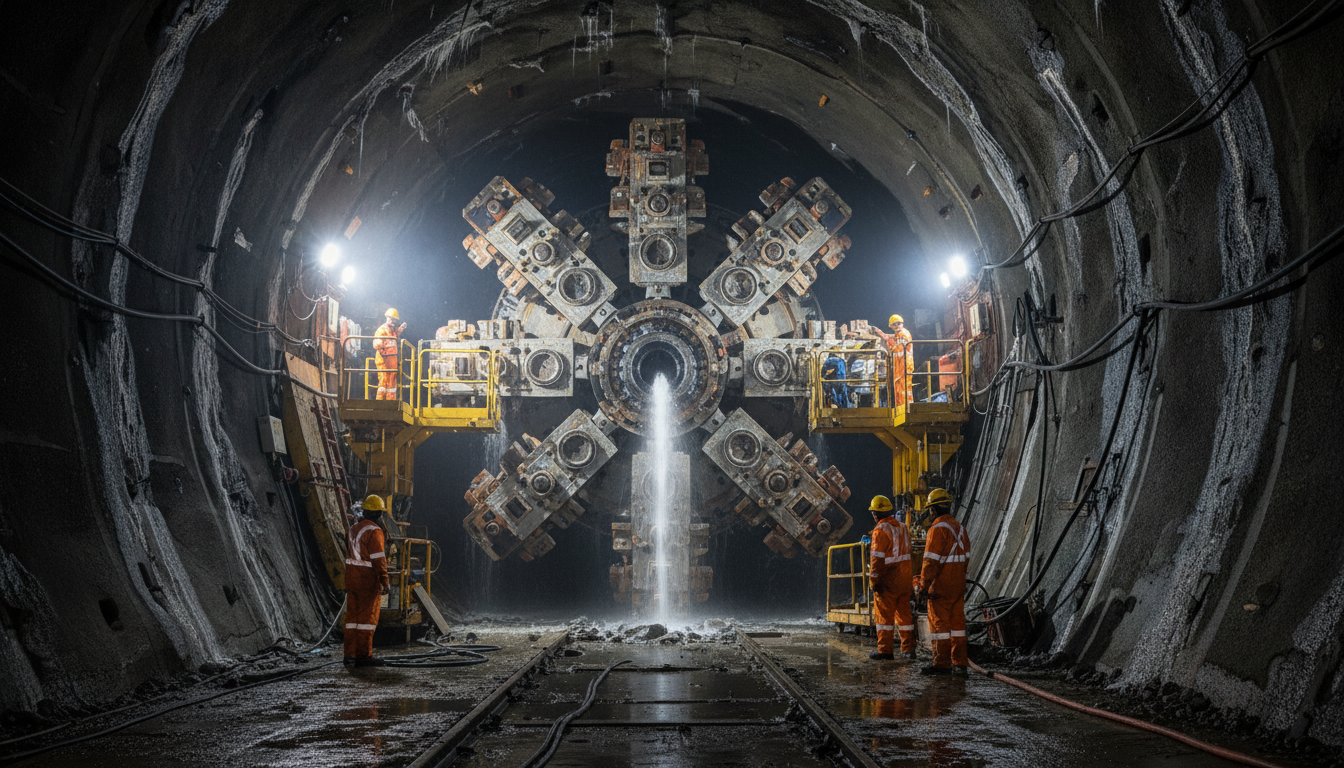
With a length of 16.18 km and 11.21 km excavated under the seabed, the Jintang tunnel connects Ningbo to Zhoushan in China with trains traveling at 250 km/h — two tunnel boring machines of 14.5 meters are advancing in opposite directions at a depth of 78 meters and are expected to meet by the end of 2026
Two giant machines with 14.5 meters in diameter are advancing in opposite directions beneath the ocean. When they meet, China will have the largest underwater high-speed railway tunnel in the world. The Jintang tunnel has a total length of 16.18 km, of which 11.21 km runs under the seabed, up to 78 meters below sea level.
The project is part of the Ningbo-Zhoushan railway, in Zhejiang province, eastern China. The goal is to reduce the travel time between the two cities from approximately 1 hour and a half to about 30 minutes, with trains running at 250 km/h on a submerged double track.
According to Exame, the total drilling is expected to be completed by the end of 2026. The commercial operation of the railway is scheduled for 2028.
-
Bolivian Female Construction Workers Form Association to Combat Discrimination and 38% Pay Gap in the Industry

-
Near Amsterdam, residents buy land and discover they must also build streets, manage drainage, handle waste, and grow food on half their plot.
-
Brazil’s WEG to Open New Factory in China by 2027, Expanding Production of Large Rotating Electric Machines and Low to Medium Voltage Motors in Rugao

-
Chinese Shipyard Secures $1 Billion in Orders for Low-Carbon Container Ships Amid Global Fleet Renewal Efforts


The numbers of the Jintang tunnel
The Jintang tunnel starts in the Beilun district in Ningbo and ends in the city of Jintang in Zhoushan. The structure is designed as a bi-directional corridor, allowing simultaneous traffic in both directions.
- Total length: 16.18 km
- Underwater section: 11.21 km under the seabed
- Internal diameter: 14.5 meters
- Maximum depth: ~78 meters below sea level
- Projected speed: 250 km/h
- Tracks: double (traffic in both directions)
- Total railway: Ningbo-Zhoushan, 76.4 km
- Completion of drilling: end of 2026
- Commercial operation: 2028

Two tunnel boring machines advance to meet under the sea
The tunnel boring machines “Dinghai” and “Yongzhou” are operating simultaneously on the sides of Zhoushan and Ningbo, advancing towards each other. The meeting of the two machines beneath the ocean will mark the most emblematic moment of the project.
In June 2025, excavation from the Zhoushan side surpassed 3,135 meters, officially inaugurating the maritime crossing phase. By March 2026, the Yongzhou tunnel boring machine had advanced 3,182 meters from Ningbo, while the Dinghai reached 5,850 meters.
The combined advance of the two machines has already surpassed 9 km. Every day, hundreds of meters of rock are transformed into a habitable tunnel for high-speed trains.
Other Chinese megaprojects, such as the construction of record tunnels that cross mountains, use similar technology but face different challenges — here, water pressure and ocean salinity multiply the complexity.

Excavating granite 78 meters underwater
The technical challenge of the Jintang tunnel lies underground. About 70% of the route crosses hard or mixed rock formations, with resistance of up to 200 megapascals — equivalent to the hardness of granite.
This means that the cutting blades of the tunnel boring machines wear out at an accelerated rate. So far, the team has already performed 23 chamber openings for maintenance and replaced 326 blades, maintaining continuous progress under intense water pressure.
Excavation requires millimeter precision. Dozens of meters under the ocean, any deviation from the route can compromise the integrity of the structure. Course corrections happen in real-time, with sensors continuously monitoring pressure, humidity, and geological stability.

What changes when Zhoushan connects to the mainland by rail
Zhoushan is an archipelago with over a thousand islands that historically relies on ferries and maritime roads to connect to the mainland. Strong winds, tides, and maritime traffic make the crossing unpredictable.
With the Jintang tunnel, the connection becomes stable, fast, and predictable. The travel time drops from 1h30 to 30 minutes. This reconfigures labor markets, tourism, and port logistics in the region.
The Ningbo-Zhoushan railway is part of the Medium and Long-Term Plan for China’s National Railway Network (2016–2030). The complete line will be 76.4 km and will serve medium and long-distance passengers, in addition to strengthening port industrial chains.
Other Chinese railway projects, such as the expansion of high-speed lines across the country, follow a similar logic of connecting isolated regions to the national system. For more technical details, it is worth consulting the FENATI report and the People’s Daily coverage.

Caveats and risks of the project
The completion of the drilling scheduled for the end of 2026 still depends on the geological conditions in the remaining sections. Unexpected rock formations may delay the schedule, as has already happened in similar projects around the world.
The commercial operation in 2028 assumes that the installation of tracks, electrical systems, and ventilation occurs without setbacks after drilling. Furthermore, there is no public data on the total cost of the project in yuan or dollars, limiting the assessment of the financial return on the investment.





-

-

-

-

-

14 people reacted to this.