Portuguese
  Spanish


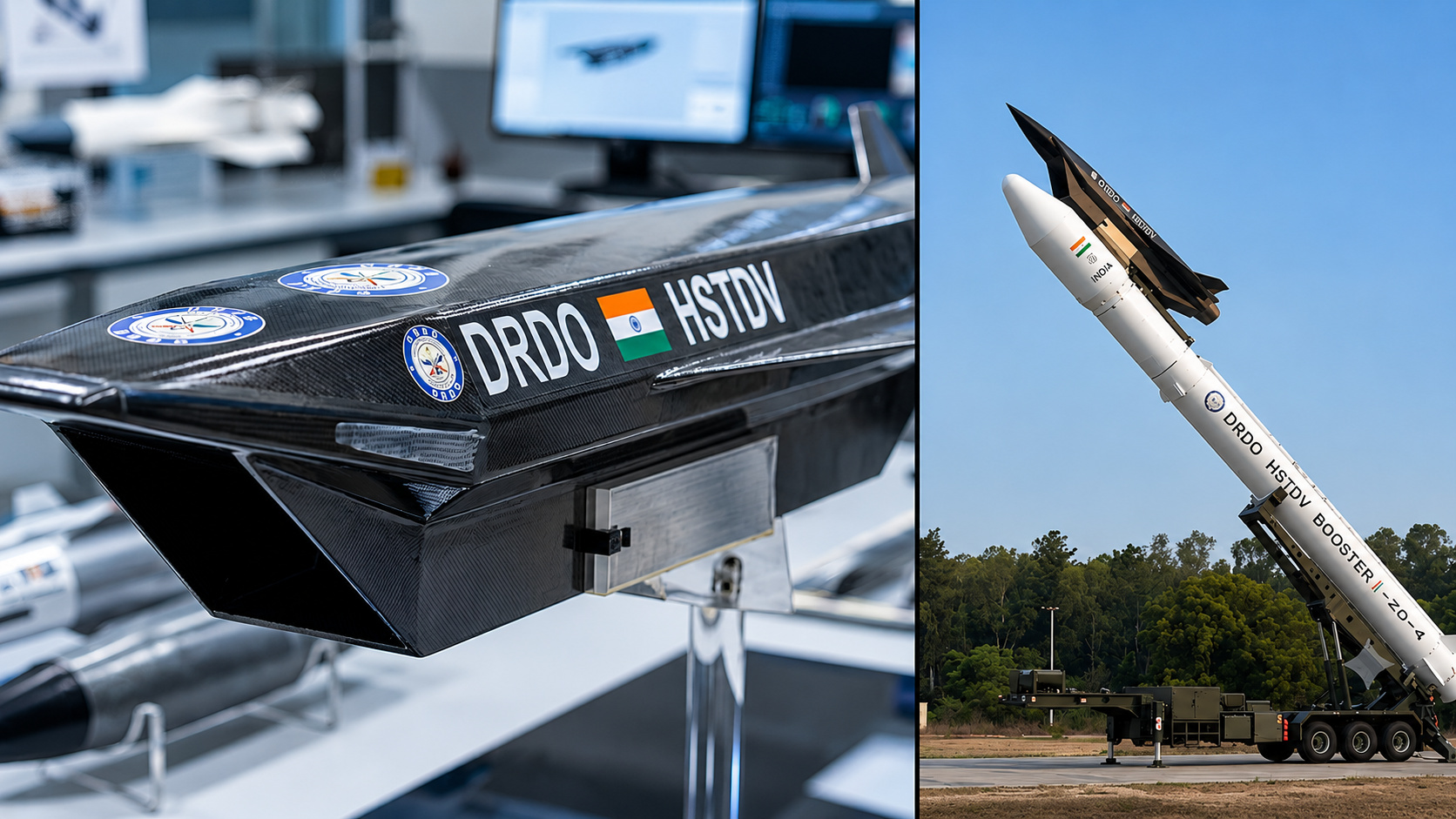

India tested the HSTDV at Mach 6 with scramjet in flight, reaching about 7,400 km/h and validating strategic hypersonic technology.
For decades, the United States, Russia, and China have dominated the race for the most advanced hypersonic technologies on the planet. But India decided to join this group with a project that attempts to solve one of the greatest challenges of modern aerospace engineering: keeping an engine running at such extreme speeds that the air itself enters the aircraft faster than many fighters can fly. The project is called HSTDV (Hypersonic Technology Demonstrator Vehicle) and is developed by the state organization Indian DRDO (Defence Research and Development Organisation).
In one of the most important tests ever conducted by the program, India managed to activate a scramjet engine in flight, sustain hypersonic combustion for approximately 20 seconds, reach a speed close to Mach 6, about 7,400 km/h, and validate technologies considered essential for future hypersonic aircraft and missiles.
HSTDV entered a speed range that brings India closer to the most advanced hypersonic programs in the world
The most impressive number from the test was the speed. According to the Ministry of Defence of India, the vehicle used a booster rocket to reach sufficient altitude and speed before the scramjet activation. After separation, the system entered hypersonic mode and maintained sustained combustion during the flight.
-
Scientists Plan to Release Air Bubbles Underwater to Protect Antarctica’s “Doomsday Glacier” from Melting

-
Chinese R6000 Drone Combines Airplane and Helicopter Features, Carries Up to 12 People for Multiple Missions

-
In the World’s Most Densely Populated Desert, Families Dig Funnel-Shaped Underground Cisterns to Capture Rare Rainfall and Store Drinking Water for Up to Eight Months

-
Smart Glass Revolutionizes Privacy: Touch-Activated Opacity Transforms Windows into Connected Home Features with App and Voice Control



The recorded speed was close to Mach 6, equivalent to about 7,400 km/h.
This places the HSTDV in a range close to that of the legendary X-15, NASA’s experimental aircraft that remains among the fastest manned vehicles ever built.
Scramjet engine operates without carrying oxidizer like conventional rockets
The heart of the project is the scramjet. Unlike traditional rockets, which carry fuel and oxidizer, scramjet engines use atmospheric oxygen during flight. This reduces mass and can increase efficiency at extremely high speeds.
The problem is that air enters the engine at supersonic speed. Maintaining stable combustion under these conditions is considered one of the most difficult challenges in modern hypersonic engineering.

According to information released by the Indian government, the HSTDV was launched on a solid booster rocket. After reaching approximately 30 kilometers in altitude, the vehicle separation occurred, the air intake opened, fuel was injected, and the scramjet automatically ignited.
From that moment, the engine began operating in real hypersonic flow. The DRDO reported that the system maintained sustained combustion for about 20 seconds, validating critical components of the project.
Vehicle reached almost 2 kilometers per second during the flight
The numbers released by the DRDO show the scale of the experiment. According to the agency, the HSTDV reached a speed close to 2 km per second, a value compatible with the Mach 6 range used during the test.
At this speed, the vehicle covers enormous distances in just a few seconds. It is precisely this regime that makes hypersonic technologies strategic for advanced aerospace applications.
Hypersonic speed means extreme temperature. According to technical descriptions of the program, critical parts of the HSTDV use titanium alloys, special nickel alloys, and components specifically developed to withstand intense aerodynamic heating.
At speeds close to Mach 6, friction with the air can drastically raise surface temperatures. Therefore, materials and thermal protection are considered as important as the engine itself.
Program attempts to create a technological base for future aircraft and hypersonic systems
The HSTDV was not designed as an operational aircraft. Its role is to function as a technology demonstration platform for scramjet engines, thermal structures, hypersonic aerodynamics, and control systems at extreme speeds.

According to DRDO, the results could be used in future generations of hypersonic vehicles.
The project is also frequently cited as part of India’s long-term strategy for developing advanced aerospace technologies.
India expanded tests after the historic flight of 2020
The program did not stop after the initial demonstration. Subsequent reports indicate that India continued expanding research related to scramjet combustors and hypersonic systems, including long-duration ground campaigns.
In 2026, DRDO announced prolonged tests of full-scale scramjet combustors, aimed at expanding sustained operational capability at speeds exceeding Mach 5. Few countries have managed to demonstrate scramjets in flight.

The reason lies in the difficulty of controlling supersonic airflow, combustion, thermal stability, and structural integrity simultaneously.
Even extremely advanced programs faced decades of testing before achieving consistent results. Therefore, demonstrations like the HSTDV tend to receive international attention within the aerospace community.
Technical specifications of the HSTDV
| Specification | Data |
|---|---|
| Project | Hypersonic Technology Demonstrator Vehicle (HSTDV) |
| Country | India |
| Responsible Organization | DRDO |
| Category | Hypersonic technology demonstrator |
| Engine Type | Scramjet |
| Demonstrated Speed | Mach 6 |
| Approximate Speed | About 7,400 km/h |
| Test Altitude | Approximately 30 km |
| Hypersonic Combustion Duration | About 20 seconds |
| Speed Achieved | Almost 2 km/s |
| Initial Launch | Solid booster rocket |
| Objective | Development of hypersonic technologies |
| Status | Experimental program in progress |
Data compiled from official information from DRDO, Ministry of Defense of India, and specialized technical analyses.
For years, engines capable of air-breathing at hypersonic speeds seemed restricted to the most advanced programs of major military powers. With the HSTDV, India has shown that it also intends to compete in this technological territory.
The flight lasted only a few seconds, but it was enough to put New Delhi in a race to master some of the fastest machines ever imagined by modern engineering.