Portuguese
  Spanish


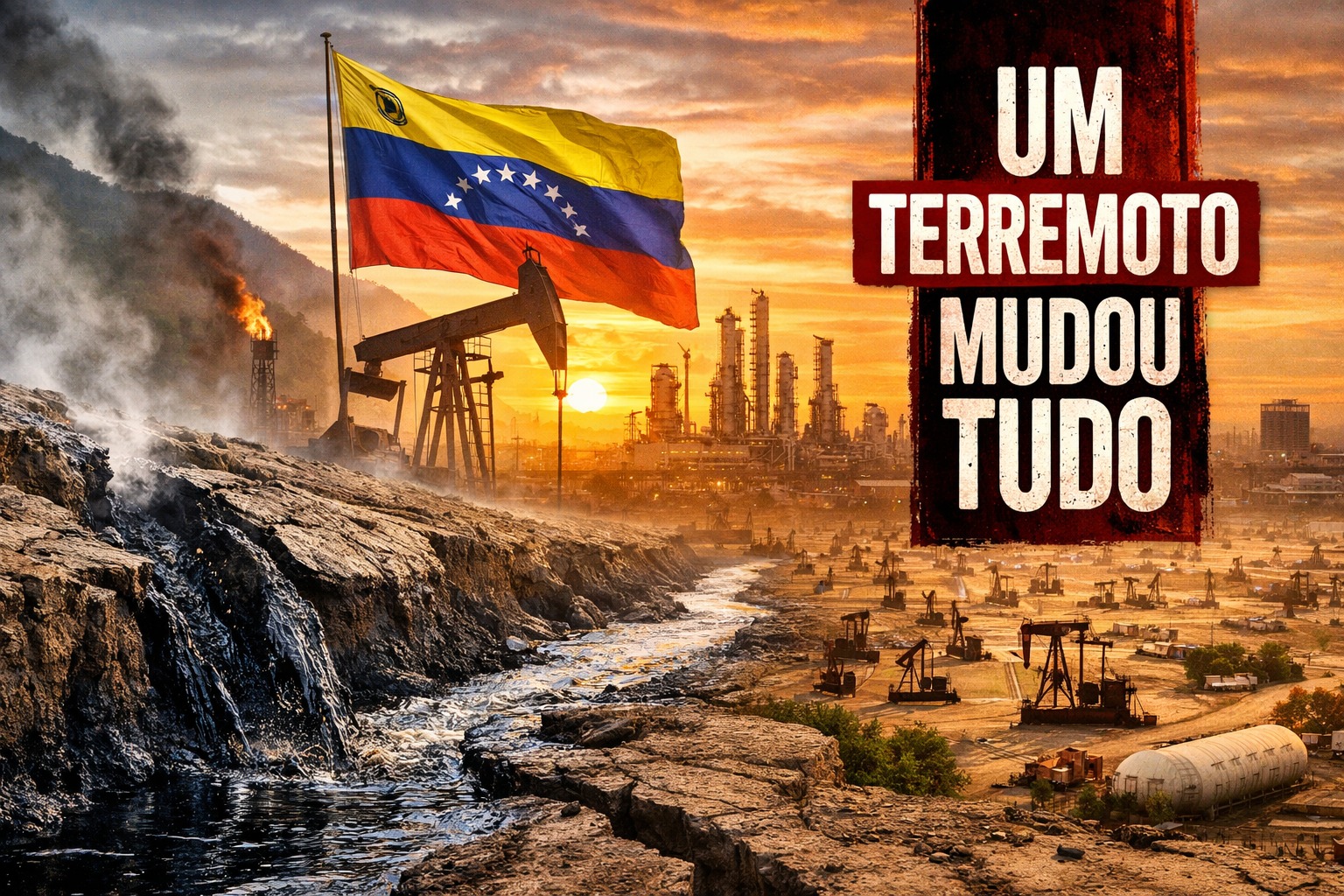


Announced Intervention After Months of Threats Alters Venezuelan Sovereignty, Exposes Weight of Largest Global Oil Reserves and Reopens Historical Debate Initiated After the 1875 Earthquake in the South American Andean Region
On last Saturday, the 3rd, the United States carried out an unprecedented military operation in the southern continent, capturing Nicolás Maduro and Cilia Flores, assuming temporary guardianship of Venezuela and announcing new elections, abruptly altering the regional political balance.
Political Escalation and Capture of the Venezuelan Government
The action occurred after months of public threats made by Donald Trump, who openly questioned Venezuelan sovereignty since October and advocated for direct intervention in the country.
In a statement after the arrest, Trump claimed that U.S. guardianship would remain until new elections were held, presenting the measure as necessary to reorganize political power.
-
Petrobras Approves $1.2 Billion Refinery in Brazil to Produce Aviation Fuel and Diesel from Plants

-
Petrobras Secures $2.2 Billion Contract to Build and Operate Four Support Vessels for Brazil’s Offshore Oil Fields
-
Oil production grows in Rio, but reserve replacement raises a warning sign

-
Petrobras is expected to complete the drilling of the Morpho well in the Foz do Amazonas in August 2026, the first well in the Equatorial Margin, an oil frontier that the ANP estimates at more than 30 billion barrels and could redraw the map of Brazil.



The U.S. president justified the offensive as a move to free the population from a dictatorship and recover the productive capacity of the Venezuelan energy sector.
According to him, the oil industry had lost efficiency over the years and needed to be restructured under U.S. control to resume operating on a significant scale.
The Strategic Weight of Oil Reserves
According to the Organization of the Petroleum Exporting Countries, Venezuela holds 17% of all known reserves in the world, an estimated volume of about 303.3 billion barrels.
This total surpasses that of any other country and places Venezuelan territory at the center of geopolitical disputes related to global energy supply.
In 1970, national production reached 3.7 million barrels per day, establishing the country as one of the largest global producers at that time.
With the rise of Hugo Chávez and later Nicolás Maduro, production steadily declined and now does not reach 1 million barrels daily.
The reduction in extraction has affected public revenues, infrastructure investments, and the maintenance capacity of oil facilities over the past decades.
An Earthquake That Changed the Economy
At 11:15 a.m. on May 18, 1875, an earthquake with a magnitude of 7.4 struck the border between Venezuela and Colombia, registering intensity X on the modified Mercalli scale.
The epicenter was San José de Cúcuta, but Venezuelan cities such as San Cristóbal, Rubio, La Grita, and Colón also suffered significant damage.
Contemporary reports indicate that the tremor lasted between 40 and 50 seconds, enough time to cause structural collapses and permanently alter the regional urban landscape.
A cloud of dust filled the streets, walls and roofs collapsed, and the reconstruction required profound changes in the layout of the most affected cities.
Oil Revealed by Cracks in the Ground
Venezuela is situated at the interaction between the Caribbean and South American plates, which explains the recurrence of seismic activity on its territory.
During the earthquake, fissures opened southwest of San Cristóbal, at La Alquitrana Farm, releasing a black liquid with an intense odor.
The material flowed into the La Alquitrán stream and visibly revealed the oil that had been known to exist in the region.
This event marked the effective beginning of commercial fuel exploration, which until then had been limited to sparse records.
From the First Company to the National State Oil Company
In 1878, three years after the earthquake, the Compañía Petrolia del Táchira was founded, the first Venezuelan oil company focused on systematic exploration.
It was only in 1914 that the activity began to yield significant commercial results, boosting the economic development of the national energy sector.
For over 50 years, the company led extraction, refining, and commercialization before the nationalization promoted in the following century.
This process preceded the creation of Petróleos de Venezuela S.A., established by the government of Carlos Andrés Pérez, ending a historical cycle initiated by a natural disaster.
With information from Revista Galileu.