Portuguese
  Spanish


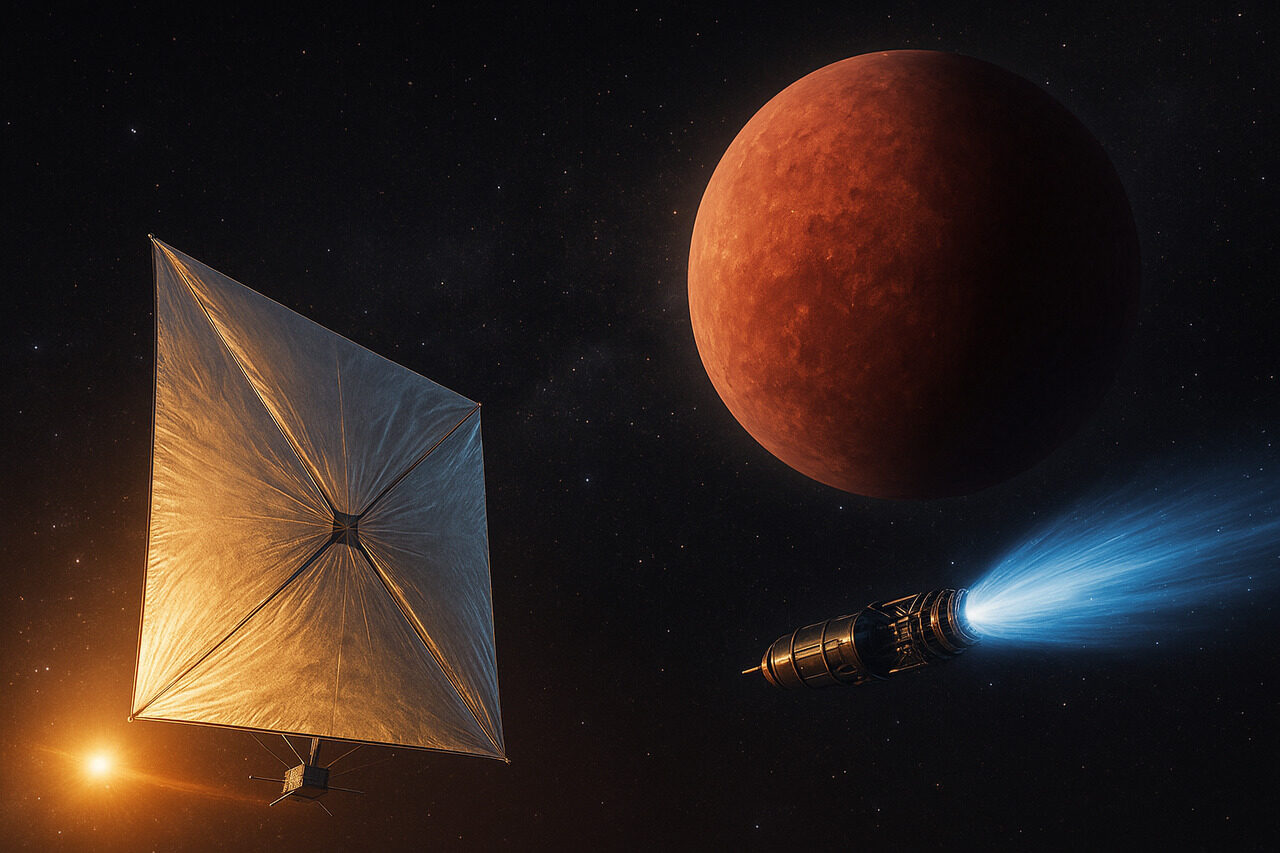

Italian Plan Wants To Explore Sedna Before 2076 With Two Advanced Technologies: Ultra-Light Ship With Solar Sail And Fusion Engine Rocket
An Italian team of scientists has proposed an ambitious plan to reach Sedna, one of the most distant and mysterious objects in the Solar System.
The proposal is in a paper published on the arXiv repository and presents two alternatives for spacecraft capable of making the journey in a significantly shorter time than current technologies.
Sedna was discovered in 2003 and has an extremely eccentric orbit, lasting about 11,000 years.
-
India Gains 2.1 Million Hectares of Dry Tropical Forest in a Decade, but Scientists Warn Much of It May Be Commercial Plantations, Not Genuine Biodiversity Recovery

-
Canada Builds World’s Largest Electric Car Battery Repurposing Plant in 6 Weeks, Aiming to Power Grids, Factories, Hospitals, and Data Centers Before Recycling Lithium, Nickel, and Cobalt

-
Scientists Discover Ancient Life Marks in 180-Million-Year-Old Moroccan Ocean Rocks
-
Students from Brazil’s Paraíba develop low-cost reusable rocket with 3D-printed engine and Arduino-controlled parachute to disperse seeds for reforestation in remote drylands.





In 2076, it will reach perihelion, the closest point to the Sun. Even at that point, it will be nearly 11 billion kilometers away—more than double the distance from Neptune to the Sun.
A Chance In Millennia
This alignment offers a rare window to explore Sedna. With current technology, a mission to the dwarf planet could take 20 to 30 years.
This would make it unfeasible to develop and launch a mission in time. However, the Italian scientists suggest two faster solutions: a high-tech solar sail and a fusion-powered rocket.
The first proposal is an ultra-light ship equipped with a solar sail. The technology harnesses solar photons to propel the ship.
Unlike previous models, such as the LightSail 2 mission, this sail would be coated with a material that, when heated, would release molecules through thermal desorption, generating extra thrust.
With the assistance of Jupiter’s gravity, this ship could reach Sedna in just seven years.
Due to its extreme lightness, it would have a very small payload, around 1.5 kg, and would only perform a flyby of Sedna, without entering orbit.
The mission would be similar to that of the New Horizons probe, which quickly passed by Pluto and collected limited data.
Nuclear Fusion Engine As A Robust Option
The second proposal is more complex but comes with greater scientific capability. It involves the use of a direct fusion engine, a technology under development at the Plasma Physics Laboratory at Princeton University.
This engine would generate thrust and electricity from a controlled nuclear fusion reaction.
Although it would take about ten years to reach Sedna—three more than the solar sail—this ship would have enough power to enter orbit.
This would allow for an extended study of the dwarf planet. Additionally, it could carry up to 1,500 kg of instruments, significantly increasing the quantity and quality of the data collected.
Why Sedna?
Sedna is not just another icy body beyond Neptune. Its reddish surface and extreme orbit make it an object almost unchanged since the formation of the Solar System.
By spending most of its time far from the Sun, Sedna is protected from radiation and heat, preserving its original composition.
Scientists believe it may contain water ice and organic compounds—fundamental elements in the formation of planets.
One even bolder hypothesis suggests that Sedna could be an exoplanet captured by the Sun during an encounter with another star.
If confirmed, the mission would allow for the direct study of an object from another stellar system without leaving our own.
This unique combination of characteristics makes Sedna a priority target for scientific exploration. The challenge now is to enable a mission within the time window that closes by the end of the century.
With information from Xataka.