






 Portuguese
  Spanish


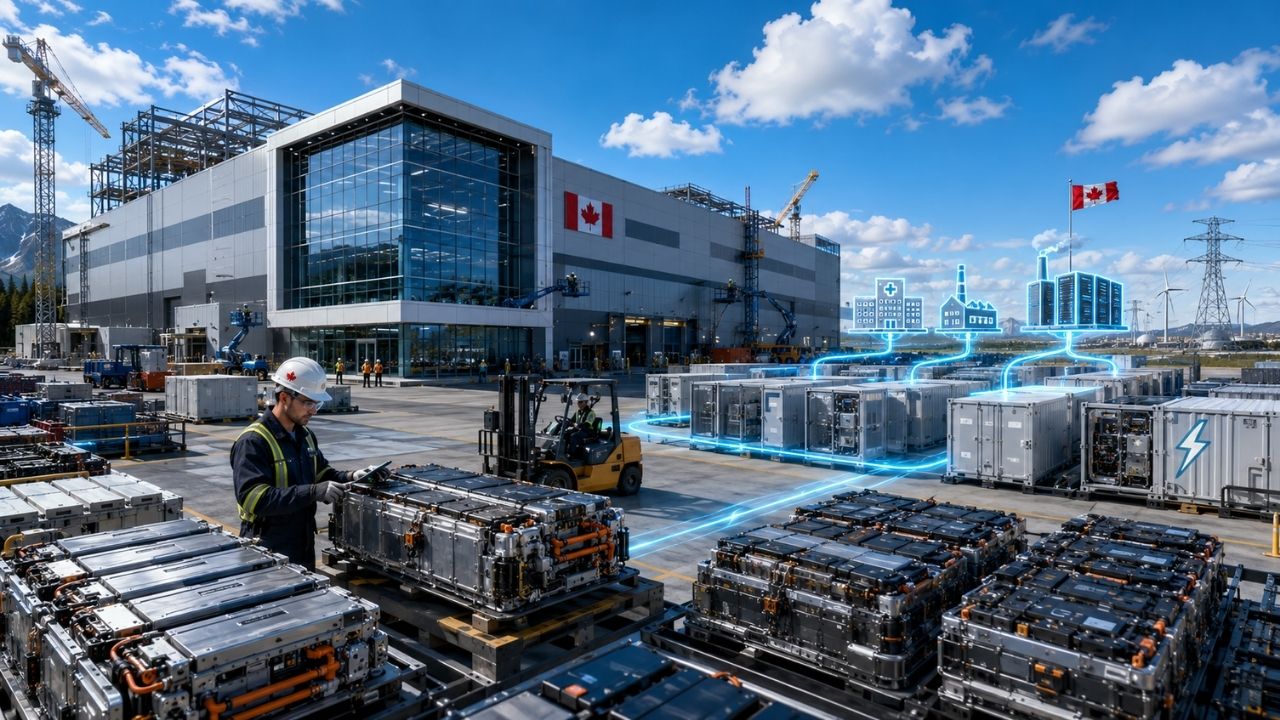

Published on June 28, 2026, the Moment Energy initiative repurposes discarded electric car batteries for stationary systems, with a megafactory in Vancouver designed for 1 GWh by 2030, over 100 skilled jobs, and operation under UL 1974 standard before the final recycling of critical strategic materials.
Electric car batteries that no longer meet vehicle requirements can gain a second life before heading to recycling. This is the focus of Megafactory 1, Moment Energy’s facility in Vancouver, Canada, presented as the world’s largest unit dedicated to repurposing discarded electric vehicle batteries.
According to a report published on June 28, 2026, by the portal Interesting Engineering, the factory was inaugurated six weeks after the project announcement. The proposal is to transform used modules into stationary energy storage systems for power grids, factories, hospitals, and data centers.
Factory aims for second life of batteries
Megafactory 1 was not created to manufacture new cells. The goal is to receive batteries removed from electric vehicles, assess their condition, and repurpose units that still have useful capacity.
-
Scientists Discover Ancient Life Marks in 180-Million-Year-Old Moroccan Ocean Rocks

-
Students from Brazil’s Paraíba develop low-cost reusable rocket with 3D-printed engine and Arduino-controlled parachute to disperse seeds for reforestation in remote drylands.

-
Brazilian Students Transform Passion Fruit Peels into Moisture-Retaining Material, Compete at World’s Largest Science Fair

-
Brazilian Student Invents Low-Cost Rainwater Harvesting System Using Recycled Materials, Showcased at World’s Largest Science Fair




This point changes the traditional logic of disposal. Instead of going directly to recycling, some batteries can go through an intermediate stage of stationary use, extending the value of already extracted and processed materials.
Vancouver became a strategic point

The facility is located in Vancouver, Canada, and belongs to Moment Energy, a Canadian clean technology company. The source describes Megafactory 1 as the world’s largest unit for repurposing electric vehicle batteries.
The location also reinforces the intention to keep processing within North America. According to the report, the company seeks to use a regional chain, avoiding that retired batteries are sent out of the region before being repurposed.
Batteries Still Retain Capacity
A battery may cease to be suitable for an electric car before losing all its usefulness. In a vehicle, it needs to deliver range, fast recharging, stable performance, and reliable response under different conditions.
When the capacity falls below the expected standard for automotive use, the battery can be replaced. Even so, many can still store and deliver enough energy for fixed applications, where weight, volume, and range are not evaluated in the same way.
Stationary Storage Gains Strength
Stationary systems are connected to buildings, factories, or power grids. They store energy when there is available supply and release electricity when demand increases.
This is where repurposed electric car batteries come in as an alternative. The second life can help meet storage shortages, support renewable sources, and reduce pressure on the manufacturing of new batteries.
Data Centers Increase Electrical Pressure
The demand for storage grows along with the expansion of networks, renewable energies, and data centers. The increase in structures linked to artificial intelligence also expands the need for stable energy.
In this scenario, repurposed batteries can function as a bridge. They do not solve the energy challenge alone, but they can accelerate the supply of storage while new industrial chains try to keep up with demand.
Facility Aims to Reach 1 GWh
According to the plans mentioned in the report, the Vancouver unit should reach a capacity of 1 GWh by 2030. The project also foresees more than 100 skilled jobs.
The scale is relevant because battery repurposing was still largely associated with smaller projects. Megafactory 1 attempts to take this process to an industrial level, with a flow of receiving, analyzing, assembling, and delivering commercial systems.
Process Begins with Technical Evaluation


Each used battery comes with a different history. Some have gone through many charge and discharge cycles; others have faced extreme temperatures, heavy use, or varied operating conditions.
Therefore, repurposing requires inspection, testing, and certification. The main difficulty is not just having batteries available, but knowing which ones are still safe and suitable for a second application.
Safety is a central part of the model
Megafactory 1 operates under UL 1974 certification standards, aimed at battery repurposing. This type of reference is important because it deals with safety, performance, and technical sorting.
Without rigorous evaluation, a battery removed from a vehicle can pose a risk in stationary use. Therefore, the industrialization of the process depends on reliable methods to measure health, remaining capacity, and stability of the modules.
Reuse comes before recycling
Recycling remains essential to recover valuable materials such as lithium, nickel, and cobalt. However, Moment Energy’s proposal is to show that some batteries can still generate value before this final stage.
This logic creates a longer sequence: first use in the vehicle, then stationary use, and finally, recycling of the materials. The goal is to extract more utility from the battery before dismantling it to recover critical metals.
Projections show growing challenge
The report cites a 2023 study according to which 1 million electric vehicle batteries will be discarded in 2030 and 1.9 million in 2040. It also mentions an estimate by the International Energy Agency of 100 to 120 GWh of discarded batteries by 2030.
These numbers show why the topic has moved beyond the experimental field. As the electric fleet ages, the volume of retired batteries tends to grow and require solutions beyond simple disposal.
Automotive chain becomes energy chain
When a battery leaves the car and starts powering stationary systems, it changes sectors. It leaves electric mobility and enters energy infrastructure.
This transition can bring together automakers, storage companies, utilities, factories, and data center operators. The second life of electric car batteries creates a bridge between transportation and energy.
Reuse can reduce costs
Reuse can reduce costs because it uses resources already produced. The cells, modules, and materials have already gone through an expensive chain of mining, refining, manufacturing, and assembly.
If there is still useful capacity, discarding or recycling immediately can waste value. The challenge is to prove that testing, adapting, and integrating these batteries is economically better than manufacturing new systems or recycling directly.
Not everything is resolved
The report itself highlights that there are still obstacles. The industry needs to improve ways to assess battery health, ensure safety, and deal with modules from different manufacturers and vehicle models.
There is also an economic calculation to be made. In some cases, immediate recycling may be more advantageous; in others, the second life may generate a greater return. The answer depends on technology, market, logistics, and material prices.
Project can set a new standard
Megafactory 1 does not close the debate on the future of used batteries. But it represents one of the largest attempts to turn a disposal problem into an energy asset.
If the model works, it could influence how the industry defines the end of a battery’s automotive life. Instead of being seen as waste, it can be treated as equipment still useful for large-scale electricity storage.
Brazil should also observe the movement
Even though it is a Canadian project, the logic interests countries that follow the growth of electric mobility and the demand for energy. The more electric vehicles enter circulation, the more batteries will need a technical and economic destination.
For Brazil, the topic involves recycling planning, regulation, safety, reverse logistics, and possible stationary use in networks, industries, and enterprises that need electrical stability.
Used battery can become infrastructure
Megafactory 1 shows that electric car batteries don’t need to have just two destinations: remain in the vehicle or go straight to recycling. Between these stages, there can be an industrial phase dedicated to stationary storage.
The question remains whether this repurposing will be a niche solution or a new pillar of the energy sector. Do you think retired electric car batteries should be used in grids, hospitals, factories, and data centers before final recycling? Leave your opinion in the comments.


