






 Portuguese
  Spanish
  4 min of reading
  0 comments


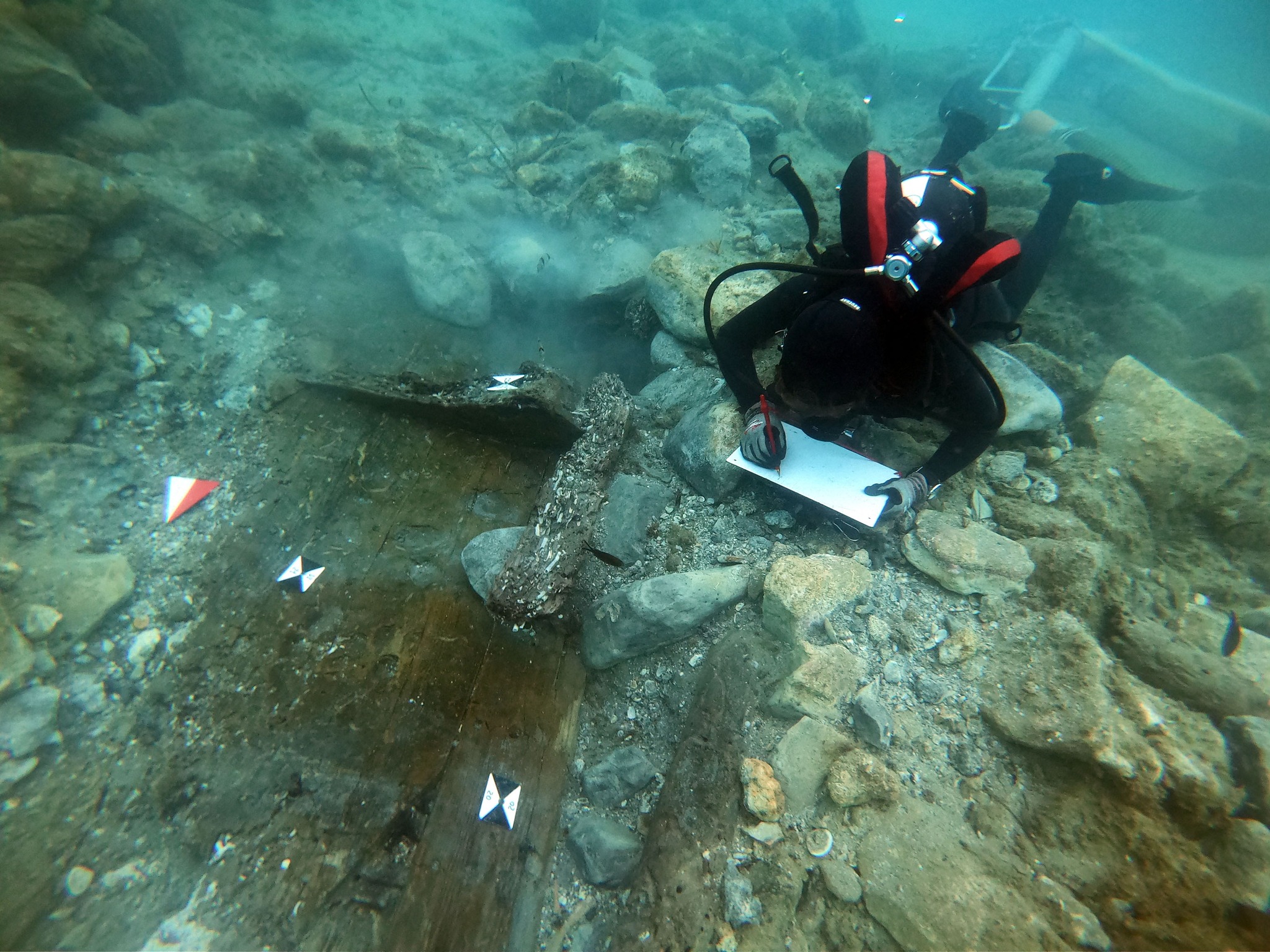
2,500-year-old shipwreck found in Sicily reveals Greek routes, ancient anchors, and naval techniques used before Roman dominance.
Hidden under approximately 6 meters of depth, covered by sand, stones, and sediments accumulated over centuries, a ship sunk between the 6th and 5th centuries BC emerged as one of the most important underwater archaeological discoveries recently made in the Mediterranean. The shipwreck was located near Santa Maria del Focallo, at the southernmost tip of Sicily, a region that during Antiquity occupied a strategic position between Greek colonies, Phoenician cities, and maritime routes that crossed the sea long before the rise of Rome.
The vessel remained buried under layers of sand and rocks for about 2,500 years. When archaeologists began to excavate the area, they found not only preserved parts of the hull but also a rare set of anchors and remnants that help to reconstruct how maritime trade functioned in one of the most turbulent and important phases of Mediterranean history.
Shipwreck was found in a region contested by Greeks and Carthaginians before Roman dominance
The discovery occurred in the waters of Santa Maria del Focallo, near the city of Ispica. According to researchers, the ship sank during a period when Sicily was one of the most important centers of the struggle for control of Mediterranean maritime routes.
-
Tired of High Rent in Portland, Newlyweds Buy 37m² Tiny House with 36 Cabinets, King-Size Bed, and Loft Office, Paving Way to Financial Freedom

-
In Sweden’s Jukkasjärvi, Artists Transform the Frozen Torne River into the Icehotel, a Seasonal Ice Structure That Melts Back into Nature

-
Innovative Heat Storage Tower in Finland Uses 2,000 Tons of Crushed Soapstone to Warm Cities
-
17-Year-Old Homeschooler from the Bahamas Solves 40-Year-Old Math Puzzle, Earns Direct PhD Admission


Greeks and Carthaginians competed for commercial and political influence in the region long before Rome became the dominant sea power.
Because of this geographical position, the island functioned as a natural bridge between Europe, North Africa, and the Eastern Mediterranean. This is precisely what makes the shipwreck so relevant to archaeologists.
Hull preserves naval technique used for more than 25 centuries
One of the most important discoveries is in the structure of the ship. Researchers identified in the hull the so-called construction technique known as “on the shell”, an ancient method in which the outer planks were assembled first and then reinforced internally.
This system was widely used by Mediterranean peoples before the evolution of more sophisticated naval methods.
As few examples from this period have survived in analyzable conditions, the shipwreck offers a rare opportunity to directly study the naval engineering used about two and a half millennia ago.
Six anchors found around the ship help tell the story of the vessel
During the excavation, archaeologists located a set of six anchors near the sinking site. Four of them were made of stone and are considered extremely ancient. The other two were made of iron and belong to later periods of the region’s occupation.
The presence of anchors from different eras suggests that the area remained in use by navigators for many centuries.
This transforms the archaeological site into something more than just a shipwreck: it may represent a historical zone of navigation and anchorage used by different Mediterranean civilizations.
Discovery began with observations made by divers and volunteers
The first indications emerged years before the main excavation. Reports published by researchers involved in the project indicate that divers observed unusual formations of stones and wood fragments on the seabed, drawing attention to the possibility of an ancient structure hidden under the sediments.
After the initial surveys, specialized teams began to map the area and confirmed the existence of the vessel. The process required careful removal of the layers of sand accumulated over the hull.
Sicily was one of the most important points of the ancient Mediterranean trade routes
Researchers highlight that the finding reinforces the importance of Sicily as a center for the circulation of goods during antiquity.
Located practically in the center of the Mediterranean, the island connected routes linking Greek colonies, Phoenician cities, African territories, and regions of the Italian Peninsula.

Therefore, each shipwreck found in the region serves as a direct record of the trade networks that helped shape the ancient world.
According to archaeologists, the vessel offers new evidence about the circulation of goods and technologies during the transition between the archaic and classical periods of Greece.
Archaeological project investigates the Sicilian seabed since 2017
The discovery is part of the so-called Kaukana Project, a scientific initiative dedicated to the archaeological exploration of the southern waters of Sicily.


The program is coordinated by the University of Udine in collaboration with Italian institutions and authorities related to the underwater heritage of the region.
The campaigns use archaeological diving, seabed mapping, and three-dimensional documentation to record structures hidden under the sediments. The goal is to expand knowledge about the ancient maritime routes of the central Mediterranean.
Shipwreck serves as a time capsule of a Mediterranean before Rome
When the ship sank, Rome was still far from completely dominating the Mediterranean. The vessel sailed in a scenario marked by Greek colonies, Phoenician cities, commercial disputes, and maritime alliances that shaped the region’s history for centuries.
Therefore, each piece of the hull, each anchor, and each fragment recovered helps reconstruct a period that precedes the formation of the empire that would later control practically the entire sea.
More than a lost ship, the archaeological site of Sicily preserves a frozen snapshot of a Mediterranean that existed before Rome turned the center of the ancient world into its own lake.


Be the first to react!