Portuguese
  Spanish



Unicamp Signs Partnership with TotalEnergies, French Multinational, Focused on Building Solar Plant and 6 Other Projects with Investments of R$ 22.9 Million.
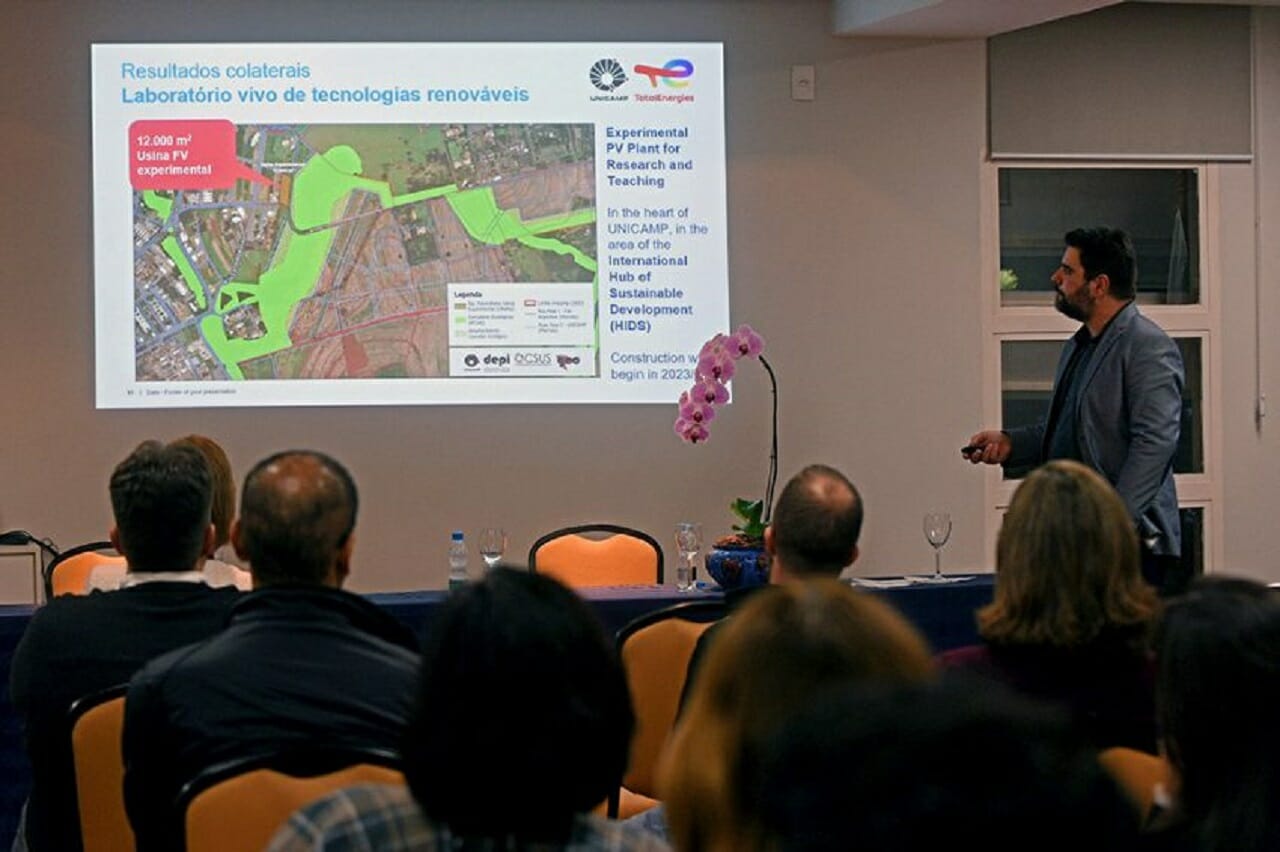
TotalEnergies, French multinational, signed an agreement with University of Campinas (Unicamp) to conduct research focused on the solar energy and battery sector. Lasting for three years with investments amounting to R$ 22.9 million, the agreement envisions the development of six projects, in addition to the construction of a solar plant at Unicamp’s International Sustainable Development Hub (HIDS) and the renovation of the university’s research laboratories.
Learn About the 6 Projects That Will Be Developed as a Result of the Partnership Between Unicamp and TotalEnergies
The first project resulting from the partnership will be the modeling and monitoring of solar plants with digital twins, which aims to develop mathematical models and tools for simulating and monitoring solar plants with “digital twins”.
The tools will enable predictions regarding energy generation and losses based on the modeling of degradation phenomena and other factors that influence system performance.
-
Green Hydrogen Projects in Northeastern Brazil Stalled for 18 Months Awaiting Government Decree, Delaying Billions in Investments

-
Brazil Concludes Largest Energy Auction in History, Secures 18.97 GW and Mobilizes $12.8 Billion to Ensure Supply Until 2031
-
How Norway Produces More Energy Than It Consumes with Nearly 1,800 Hydropower Plants and Over 1,100 Reservoirs

-
Axia Energia Invests $280 Million in Q1, Increases Investments by 36%, and Turns Loss into $740 Million Profit


The research project on methods and development of devices for detection and interruption of DC arc fault in photovoltaic systems aims to research and develop systems based on hardware and software to detect arc faults in a solar plant.
The third project is named performance monitoring, anomaly detection, and LCOE analysis in solar plants and aims to develop software to monitor performance and detect defects and anomalies in plants, as well as to allow the analysis of the economic return of these systems.
The project Reliability of Photovoltaic Inverters: Thermoelectric Modeling, Damage Assessment and Failure Prediction aims to develop comprehensive thermoelectric modeling of essential components such as semiconductor switches and capacitors in DC-AC converters used in photovoltaic plants.
In the project for Research and Development of Testing Methodologies, Evaluation and Classification of Photovoltaic Inverters, testing methods will be created to assess the quality of photovoltaic inverters. The ultimate goal is to develop an inverter testing program to generate a ranking of equipment, providing important data for consumers.
Lastly, the project on Blockchain Platform for the Digital Passport of Batteries and Its Contribution to Unravel Aging Mechanisms During First Life and Their Consequences in Second Life focuses on addressing some limitations found in the literature related to energy storage systems developed with second life batteries.
Learn More About the Signing Event Between Unicamp and TotalEnergies
The agreement was signed on the night of last Wednesday (14) by the rector of Unicamp, Professor Antônio José de Almeida Meirelles, and also by Isabel Waclawek, Director of Research and Development at TotalEnergies.
The ceremony was attended by Liviu Nicu, Director of the French National Center for Scientific Research (CNRS) in South America, and Nadége Mézie, Science and Technology Attaché of the Service for Cooperation and Cultural Action, both representatives of the French Consulate General in the country.
The event was organized by Professor Marcelo Souza de Castro, Director of the Center for Energy and Petroleum Studies (Cepetro) at Unicamp. The project was presented by Marcelo Villalva, a professor from the Faculty of Electrical and Computer Engineering, who will also be the general coordinator of the program.
Partners Speak Out About the Agreement
In addition to the projects and the solar plant, the program will also establish a battery tracking system. According to the project coordinator, Professor Hudson Zanin, the focus is to map the chain of these batteries to understand their life cycle, assessing the mechanisms of their aging, and detecting the processes adopted by suppliers in first life and in reuse.
Rector Antonio Meirelles states that this agreement with TotalEnergies is a new demonstration that Unicamp considers initiatives for innovation and sustainability to be a priority. Meirelles claims that, last week, he was informed that the institution is the top-ranked in the country for actions aimed at economic growth.