






 Portuguese
  Spanish


The project, called SWARM, is by the companies Reach Power and Gambit and received funding from the OECIF fund, linked to the Department of Defense. The idea is to combine wireless energy via radiofrequency with swarm artificial intelligence to keep drones in the air. For now, it is a promise of a project still under development.
The American companies Reach Power and Gambit announced that their joint project, SWARM, received funding from the United States Department of Defense to keep drones in the air continuously. According to the responsible teams, the proposal is to recharge the aircraft in mid-flight, via radio waves, so that small fleets can fly 24 hours a day, 7 days a week, without needing to land or change batteries. This promise is at the heart of the project.
SWARM combines Reach Power’s wireless energy transmission technology with Gambit’s autonomous systems software, aimed at military missions. According to the material released in June 2026 by the portal interestingengineering, the project received funding from OECIF, a fund from the US Department of Defense dedicated to operational energy innovations. It is worth noting, however, that the system has just been funded and is not yet operational.
The battery problem in drones
The major limitation of small drones is the battery. According to Reach Power, models of the so-called Group 1, which are cheap and widely used in current conflicts, usually fly for only about 30 minutes on a single charge. When a swarm is launched and organized, the mission’s useful time decreases even further.
-
16-Year-Old Kentucky Student Solves Long-Standing Biomedical Challenge, Wins Top Young Scientist Award at $9 Million Science Fair

-
Teen Invents Biodegradable Material from Shrimp Shells That Decomposes 1.5 Million Times Faster Than Regular Plastic
-
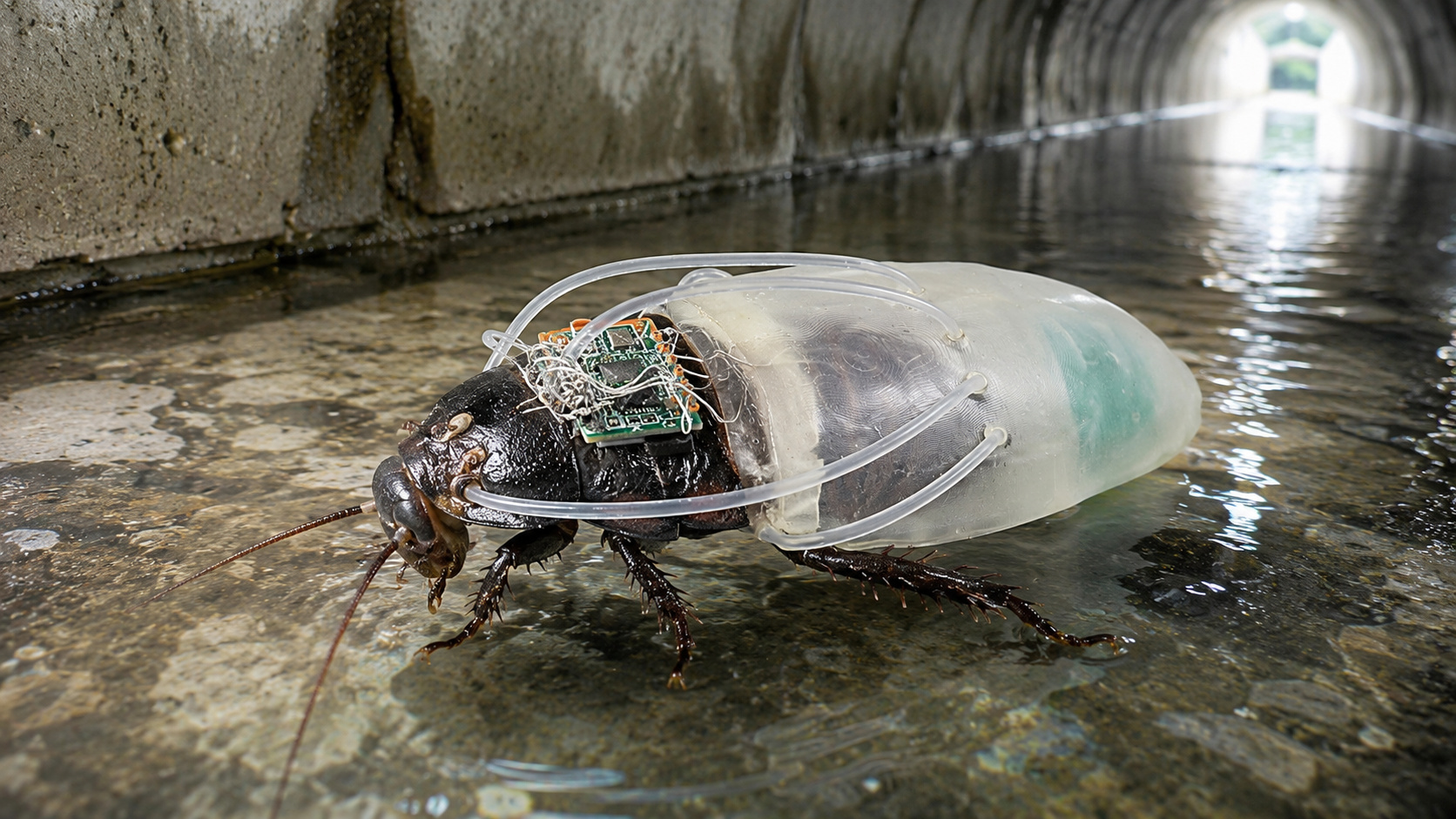
Scientists Develop Diving Suit for Cyborg Cockroaches to Survive Underwater for 3 Hours, Navigate Flooded Tunnels, and Aid in Disaster Rescue Missions, with Potential for Mars Exploration
-
Xiaomi Unveils Ultra-Slim Washer-Dryer with Over 30 Programs, Hygienic Steam, Smart Drying, 15-Minute Quick Wash, App Control, and Space-Saving Design




According to the material, increasing the battery does not solve the problem because it makes them more expensive and heavier, precisely the opposite of the advantage of these drones, which is being cheap and disposable. The logistics of large fleets are also complex, as operators need to install, remove, charge, and replace the batteries of each device before and after each flight. In conflict zones, this refueling is dangerous and helps explain why the effectiveness of drones in active combat would be only 30%, according to Reach.
How SWARM intends to recharge drones in the air
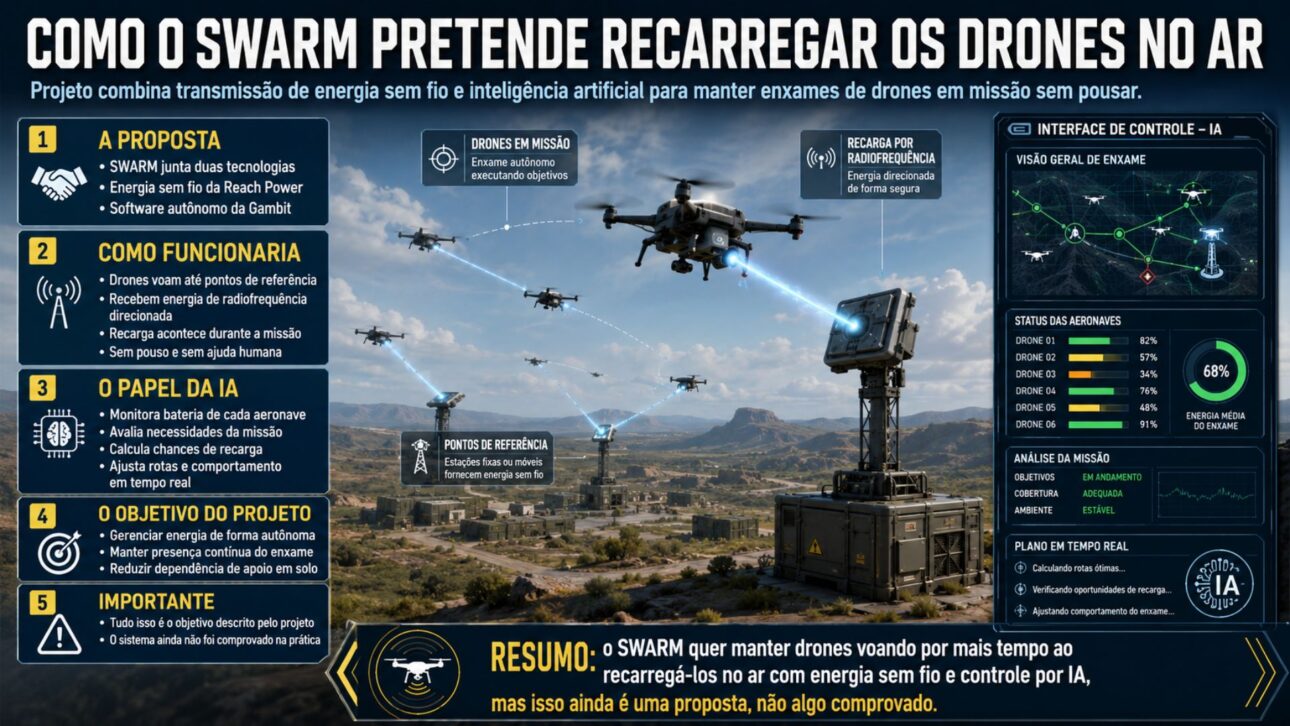
The SWARM proposal aims to overcome this limit by combining two technologies. According to the material, Reach Power’s wireless energy transmission joins Gambit’s autonomous systems software. In practice, drones would fly to reference points to receive directed radiofrequency energy during the mission, without landing and without human assistance.
Gambit’s artificial intelligence would be responsible for monitoring, in each aircraft, the battery level, mission needs, and recharge opportunities, adjusting routes and behavior in real-time. According to the companies, the combined system would allow the swarm to manage energy autonomously, maintain continuous presence, and rely less on ground support. All this, it is worth noting, is the objective described by the project, not yet proven in practice.
What the Companies and the Department of War Say
For the creators, the gain would be in freeing drones from battery dependence. Chris Davlantes, founder and president of Reach Power, stated that “drone swarms are as persistent as their batteries” and that SWARM would change this logic. Josh Giegel, president of Gambit, said that “the current limitation is not just autonomy, but the operational load” involved in maintaining the equipment.
On the government side, the OECIF is presented as the main program of the United States Department of War for operational energy innovations. According to the material, energy transmission appears as a priority in this effort. Christopher DePuma, leader of the operational energy portfolio, stated that “OECIF’s initial investment in energy transmission” would be generating strategic results as combat moves towards autonomous operations.
What It Is For and What Still Needs to Be Proven
According to the material, SWARM targets missions that require continuous coverage, such as intelligence, surveillance and reconnaissance, border security, air defense and troop protection, as well as defense systems against drones. Reach Power develops wireless charging by radiofrequency for drones, sensors, and robots in the defense and industrial sectors, while Gambit provides artificial intelligence software for robot teams operating in complex environments.
Even so, it is important to separate the announcement from the result. All the described performance is the goal of a project that has just received funding, and not of a system already tested in the field, remaining to prove if radiofrequency recharging works reliably on a large scale and in real combat. The award reflects the growing military interest in more autonomous drones, a field that also raises operational and ethical questions about increasingly autonomous military systems.
SWARM attempts to attack the weakest point of drones, the battery, with a bold promise to recharge the aircraft in the air via radio waves so that a swarm can fly nonstop. The funding from the United States Department of Defense shows military interest in the idea, but the outcome still depends on the project moving from paper to practical implementation. Between the promise and the proof, there is anticipation about how far wireless recharging can change the use of drones.
And you, do you believe that recharging drones in the air via radio waves will work as promised, or do you still see it as distant? Share your opinion and exchange ideas with other readers, respecting different views


