






 Portuguese
  Spanish


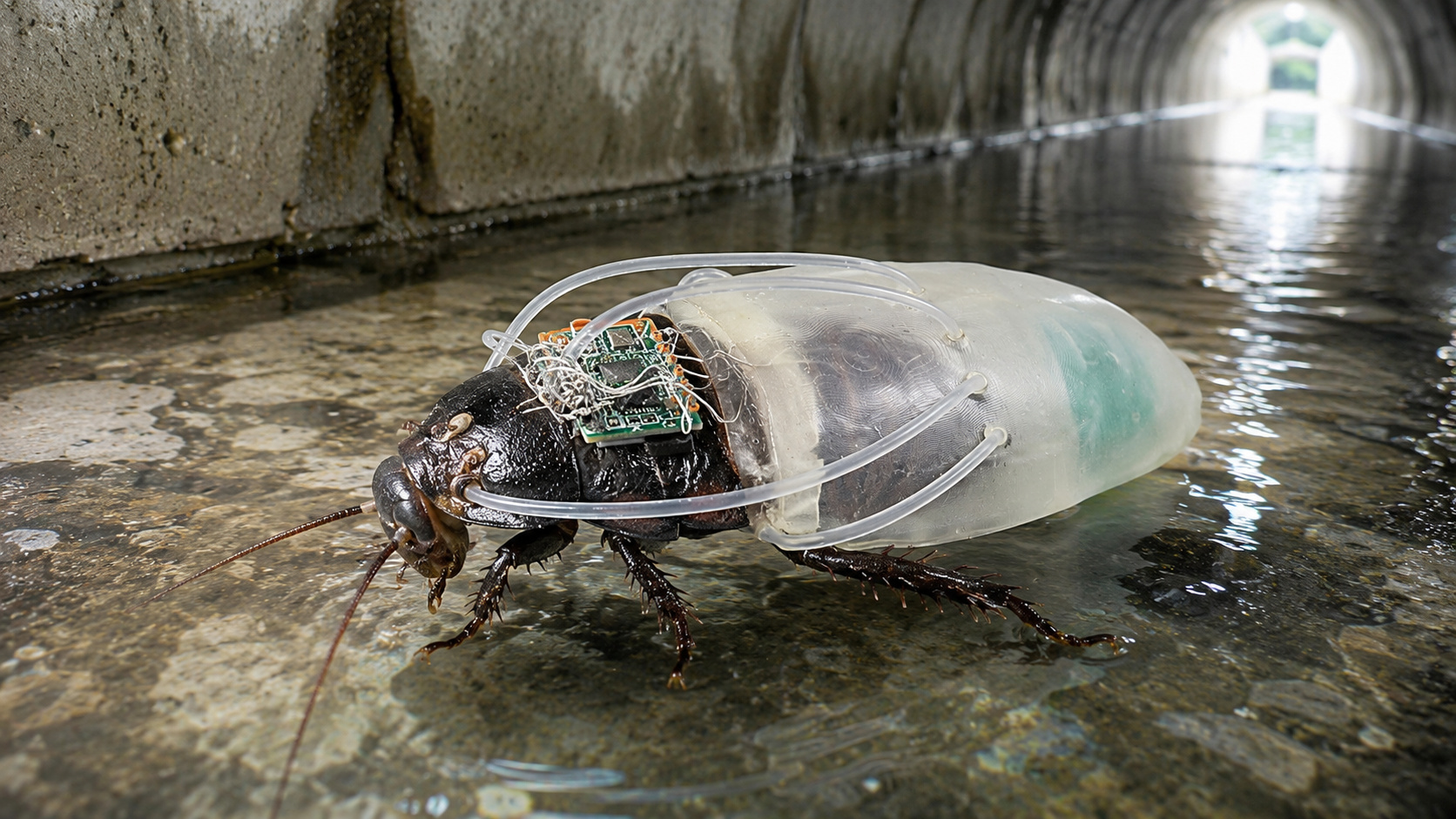

Technology developed by researchers from Singapore and Japan allows insects equipped with electronics to breathe in submerged and low-oxygen environments, opening new possibilities for search and rescue operations in places where conventional robots still face significant limitations.
An international team of researchers has presented an innovation that seems straight out of science fiction but already works in the laboratory. Scientists from Nanyang Technological University (NTU) in Singapore and Waseda University in Japan have developed a tiny diving suit capable of keeping cyborg cockroaches alive and active for up to three hours underwater. The information was published in a study in the scientific journal Nature Communications and reported by the portal ZME Science.
The advancement represents another step in the integration between biology and robotics. The proposal is to use live insects equipped with small electronic devices to access extremely dangerous or inaccessible environments for humans and traditional robots, such as collapsed buildings, flooded galleries, collapsed tunnels, and underground networks.
How the cyborg cockroach diving suit works
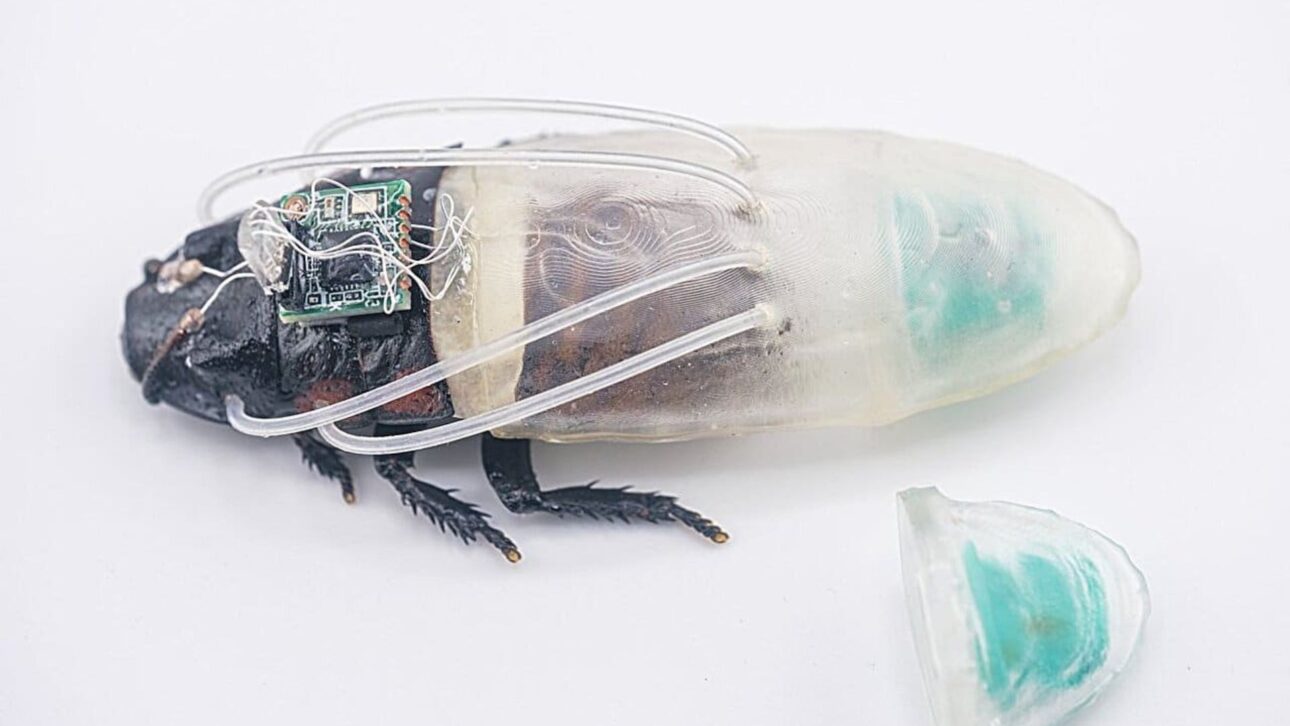
The so-called cyborg insects are living organisms that receive small electronic components responsible for guiding their movements. Instead of building tiny robots from scratch, researchers take advantage of the insects’ natural abilities, which already walk efficiently, avoid obstacles, and traverse extremely narrow spaces while consuming little energy.
-
Xiaomi Unveils Ultra-Slim Washer-Dryer with Over 30 Programs, Hygienic Steam, Smart Drying, 15-Minute Quick Wash, App Control, and Space-Saving Design

-
Brazilian Researchers Develop Ultrasound-Based Breast Scanner Using Warm Water, Currently Undergoing Clinical Validation

-
Brazil Develops Its First Locally-Made 5G Radio Unit, Achieves Over 1.5 Gbps in Lab Tests, Paving the Way for Interoperable Equipment
-
El Niño Intensifies: Over 90% Chance of Persisting Until 2027, Raising Ocean Temperatures and Increasing Severe Weather Risks in Southern Brazil, Warns Federal Report




The new system developed by the researchers works similarly to the cylinder used by divers. Instead of carrying a heavy oxygen tank, the equipment continuously produces oxygen through a chemical reaction.
The suit is composed of three main elements:
- a flexible and waterproof structure;
- a chemical oxygen generator;
- four small flexible tubes connected to the cockroach’s thoracic spiracles, responsible for its breathing.
Oxygen is produced when manganese dioxide comes into contact with diluted hydrogen peroxide. In this reaction, manganese dioxide acts as a catalyst, breaking down the peroxide into water and oxygen. A special membrane prevents the liquid from escaping, allowing only the gas to pass through to the insect’s respiratory system.
According to Professor Hirotaka Sato from NTU Singapore, the equipment functions similarly to the system used by human divers, providing oxygen directly to the cockroach’s airways during its stay in submerged environments or areas with low oxygen concentration.
Tests show impressive performance underwater
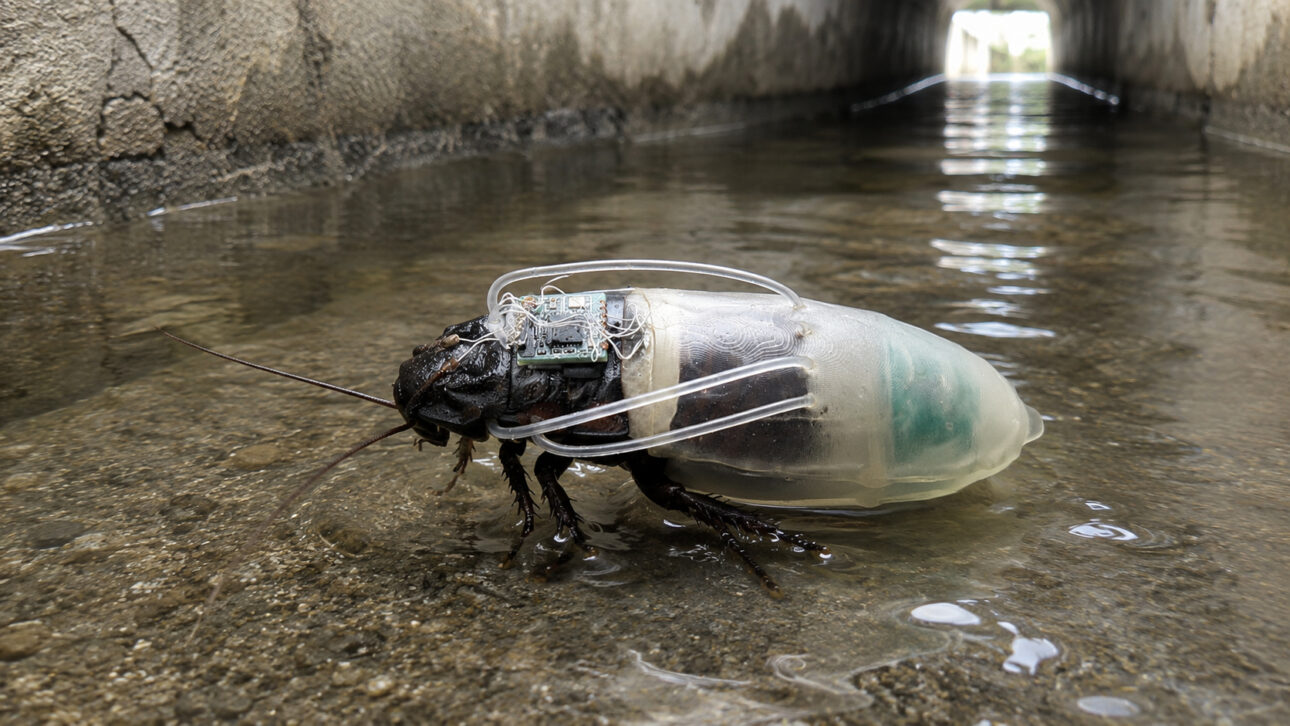
The experiments used Madagascar hissing cockroaches, a species often employed in robotics research due to their large size, physical resilience, and lack of wings.
The results caught the researchers’ attention.
Equipped with the suit, the cockroaches remained active underwater for up to three hours. In contrast, the insects not using the equipment lost the ability to survive after a few minutes during the tests.
Besides the endurance, the performance was also surprising.
On dry land, the insects reached an average speed of 87.5 millimeters per second. Underwater, even using the suit, they maintained an average of 78.4 millimeters per second, demonstrating mobility quite close to that recorded in a dry environment.
The only limitation observed occurred during changes of direction. The water resistance and the additional volume of the equipment reduced agility in turns, although without significantly compromising locomotion.
Professor Shinjiro Umezu from Waseda University explained that the main challenge was to develop a system small, light, and flexible enough to be carried by the insect without limiting its movements, while also producing enough oxygen for long periods of submerged activity.
Technology can revolutionize search and rescue missions
Although the idea of using cockroaches in rescue operations may seem unusual, it addresses one of the biggest challenges faced by modern robotics: energy autonomy.
Extremely small robots can access narrow spaces, but they usually carry very limited batteries, drastically reducing operation time.
Insects, on the other hand, use their own muscles and metabolism, the result of millions of years of biological evolution. Thus, the electronic components are only responsible for directing movements, significantly reducing energy consumption.
During another experiment, researchers built a tunnel of 1.7 meters, initially containing a region filled with carbon dioxide and then a completely flooded section.
The cockroaches without the suit could not cross the course.
However, the equipped insects successfully completed the route in three out of three tests conducted, demonstrating the ability to face hostile environments composed of different obstacles.
In another experimental scenario, researchers created a submerged crevice only 2 centimeters high. To allow passage, the electronic components and battery were implanted inside the insect’s body, eliminating the external volume that could trap the equipment during the crossing.
Next step could be space exploration
Despite the promising results, scientists emphasize that the technology is still in the experimental phase.
Real disaster environments present much more complex challenges than laboratories, including mud, unstable structures, unpredictable water currents, chemicals, metallic debris, and sharp materials.
Even so, the study reinforces a growing trend in modern engineering: combining living organisms with electronic systems to create hybrid solutions capable of overcoming limitations faced by conventional robots.
Researchers are already thinking of even more ambitious applications.
According to Hirotaka Sato, one of the future goals is to adapt this technology for space missions, even imagining “space suits” for cyborg insects intended for exploring the surface of Mars.
This possibility, however, also raises concerns about biological contamination, as space agencies adopt strict protocols to prevent the introduction of terrestrial microorganisms on other planets.
For now, the most likely destination for these small explorers remains here on Earth: dark, flooded, and hard-to-reach environments where rescue teams and conventional robots still face enormous difficulties operating.
Source: ZME Science.
Scientific reference: Study published in the journal Nature Communications.


